
SupremeCourt – Top Court Grants Interim Relief to TVK MLA Sethupathi
SupremeCourt – The Supreme Court on Wednesday provided temporary relief to Tamilaga Vettri Kazhagam (TVK) legislator R Sreenivasa Sethupathi by suspending a Madras High Court directive that had barred him from taking part in the floor test in the Tamil Nadu Assembly. The development came amid an ongoing legal dispute linked to the closely fought Assembly election in which Sethupathi secured victory by a margin of just one vote.
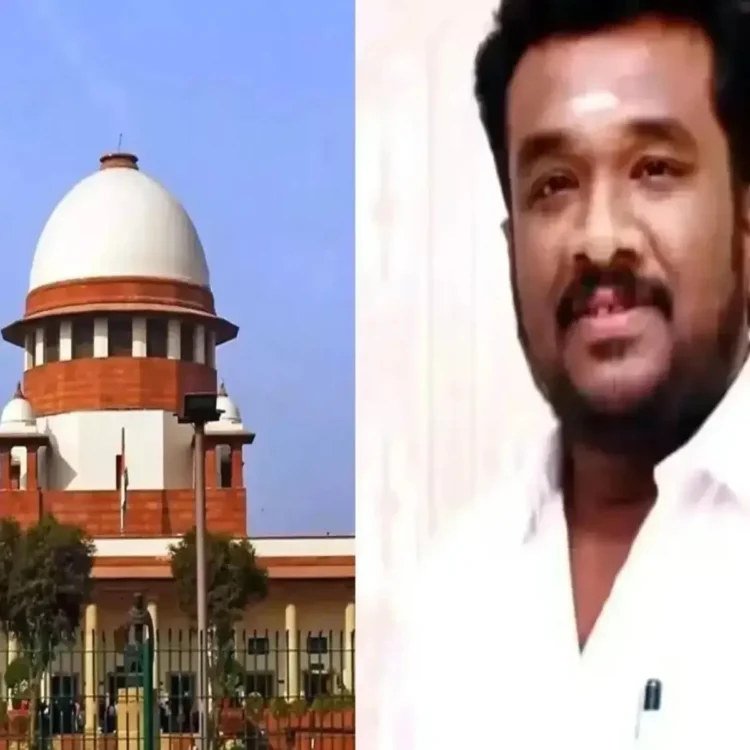
Supreme Court Raises Concerns Over High Court Proceedings
A three-judge bench comprising Justices Vikram Nath, Sandeep Mehta and Vijay Bishnoi questioned the manner in which the matter was handled by the Madras High Court. During the hearing, the bench observed that election-related disputes are generally required to be challenged through an election petition rather than through a writ petition under Article 226 of the Constitution.
The judges expressed concern over the High Court proceeding with the writ petition despite acknowledging that the appropriate legal remedy was an election petition. The bench remarked that such an approach appeared inconsistent with established legal principles governing election disputes.
Petition Filed After Narrow Electoral Defeat
The controversy began after senior DMK leader K R Periakaruppan challenged Sethupathi’s election victory before the Madras High Court. Periakaruppan, who lost the election by a single vote, alleged irregularities in the voting process and sought judicial intervention regarding Sethupathi’s participation in Assembly proceedings.
According to submissions made before the Supreme Court, the writ petition had been filed on a Saturday and was heard by the High Court the following day. Senior advocate Abhishek Manu Singhvi, representing Sethupathi, highlighted the unusual speed at which the proceedings took place.
Dispute Over Postal Ballot Cited in Court
Representing Periakaruppan, senior advocate and former Attorney General Mukul Rohatgi argued that the matter involved exceptional circumstances requiring urgent judicial consideration. He informed the court that one postal ballot had allegedly been mistakenly delivered to a different constituency, which he claimed could have affected the election outcome.
Rohatgi maintained that the extraordinary nature of the situation justified the High Court’s intervention through its special constitutional powers. However, the Supreme Court appeared unconvinced that a writ petition was the correct legal route in the matter.
Interim Stay on High Court Order
After hearing arguments from both sides, the apex court stayed the Madras High Court’s interim order as well as further proceedings connected to it. The Supreme Court reiterated that election disputes are ordinarily addressed through election petitions under election law procedures.
The temporary stay now allows Sethupathi to participate in the Assembly floor test unless a different direction is issued in future hearings. The matter has attracted political attention in Tamil Nadu because the voting strength in the Assembly could play a significant role in maintaining government stability.
High Court Had Raised Stability Concerns
Before the Supreme Court’s intervention, the Madras High Court had observed that allowing Sethupathi to vote in the Assembly while the dispute remained unresolved could influence the balance of power in the House. Based on that reasoning, the High Court had imposed interim restrictions on his voting rights.
Sethupathi subsequently approached the Supreme Court challenging the order and argued that preventing an elected representative from participating in Assembly proceedings without a final verdict would be legally unjustified.
The latest order from the Supreme Court has temporarily altered the course of the dispute, while the broader legal challenge concerning the election result is expected to continue through appropriate judicial channels.