
Politics – Congress Questions BJP After AAP MPs Shift Allegiance in Rajya Sabha
Politics – The recent shift of several Aam Aadmi Party (AAP) leaders to the Bharatiya Janata Party (BJP) has triggered sharp reactions across the political spectrum, with the Congress strongly criticizing both parties over the development.
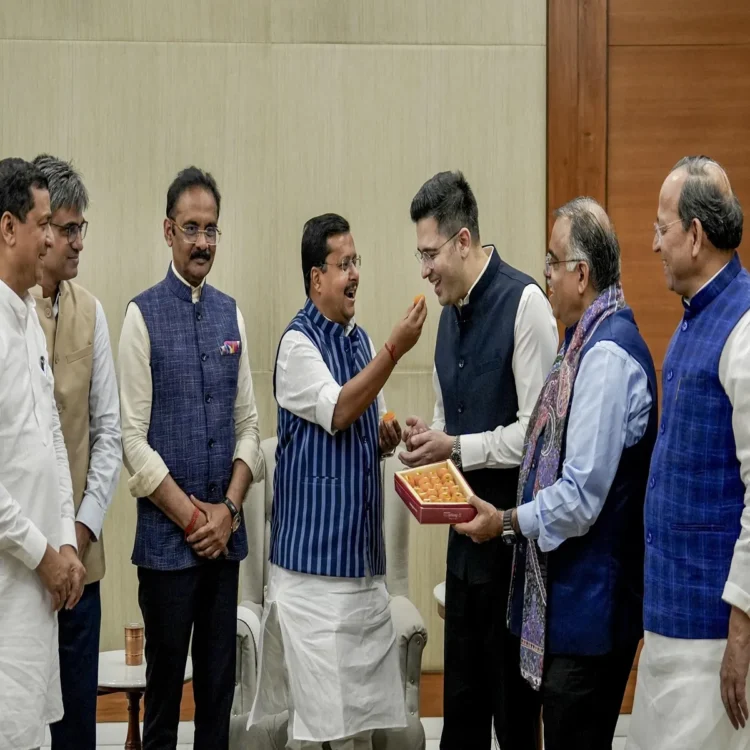
Congress Raises Concerns Over Defections
Senior Congress leader and former Rajya Sabha member Husain Dalwai voiced serious objections to the manner in which elected representatives changed their political allegiance. He argued that lawmakers who decide to leave their party should first resign from their positions instead of switching sides while retaining their seats. According to him, such actions raise concerns about constitutional values and weaken democratic norms.
Dalwai further stated that political conduct should be guided by ideology and public service rather than personal gain. He criticized the practice of awarding significant positions, such as Rajya Sabha seats, to individuals who may not have a clear ideological commitment. In his view, this trend undermines the credibility of democratic institutions.
AAP Faces Setback After Multiple MPs Exit
The controversy follows a major political shift in the Upper House, where seven MPs associated with AAP moved closer to the BJP. Among those who made the transition were Raghav Chadha, Sandeep Pathak, and Ashok Mittal. The announcement was later expanded to include Harbhajan Singh, Rajinder Gupta, Vikramjit Singh Sahney, and Swati Maliwal.
This development has significantly impacted AAP’s strength in the Rajya Sabha, as the party reportedly lost a substantial portion of its representation. Political observers see this as a critical moment for AAP, which now faces challenges in maintaining its influence in parliamentary proceedings.
Congress Criticism Intensifies
Congress leader Jairam Ramesh also reacted strongly, using sharp political language to describe the situation. He suggested that the leaders who joined the BJP had exposed themselves politically, reiterating the party’s long-standing criticism of defections. The Congress has repeatedly accused the BJP of encouraging such shifts to consolidate power in legislative bodies.
The remarks reflect broader concerns within opposition parties regarding the stability of alliances and the implications of frequent political realignments.
Legal Challenge Filed in Rajya Sabha
Amid the political developments, AAP MP Sanjay Singh has taken formal steps by approaching the Rajya Sabha Chairman, CP Radhakrishnan, seeking disqualification of the seven MPs. The petition questions the validity of what has been described as a “merger” and invokes provisions under the Tenth Schedule of the Constitution.
The Tenth Schedule, often referred to as the anti-defection law, outlines conditions under which legislators can be disqualified for changing parties. Singh’s petition specifically cites provisions that disallow members from voluntarily giving up their party membership while continuing to hold office.
Constitutional Provisions Under Scrutiny
The case has brought renewed attention to the anti-defection framework. Paragraph 2 of the Tenth Schedule deals with disqualification on grounds of defection, stating that a member can lose their seat if they voluntarily leave their political party. However, certain exceptions exist under other paragraphs, including provisions related to mergers.
The current dispute hinges on whether the actions of the MPs qualify as a legitimate merger under constitutional guidelines or fall under defection, which would make them liable for disqualification. The decision by the Chairman is expected to play a crucial role in determining the outcome.
Broader Political Implications
The episode highlights ongoing tensions in Indian politics over party loyalty, ideological commitment, and the interpretation of constitutional provisions. While defections are not new, each instance raises questions about accountability and the functioning of democratic institutions.
As the matter moves forward, both political and legal developments will be closely watched, given their potential impact on parliamentary dynamics and party strategies in the months ahead.