
Parliament – Rajya Sabha Approves Bill to Extend Legal Protection to Vande Mataram
Parliament – The Rajya Sabha on Wednesday approved the Prevention of Insults to National Honour (Amendment) Bill, 2026, proposing to make the intentional insult of the National Song, Vande Mataram, a punishable offence. The proposed amendment places the National Song under the same legal protection already available to the National Anthem and other officially recognised national symbols. The legislation was cleared after an intense discussion that witnessed repeated disruptions and a walkout by Opposition parties.
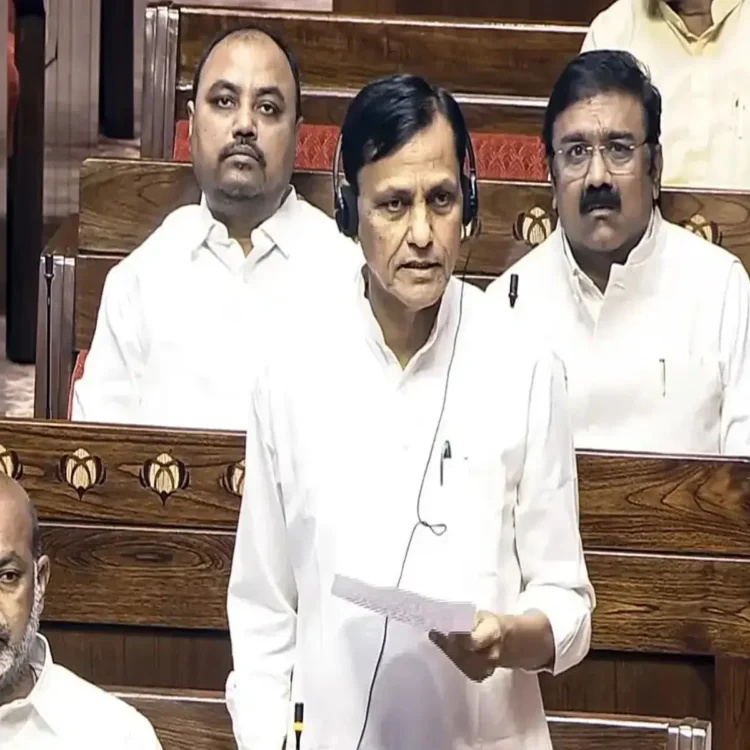
Heated Debate Dominates Proceedings
The debate on the Bill remained stormy throughout the session. Opposition MPs repeatedly demanded the presence of Union Home Minister Amit Shah during the discussion and raised slogans inside the House. The protests disrupted speeches by several members, prompting Deputy Chairman Harivansh Narayan Singh to decline multiple points of order, stating that the House was not functioning in an orderly manner. As the protests continued, Opposition members eventually staged a walkout before the Bill was put to a vote.
Opposition Raises Objections
During the discussion, MPs from different Opposition parties questioned both the timing and intent of the proposed amendment. Aam Aadmi Party member Sanjay Singh criticised the legislation, alleging that it had been introduced by a political party whose ideological parent organisation had not historically hoisted the national flag at its headquarters. CPI(M) member John Brittas, Congress leader Pramod Tiwari and several other Opposition lawmakers also attempted to raise procedural issues during the debate.
Government Explains Purpose of Amendment
Replying to the discussion, Minister of State for Home Affairs Nityanand Rai said the amendment reflected the country’s collective commitment to protecting its national identity, cultural values and the legacy of the freedom movement. He noted that the Prevention of Insults to National Honour Act was originally enacted in 1971 to safeguard national symbols and that the latest amendment seeks to extend similar legal protection to Vande Mataram.
Historical References Highlighted
While defending the Bill, Rai outlined the historical significance of Vande Mataram. He recalled that the song was composed by Bankim Chandra Chatterjee in 1875 and later gained prominence during India’s freedom movement. According to the minister, Rabindranath Tagore performed the song at the 1896 session of the Indian National Congress, while Sarala Devi Chaudhurani presented its complete version in Varanasi in 1905.
He also referred to developments in later years, including the 1937 decision during Jawaharlal Nehru’s Congress presidency to officially adopt only the first two stanzas. Rai further mentioned that Subhash Chandra Bose encouraged the preparation of a complete musical arrangement in 1938 and noted that the full version was broadcast by All India Radio on Independence Day in 1947 following the initiative of Sardar Vallabhbhai Patel. He additionally cited Dr Rajendra Prasad’s statement in the Constituent Assembly on January 24, 1950, which recognised Vande Mataram alongside the National Anthem.
Government Defends the Legislation
The minister argued that opposing the amendment overlooked the views expressed by several prominent leaders associated with India’s freedom struggle. He also recalled that revolutionaries such as Chandrashekhar Azad, Ram Prasad Bismil, Ashfaqulla Khan and Khudiram Bose had raised the slogan Vande Mataram during the independence movement. Rai said the proposed law aligns with Prime Minister Narendra Modi’s vision of “Ek Bharat, Shreshtha Bharat” and described it as a measure intended to strengthen national unity beyond political differences.
Bill Cleared by the Upper House
Before the minister’s reply, members from several political parties, including the BJP, Congress, DMK, RJD, BRS, TDP, YSRCP, BJD, AIADMK, Shiv Sena and others, participated in the debate and expressed their views on the legislation. Following the government’s response and the Opposition’s walkout, the Rajya Sabha passed the Prevention of Insults to National Honour (Amendment) Bill, 2026.