
India- India and Indonesia Expand Strategic Cooperation During Modi Visit
India- India-Indonesia relations gained fresh momentum during Prime Minister Narendra Modi’s state visit to Jakarta and Yogyakarta, where he held extensive discussions with Indonesian President Prabowo Subianto on defence, trade, technology, maritime security and regional developments.
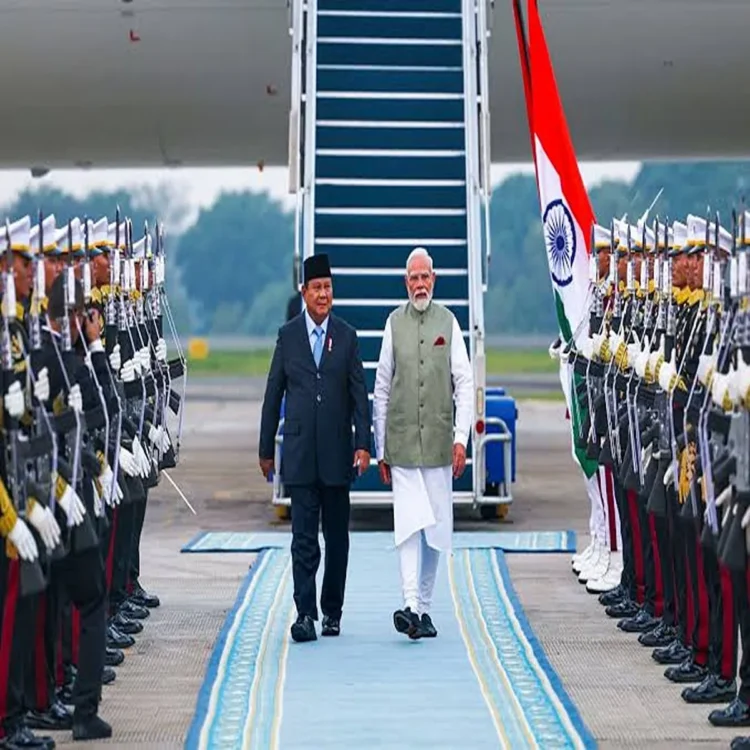
Leaders review partnership framework
The July 6-8 visit came months after President Prabowo attended India’s 76th Republic Day celebrations in January 2025 as chief guest. In their joint statement, the two governments said the meetings had reinforced the Comprehensive Strategic Partnership and created a broader roadmap for future cooperation.
Both leaders agreed to maintain regular summit-level engagement, including meetings alongside major international gatherings. They also called for stronger use of existing bilateral dialogue channels to ensure progress across priority areas.
During the visit, Modi and Prabowo held formal talks in Jakarta and witnessed the exchange of several agreements. Modi also addressed Indonesia’s Parliament, joined the Indonesian President at the Prambanan Temple Compounds in Yogyakarta, and met members of the Indian community.
Defence and maritime ties receive attention
Defence cooperation featured prominently in the discussions. India and Indonesia agreed to widen engagement through military exercises, staff-level consultations, defence research, hydrographic cooperation, peacekeeping coordination and industrial partnerships.
The two sides welcomed deeper collaboration linked to the BrahMos missile system and the Air-to-Air Missile Cooperation Agreement. They also discussed opportunities for co-production and development of defence technologies.
Maritime security was another major focus, particularly as both countries are located along important sea routes in the Indo-Pacific. The leaders supported greater coordination on coastal surveillance, maritime domain awareness, search and rescue operations, pollution response, humanitarian assistance and disaster relief.
They welcomed the renewal of the maritime safety and security agreement, as well as an implementing arrangement involving Indonesia’s BAKAMLA agency and the Indian Coast Guard. Indonesia has also posted an International Liaison Officer at the Information Fusion Centre-Indian Ocean Region in Gurugram.
Trade, supply chains and digital links
Economic cooperation was described as a central pillar of the relationship. The leaders urged an early completion of the review of the ASEAN-India Trade in Goods Agreement, while identifying finance, critical minerals, digital commerce and supply-chain resilience as areas for closer work.
Among the developments noted was a proposed strategic venture between Steel Authority of India Limited and PT Krakatau Steel to examine a stainless-steel slab manufacturing facility in Indonesia. The two countries also reviewed progress on local currency settlement arrangements involving the Reserve Bank of India and Bank Indonesia.
Cooperation in health, pharmaceuticals, agriculture, food security, fertilisers and energy was also discussed. Agreements covering health workforce development and medical product regulation were welcomed, alongside plans to expand work in renewable energy, green hydrogen, liquefied natural gas, bioenergy and energy efficiency.
Connectivity and technology projects discussed
The leaders backed stronger maritime and air connectivity between the two countries. India expressed interest in contributing to the integrated development of Sabang Port, a project seen as potentially improving links between India’s Andaman and Nicobar Islands and Indonesia’s Sumatra region.
Digital cooperation also moved forward through Indonesia’s Open Network initiative, which draws on the architecture of India’s Open Network for Digital Commerce. The two governments noted progress on cross-border QR payment connectivity and signed an agreement on telecommunications technologies and services.
In science and space, India’s space agency ISRO and Indonesia’s National Research and Innovation Agency, BRIN, will continue cooperation on peaceful uses of outer space. Discussions also covered Indonesia’s interest in satellite launch support, the Gaganyaan programme and a proposed Indonesian spaceport project.
Cultural diplomacy and regional issues
Modi and Prabowo inaugurated India-supported restoration work at the UNESCO-listed Prambanan Temple Compounds. They also agreed to observe 2026-27 as the Tagore-Dewantara Year of India-Indonesia Cultural and Educational Diplomacy, marking 100 years since Rabindranath Tagore’s 1927 visit to Indonesia.
The leaders reiterated support for a free, open and rules-based Indo-Pacific, respect for international law and freedom of navigation under UNCLOS. They also called for stronger action against terrorism, terror financing, organised crime and the misuse of emerging technologies.
At a community event, members of the Indian diaspora welcomed the visit and said the agreements signed during the trip could strengthen long-term relations between the two nations.