
Elections – Bengal Verdict Signals Dramatic Shift in Political Landscape
Elections – The outcome of the West Bengal Assembly elections has triggered strong reactions across political and social circles, with spiritual leader Sadguru Riteshwar Maharaj describing the result as a landmark moment in India’s democratic journey. He stated that the verdict reflects a widespread public response to concerns raised by various communities in the state.
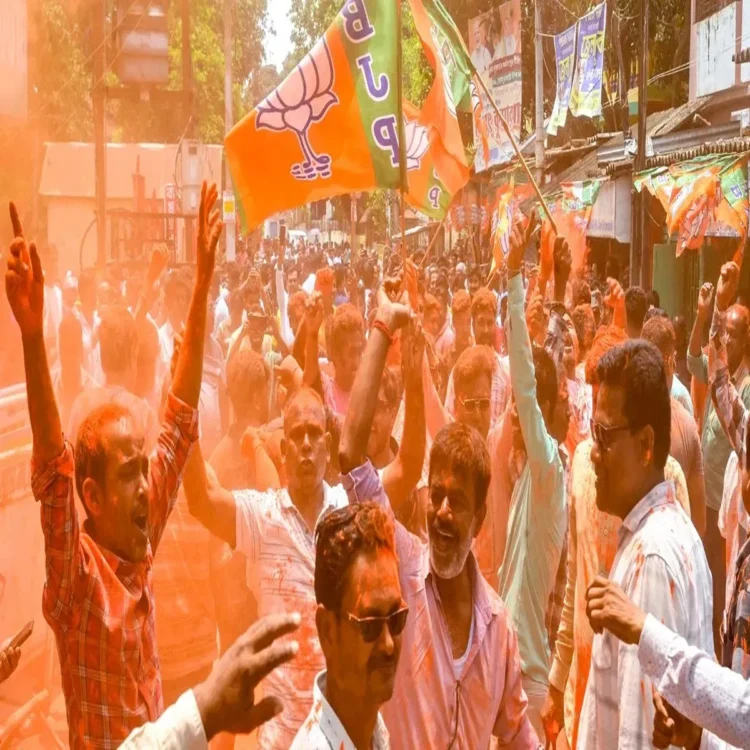
Leader Calls Result a Public Response to Social Concerns
Addressing the media after the results were declared on Monday, Sadguru Riteshwar Maharaj said the mandate represents a collective expression of public sentiment. He claimed that several sections of society, including women and Hindus, had experienced distressing situations in recent years, and the election outcome should be seen as a reaction to those issues.
According to him, the scale of the result makes it one of the most significant democratic developments in the country since independence. He further suggested that voters used the ballot as a means to voice their dissatisfaction and demand change.
Claims of National Unity and Cultural Protection
The spiritual leader also argued that the electoral outcome carries broader implications beyond state politics. He said the result has contributed to preserving national unity and preventing divisions within the country. In his remarks, he emphasized the importance of safeguarding cultural values and ensuring public safety, stating that both would remain protected following the verdict.
While such views reflect a particular perspective, political analysts note that interpretations of election outcomes often vary widely depending on ideological positions.
BJP Secures Strong Majority in Assembly
The Bharatiya Janata Party (BJP) achieved a decisive victory in the 294-member Assembly, marking a significant breakthrough in a state where it had historically played a limited role. According to data released by the Election Commission of India, the party won 206 seats, establishing a clear majority.
The Trinamool Congress (TMC), which had governed the state for years, secured 80 seats and was leading in one constituency at the time of reporting. Other parties recorded minimal success, with the Congress winning two seats and the All India Secular United Party (AJUP), led by Humayun Kabir, also securing two. The Communist Party of India (Marxist) managed to win just one seat.
Vote Share Indicates Competitive Electoral Contest
Despite the BJP’s commanding lead in terms of seats, the vote share presents a more nuanced picture of the contest. The party received 45.84 percent of the total votes, while the TMC followed closely with 40.80 percent.
This relatively narrow gap suggests that the electoral battle remained highly competitive at the grassroots level. Smaller parties and independents collectively accounted for a modest share of votes, while the CPI(M) and Congress secured 4.45 percent and 2.97 percent respectively.
Experts point out that such figures indicate a divided electorate, where shifts in voter preferences can significantly influence seat distribution under the current electoral system.
Comparison with 2021 Election Results
The latest outcome marks a notable reversal from the 2021 Assembly elections, when the Trinamool Congress, led by Mamata Banerjee, secured a dominant victory with 213 seats and nearly 48 percent of the vote share.
In that election, the BJP had emerged as the principal opposition with 77 seats and around 38 percent of the votes, reflecting a substantial rise in its support base at the time. Meanwhile, the Left-Congress alliance failed to win any seats in 2021, highlighting the changing dynamics of state politics.
Changing Political Landscape in Bengal
The current results signal a major transformation in West Bengal’s political environment. While the BJP has translated its vote share into a strong legislative presence, the relatively close vote percentages suggest that opposition parties still retain considerable public support.
Observers believe the coming months will be crucial in determining how the new government addresses key issues and whether the opposition can reorganize effectively. The verdict underscores both a decisive shift in power and the continuing complexity of voter behavior in the state.