
EducationProtest – Creative Expression Shapes Student Demonstration at Delhi’s Jantar Mantar
EducationProtest –Thousands of students who assembled at Delhi’s Jantar Mantar to seek accountability over the ongoing education crisis transformed the protest venue into a vibrant platform where creativity became as influential as speeches. Through music, poetry, paintings, posters and performances, participants found new ways to communicate their concerns while encouraging wider public engagement.
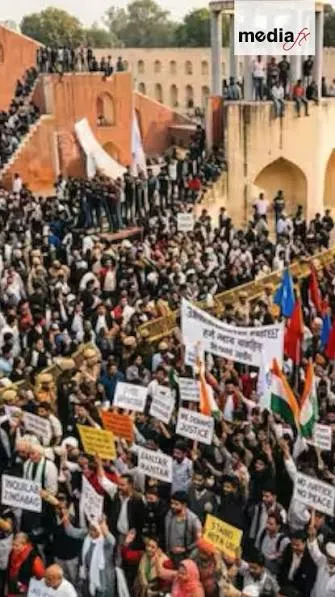
Art Became the Voice of the Demonstration
As the gathering continued, artistic expression emerged as one of the defining features of the movement. Protesters used poems, songs, murals and slogans to present complicated issues in a form that was easy for people to understand and connect with.
Harshit Singh, a queer poet and storyteller who participated in the protest, said creative expression played a central role throughout the campaign. According to Singh, converting discussions about education policies into poetry, music and short slogans helped communicate difficult topics more effectively than lengthy speeches. He believes creative formats allow larger audiences to absorb important messages without losing interest.
Digital Posters Reached Protesters Across the Country
The movement also encouraged people who were unable to attend in person to contribute from elsewhere. Bengaluru-based advertising professional Atharva Mote designed several digital posters addressing the education crisis and criticizing the handling of the demonstrations, including the police action during the July 20 “Sansad Chalo” march.
Among his widely shared artworks were satirical illustrations comparing a large security deployment with a tiny cockroach and another featuring model Rhiya Ahir, who gained attention after standing in front of a Mumbai Police vehicle carrying detained protesters. After circulating widely on Instagram, many of these posters were printed and displayed at Jantar Mantar.
Mote said seeing people carry his artwork during the protest changed its meaning, as it became part of a collective movement rather than remaining his personal creation. He also observed that the demonstrations challenged stereotypes about Generation Z, showing that young people actively participate in public issues alongside their strong presence on social media.
Music and Performances Strengthened Collective Participation
As evening approached, the protest site became increasingly animated with live performances, rap sessions and community singing. Many first-time participants discovered they did not need formal artistic training to contribute. Simple hand-drawn placards, handwritten messages and group singing became meaningful ways to take part.
Rapper Shiv Mishra, known online as @shivaay_music, recalled performing during a rap cypher held at the venue. Videos of his performance spread widely across Instagram. His lyrics, inspired by concerns surrounding the NEET examination controversy, questioned political leadership and highlighted the disappointment felt by many students over unfulfilled promises.
Poetry also became a significant part of the protest atmosphere. Scriptwriter Kashif’s compositions, including Yeh Kaisi Sarkar Hai and Jago Phir Ek Bar, resonated with participants and were frequently shared among demonstrators.
Personal Creativity Reflected Public Frustration
Creative symbolism extended beyond posters and performances. Meeza, a Class 12 student, attended the protest with clown-style face paint to express what she described as the government’s treatment of students. Standing beside fellow protester Kavya, who was affected by the CBSE’s new digital On-Screen Marking (OSM) evaluation system, Meeza said the painted face represented the frustration shared by many students rather than being a personal statement alone.
Such visual expressions became powerful conversation starters and reflected the emotions experienced by those affected by recent education-related developments.
Community Activities Expanded the Movement
Beyond artistic performances, participants organized activities designed to involve people of different age groups. Harshit Singh conducted a letter-writing workshop where approximately 60 to 70 children wrote messages to the Prime Minister describing their dreams, schools and hopes for an education system that remains accessible to everyone.
Spoken word artist Anurag viewed his participation as a responsibility rather than an opportunity for recognition. Alongside helping distribute food and drinking water, he joined students in singing protest songs and raising slogans. Through his social media platforms, he regularly shared updates from the demonstration and published satirical poetry inspired by current political developments.
According to Anurag, creative expression gives public movements a shared voice, allowing people from different backgrounds to unite through words, music and collective slogans. The events at Jantar Mantar demonstrated how artistic participation became an important part of the wider conversation surrounding education and public accountability.