
Aadhaar – Supreme Court Petition Questions Use in Voter Registration Process
Aadhaar – A fresh petition filed before the Supreme Court has raised concerns over the use of Aadhaar in electoral and public documentation processes, arguing that the identity document should not be treated as proof of citizenship, residence, or date of birth.
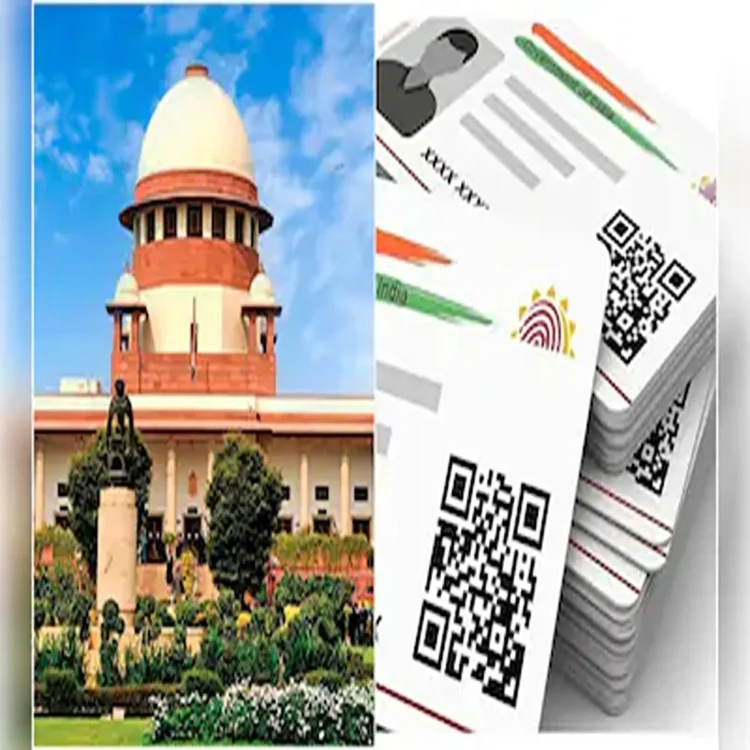
The Public Interest Litigation (PIL), submitted by advocate Ashwini Kumar Upadhyay, seeks directions to the Union government, state authorities, and the Election Commission of India regarding the limited legal scope of Aadhaar. The plea urges authorities to ensure that Aadhaar is accepted only as a document establishing identity and not for verifying citizenship, domicile, age, or residential status.
Petition Challenges Aadhaar Use in Voter Registration
The petition has been filed under Article 32 of the Constitution and questions the validity of provisions allowing Aadhaar to be used during voter registration. It specifically objects to the use of Aadhaar details in Form 6, which is used for enrolling new voters in electoral rolls.
According to the plea, allowing Aadhaar as proof of residence and date of birth violates Section 9 of the Aadhaar Act, Section 23(4) of the Representation of the People Act, 1950, and constitutional guarantees under Article 14. The petitioner has requested the court to declare such usage legally invalid and ineffective.
The PIL argues that the law clearly limits Aadhaar’s function to identity verification and does not recognise it as proof of nationality, domicile, or age.
UIDAI Notification Cited in the Plea
The petition relies on provisions under the Aadhaar Act as well as a notification issued by the Unique Identification Authority of India (UIDAI) on August 22, 2023. The notification reportedly clarified that Aadhaar should only be considered proof of identity.
The plea states that despite this clarification, Aadhaar continues to be accepted for several activities where proof of residence, citizenship, or age is required. These include voter enrolment, school admissions, ration card applications, driving licences, and property-related transactions.
The petitioner has argued that this widespread practice goes beyond the legal framework governing Aadhaar and creates confusion regarding its intended purpose.
Concerns Raised Over Verification Mechanisms
Another major issue highlighted in the petition relates to the verification process used while issuing Aadhaar cards. The plea alleges that weak verification systems may enable illegal immigrants and infiltrators to obtain Aadhaar documents.
It further claims that once Aadhaar is obtained, it can be used as a supporting document for securing additional identification papers, including voter identity cards. According to the petition, this may impact welfare distribution systems and raise concerns about the credibility of electoral records.
The plea also states that such practices could influence demographic patterns and affect the functioning of public welfare schemes.
Constitutional Provisions Referenced
The PIL refers to several constitutional provisions, including Articles 14, 19, 21, 29, 326, 327, and 355. It argues that unchecked illegal migration may have consequences for electoral integrity, national security, and administrative balance.
The petitioner has also cited the Supreme Court’s earlier ruling in the Sarbananda Sonowal versus Union of India case. In that judgment, large-scale illegal migration had been described as both “external aggression” and “internal disturbance.”
Using this precedent, the plea contends that proper verification standards are necessary while handling documents connected to electoral and civic rights.
Reliefs Sought Before Supreme Court
Among the key demands, the petition seeks directions ensuring that Aadhaar is used strictly in line with Section 9 of the Aadhaar Act and the UIDAI notification issued in 2023. It asks authorities to prevent Aadhaar from being treated as conclusive evidence of age, residence, or citizenship in official procedures.
The Supreme Court is yet to consider the matter in detail. The case is expected to reopen discussions around Aadhaar usage, electoral documentation, and verification practices linked to identity systems in India.