
Politics – North Korea Marks Founder Anniversary With Loyalty Call
Politics – North Korea has renewed its call for unity and loyalty as the country marked the birth anniversary of its founding leader, Kim Il-sung. State media emphasized continuity in leadership ideology, highlighting the connection between past and present governance under Kim Jong-un. The message, carried prominently on Wednesday, reinforced the ruling party’s focus on people-centered policies while urging citizens to remain steadfast in their support.
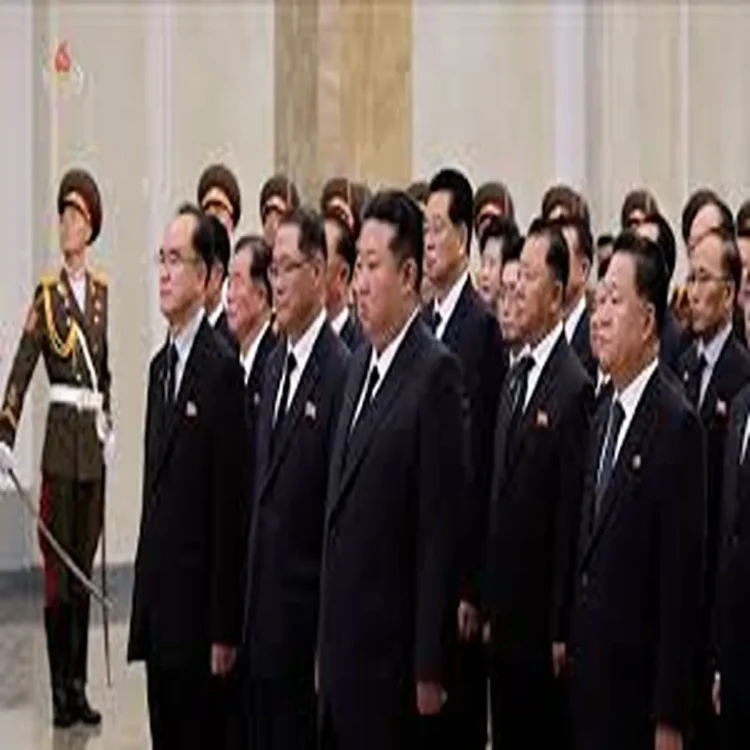
State Media Highlights Leadership Continuity
The official newspaper of the ruling Workers’ Party published a detailed article commemorating the 114th anniversary of Kim Il-sung’s birth. The piece underscored the enduring relevance of the founder’s political philosophy, particularly his emphasis on prioritizing the needs of the people.
According to the publication, these principles continue to guide the current leadership. It described the approach as a lasting foundation of the state’s governance, portraying it as a consistent thread linking generations of leadership. The article framed Kim Jong-un as the successor carrying forward this legacy.
Renewed Emphasis on Loyalty and Ideology
The message from state media went beyond historical reflection, urging party members and citizens to strengthen their commitment to the current leadership. It called for unwavering loyalty, presenting it as essential to preserving the nation’s ideological direction.
The narrative positioned Kim Jong-un as the central figure responsible for continuing the founder’s vision. By linking his leadership closely to that of Kim Il-sung, the report reinforced the idea of a unified and unbroken political tradition.
The article also stressed the importance of collective determination, encouraging people to work toward improving living standards, which it described as a top priority of the ruling party.
National Holiday Observed With Subtle Changes
The anniversary of Kim Il-sung’s birth remains one of the most significant dates in North Korea’s national calendar. Traditionally referred to as the “Day of the Sun,” the occasion has long been associated with large-scale celebrations and public displays of respect.
However, recent years have seen a noticeable shift in how the event is presented. State media has reduced its use of the traditional honorific term, suggesting a gradual move toward focusing attention more directly on the current leader.
This subtle change reflects a broader effort to reshape public messaging while still maintaining respect for historical figures.
Public Events and Organized Gatherings
Various organizations across the country marked the anniversary with coordinated events. According to official reports, groups such as the Socialist Women’s Union and the Union of Agricultural Workers held gatherings to commemorate the occasion.
These events included expressions of support for the current leadership, reinforcing the broader message of unity and continuity. Such activities are a common feature of national celebrations in the country, often serving both ceremonial and political purposes.
In addition, youth and student groups were scheduled to participate in an outdoor rally at Kim Il Sung Square in the capital, Pyongyang. The event was expected to bring together large numbers of participants, highlighting the role of younger generations in maintaining national traditions.
Focus on Future Goals
Beyond honoring the past, the messaging surrounding the anniversary also pointed toward future objectives. The ruling party’s stated goal of improving public welfare was highlighted as a key priority.
State media encouraged citizens to remain committed to this vision, framing it as a shared national mission. By linking historical legacy with present-day goals, the leadership aimed to reinforce a sense of direction and purpose.
The anniversary, therefore, served not only as a remembrance of the country’s founder but also as a platform to reaffirm current policies and strengthen public alignment with the leadership’s agenda.