
Air Force One – Trump Changes Aircraft During Return From Turkey Summit
Air Force One – President Donald Trump changed aircraft during his return trip from a NATO summit in Turkey, travelling initially on an older presidential jet before boarding a newly converted Boeing 747 at RAF Mildenhall in the United Kingdom. The unexpected switch came as tensions between the United States and Iran escalated, with both sides reporting new military strikes.
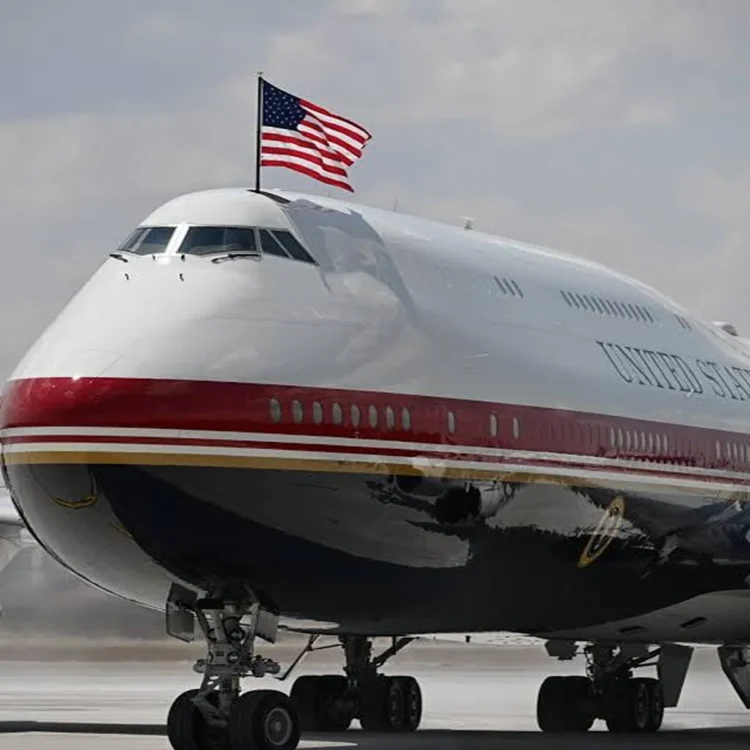
Aircraft change draws attention during overseas journey
Trump had arrived in Turkey aboard the recently retrofitted Boeing 747-800 gifted by Qatar, painted in red, white and navy blue. However, he left Turkey on one of the long-serving Boeing VC-25A aircraft that has carried U.S. presidents for decades.
Speaking to reporters during the journey, Trump said he chose the older aircraft “for old time’s sake.” He also said both aircraft would make an unscheduled stop at RAF Mildenhall, where American personnel are stationed.
After arriving at the British base, Trump met service members before boarding the newer aircraft for the final flight to Joint Base Andrews near Washington. In a social media post, he said the stop allowed troops to see the plane at the request of the base.
Security questions surround converted Qatari jet
The aircraft change prompted renewed scrutiny of the Qatari-gifted plane, which the United States reportedly spent about $400 million modifying for presidential use. Public images of the aircraft have indicated that it may not carry the full range of missile-warning and defensive countermeasure systems found on the older presidential fleet.
The White House did not provide a detailed explanation for the decision to use two aircraft during the journey. Trump rejected suggestions that an Iranian threat had influenced the travel plan, though he repeated his view that he remains a major target for Iran.
White House spokesman Steven Cheung said the new aircraft has been fitted with strong security measures to protect the president and staff. He added that U.S. authorities use a range of protective methods, including operational deception, when addressing threats against the president.
Flight tracking briefly unavailable after departure
Flight-tracking services were unable to follow the older VC-25A for part of its journey after it departed Turkey. The aircraft’s transponder appeared to be unavailable during the early stage of the flight, a practice sometimes used for presidential travel in areas considered sensitive or high risk.
Flights used by other leaders leaving the summit, including delegations from Germany and the United Kingdom, remained visible on public tracking services.
The newer Boeing 747 departed Turkey separately and landed at RAF Mildenhall before Trump arrived there. The two-aircraft arrangement took place shortly after U.S. military action in Iran, carried out in response to attacks on commercial shipping in the region.
Range of Iranian weapons remains a concern
Iran has missiles and drones that could potentially reach Turkey from its territory, including some Shahed drones and Shahab ballistic missiles. Turkey shares a border with Iran, making regional air security a continuing concern during periods of conflict.
However, analysts at the Center for Strategic and International Studies have said Iran does not have weapons capable of effectively reaching England from its territory, a distance of about 2,500 miles.
New fleet remains years from full deployment
The U.S. Air Force has previously acknowledged that the Qatari aircraft, described as a bridge aircraft, did not receive every planned modification for the permanent replacement fleet. Officials have maintained that the conversion was completed without compromising security, safety or secure communications.
Aviation analyst Jeremiah Gertler of Teal Group has said the apparent absence of some countermeasure systems and the aircraft’s communications configuration could make it more suitable for domestic missions than high-risk international travel.
The current VC-25A aircraft were built near the end of the Cold War and include hardened systems, missile defenses, medical facilities and air-to-air refuelling capability. Their permanent replacements, two Boeing aircraft now under modification, are expected to enter service in 2028.