
Satyajit Ray: How 14-year-old Sharmila Tagore was introduced to movies by
Satyajit Ray: Many fans of Hindi cinema will always remember Sharmila Tagore as the elegant, passionate, and effortlessly radiant lady from “Kashmir Ki Kali,” “Aradhana,” and “Amar Prem.” But Tagore’s foray into the film industry started in a far more private setting long before the actress rose to fame. When she was only in her teens, it all began in Bengali cinema under the close supervision of Satyajit Ray, one of India’s best directors.
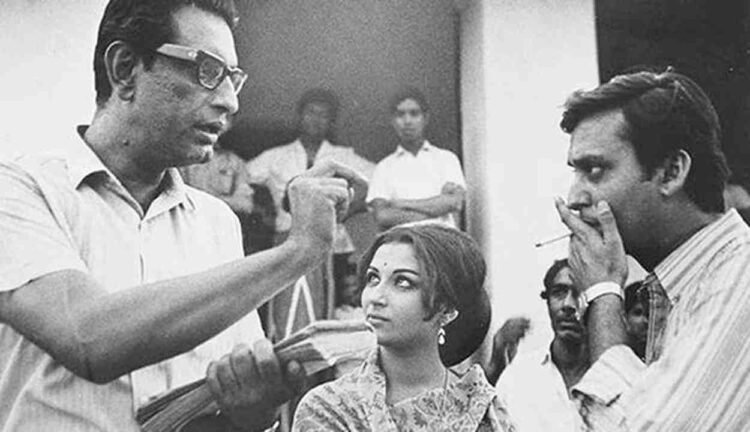
Ray placed Tagore in ‘Apur Sansar’ (1959), the last movie of his critically acclaimed Apu Trilogy, when she was barely 14 years old. She had no formal “exposure” to movies at that age, no knowledge of acting techniques, and no awareness of the cinematic tradition she was entering. In retrospect, the actress says that Ray’s kind demeanor made the encounter seem less scary than one would think.
The seasoned performer remembered her very first shot on set, which she claims she can still vividly recall, in an interview with ANI.That’s going to take a long time, my god. However, it was fantastic. And I can still remember it. I decided to start by going inside and taking a look around. Naturally, one never forgets their first shot.
She gives gratitude to the first Indian Oscar-winning filmmaker, whom she lovingly calls “Manik da,” for establishing a setting that made even a novice feel comfortable. She said he never gave actors the impression that a scene was “difficult.” That certainty was crucial for a little girl making her first appearance on a movie set.I had never heard of any of it before. It was thus quite stress-free and wonderful. And that’s what makes Manik da so beautiful. as he never gave his actors the impression that the scene was challenging. I had never seen a movie before, therefore it was my first day. She told ANI, “He just made everything so much easier for me.”
Tagore and Ray went on to work together on five films over the years, becoming one of the most renowned actor-director collaborations in Indian cinema. In addition to “Apur Sansar,” they collaborated on “Devi,” “Nayak,” “Aranyer Din Ratri,” and “Seemabaddha.”
Ray’s “Aranyer Din Ratri” (Days and Nights in the Forest, 1970) was recently presented in Delhi in a restored 4K version, revisiting that legacy. The picture, which examined societal conflicts and urban alienation, is still regarded as one of Ray’s most complex pieces and evokes strong emotions for Tagore.
She spoke about the physical hardships of shooting in Jharkhand while recalling the shoot. Ray had purposefully picked the area for its seasonal aesthetic, and the actors had to drive there after passing through Ranchi. She recalled the “absence of electricity,” the sparse, leafless trees, and the “heat,” all of which Ray wished to depict. She said that the rest of the group shared the agony but decided to laugh rather than moan, even though she had access to a generator and a cooler.Indeed, in Jharkhand. We had to drive after getting off at Ranchi. I mean, he wanted that specific place and that season, and it was gorgeous. As a result, it was quite hot and there weren’t many trees. He wanted that type of image, yet there were no leaves. I was given a generator with a chiller even though we didn’t have power. Despite the boys’ extreme discomfort, we all joked about it. It was very nice in the evenings,” she said.
Every movie Tagore made with Ray had a unique style, and people still cherish these works of art. Her reserved, reflective, and contemporary traits were shown in each of the five films, and they often contrasted with the more glitzy parts she subsequently performed in Hindi cinema.