
Politics – Bihar’s New Government Defends Mandate, Outlines Development Priorities
Politics – Bihar’s newly formed government has responded firmly to criticism from the Opposition, stating that its legitimacy remains intact despite recent political developments. Deputy Chief Minister Bijendra Prasad Yadav, speaking shortly after taking oath, emphasised that the National Democratic Alliance continues to hold its ground and that electoral mandates are given to political alliances rather than individual governments.
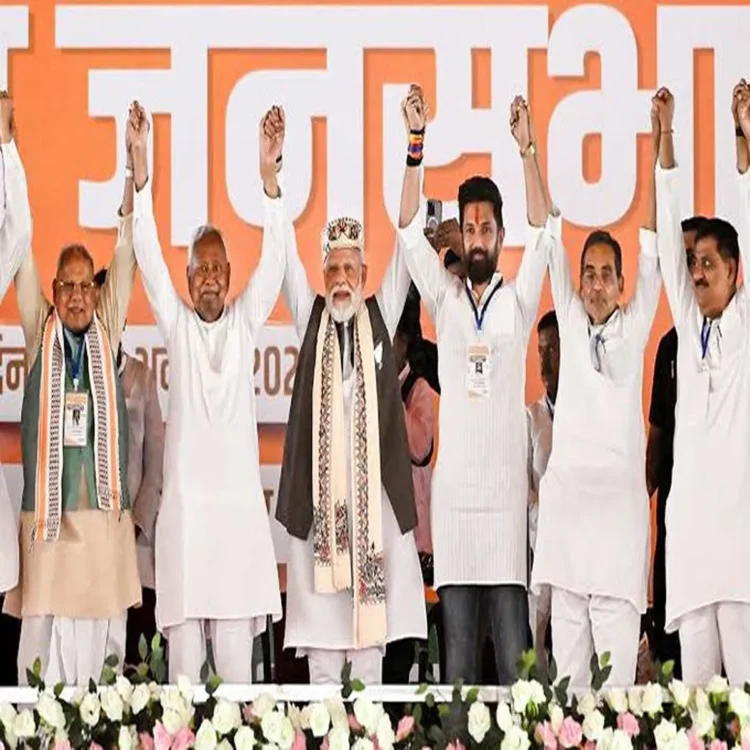
Government Stresses Continuity of Policies
Addressing questions about the administration’s immediate agenda, Yadav made it clear that the new leadership intends to carry forward the commitments made earlier. He pointed out that the promises outlined for the 2025–2030 period would remain a guiding framework. According to him, development goals will remain consistent, with a strong focus on transforming Bihar into a more prosperous state.
He highlighted that infrastructure development will be central to these efforts. Improving connectivity through air, rail, road, and waterways is expected to be a key priority, reflecting the government’s broader plan to strengthen economic activity and regional integration.
Existing Schemes to Continue Alongside New Initiatives
The Deputy Chief Minister reassured that ongoing welfare and development schemes will not be disrupted. All current programmes introduced during the previous tenure will continue without interruption. At the same time, the administration is preparing to introduce new initiatives aimed at addressing emerging challenges and opportunities.
This approach, he suggested, is intended to ensure stability in governance while also allowing room for innovation and policy expansion.
Employment Generation Remains a Core Focus
On the issue of employment, Yadav reiterated that job creation will remain one of the government’s primary concerns. He stressed the importance of boosting industrial growth, particularly in sectors linked to agriculture. Agro-based industries are expected to play a major role in generating employment opportunities within the state.
By encouraging such industries, the government hopes to create sustainable livelihoods and reduce economic pressure on rural populations. Other sectors will also receive attention, but agriculture-linked enterprises are seen as a natural fit for Bihar’s economy.
Perspective on Migration and Workforce Movement
When asked about the migration of young people from Bihar to other states, Yadav offered a broader perspective. He noted that movement for work is a global phenomenon and not unique to Bihar. He pointed out that many individuals from other states also come to Bihar for agricultural work, suggesting that workforce mobility should not always be viewed negatively.
His remarks indicate that the government may focus more on expanding local opportunities rather than framing migration solely as a problem.
Continued Focus on Agriculture and Farmers’ Income
The government has also committed to continuing the agricultural roadmap initiated earlier. This plan is expected to remain a cornerstone of efforts to improve farmers’ income and strengthen the rural economy.
By maintaining continuity in agricultural policies, the administration aims to provide stability for farmers while gradually introducing improvements where necessary.
Women’s Empowerment Efforts Highlighted
Yadav also spoke about women’s empowerment, pointing to Bihar’s earlier initiatives as a model. He recalled that reservation for women in local governance structures, such as panchayats and municipal bodies, had set a precedent.
In addition to political representation, the government has previously introduced schemes aimed at supporting education and welfare for women and young people, including provisions for bicycles and school uniforms. These measures, he said, reflect a broader commitment to inclusive development.
NDA’s Mandate and Political Stability
Responding to Opposition claims that the current government lacks a proper mandate, Yadav maintained that the alliance still holds the support it received during elections. He argued that voters choose political parties and alliances, not individual leaders or governments.
He also indicated that the alliance remains open to future political developments, suggesting that leadership dynamics could evolve over time.