
AyodhyaRamTemple – Mahana Accuses SP MP of Insulting Hindus Over Temple Donation Remarks
AyodhyaRamTemple – Uttar Pradesh politics witnessed fresh controversy after sharp exchanges erupted over remarks related to donations at the Ram Temple in Ayodhya.
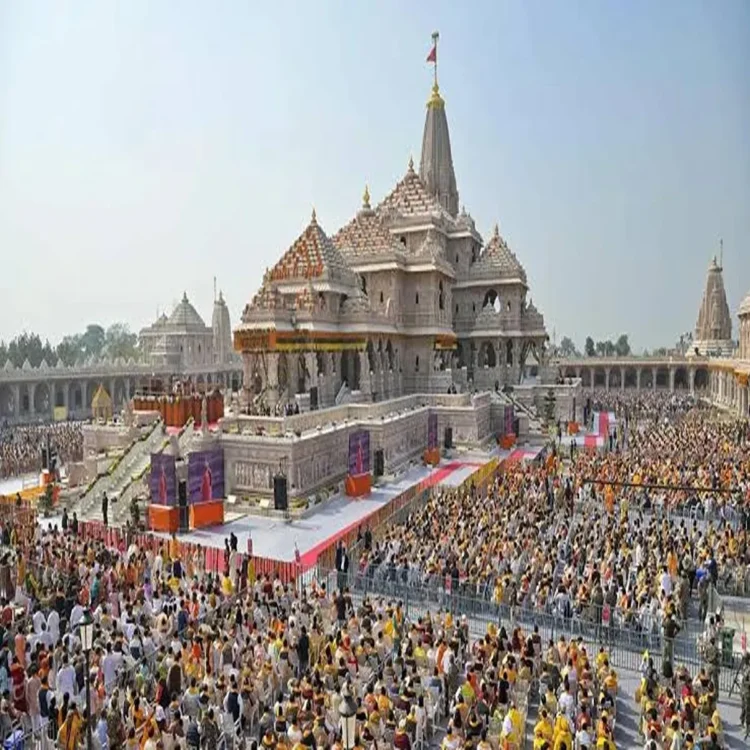
The political confrontation between the Bharatiya Janata Party (BJP) and the Samajwadi Party (SP) intensified on Tuesday after Uttar Pradesh Assembly Speaker Satish Mahana strongly criticised SP MP Awadhesh Prasad for his comments regarding the alleged theft of donations at the Ram Temple in Ayodhya. Mahana alleged that Prasad’s remarks went beyond questioning the reported incident and unfairly reflected on the Hindu community, triggering a fresh round of political debate in the state.
Mahana Questions Prasad’s Remarks
Speaking to reporters, Mahana said that Prasad’s statement had crossed the limits of political criticism. According to him, while discussing the reported incident involving temple donations, the Faizabad MP made observations that could be interpreted as targeting the broader Hindu community.
Mahana objected in particular to Prasad’s reported comment suggesting that the alleged theft would not have taken place if Muslims had been present. He argued that such a statement indirectly portrayed Hindus in a negative light and questioned why opposition leaders had not publicly distanced themselves from the remark. He maintained that comments of this nature should not become part of political discourse.
Controversy Linked to Temple Donation Allegations
The dispute began after Awadhesh Prasad raised concerns over media reports about an alleged theft involving donations collected at the Ram Temple. While addressing the issue, the Samajwadi Party leader called for greater transparency in the handling of contributions made by devotees.
Prasad urged the temple administration to introduce a system under which devotees would receive receipts for their donations. He also sought clarity on how the collected funds are being managed and utilised, arguing that accountability would strengthen public confidence in the administration of temple donations.
BJP Leaders Register Strong Protest
Prasad’s comments, particularly his reference to Muslims while discussing the alleged theft, drew immediate criticism from several BJP leaders. Party representatives alleged that his remarks were inappropriate and hurt the sentiments of Hindus by extending the discussion beyond the reported incident.
Echoing the party’s stand, Mahana said the issue was no longer limited to allegations concerning temple funds but had become a matter involving respect for religious sentiments. He asserted that criticism should remain focused on specific issues instead of making statements that could be perceived as targeting an entire community.
Political Rivalry Gains Momentum
The exchange has added to the continuing political rivalry between the BJP and the Samajwadi Party in Uttar Pradesh. Both parties have accused each other of attempting to derive political advantage from issues connected with the Ram Temple, which continues to occupy an important place in the state’s political landscape.
The controversy has also renewed discussion over the management of religious institutions and the need for transparency in handling public donations. While the opposition has continued to emphasise accountability in the administration of temple funds, the BJP has maintained that criticism should be expressed responsibly without making remarks that could hurt religious sentiments.
Ram Temple Remains at the Centre of Political Debate
Since its consecration, the Ram Temple in Ayodhya has remained a subject of frequent political discussion. Questions relating to its administration, donation management and operational transparency have periodically attracted attention from both ruling and opposition parties.
The latest exchange between Mahana and Prasad reflects how developments linked to the temple continue to influence political discourse in Uttar Pradesh. As both sides defend their respective positions, the debate has once again highlighted the intersection of religious issues, governance and electoral politics in the state.