
One Nation One Election – JPC Holds Key Consultations in Lucknow on Election Reform
One Nation One Election –The Joint Parliamentary Committee (JPC) continued its nationwide consultation process in Lucknow, Uttar Pradesh, where it engaged with senior government officials and stakeholders to gather views on the proposed system of simultaneous elections across India. The discussions are part of the committee’s review of two important legislative proposals that seek to introduce a common election cycle for the Lok Sabha and state legislative assemblies.
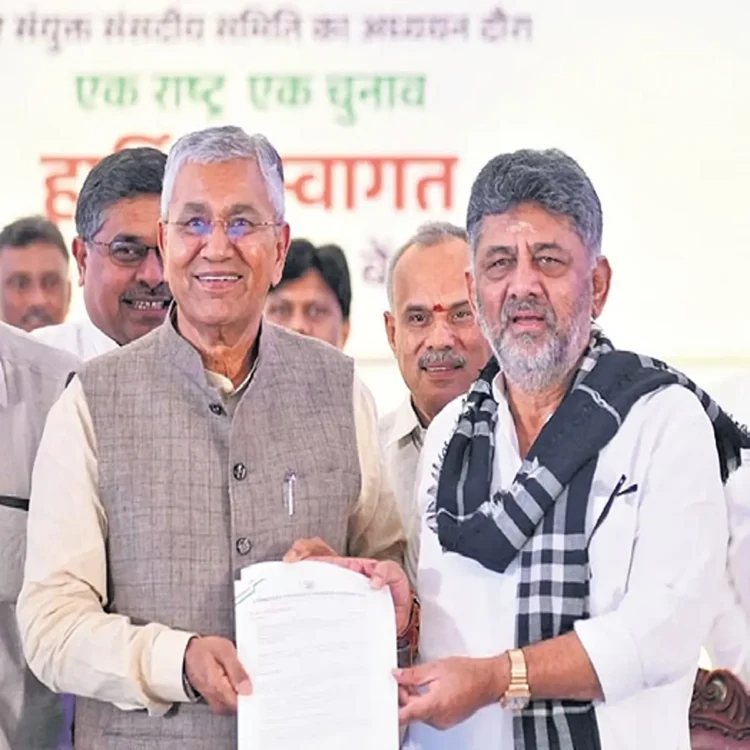
Committee Engages State Officials
During its visit on Monday, the parliamentary panel held an informal meeting with the Uttar Pradesh Chief Secretary, Director General of Police, Chief Electoral Officer, and representatives from several state departments, including Finance, Home, Education, Tourism, Agriculture, Industries, Health, and Labour. The objective of the interaction was to understand administrative, legal, and logistical aspects associated with implementing simultaneous elections under the proposed framework.
The committee is examining the Constitution (One Hundred and Twenty-Ninth Amendment) Bill, 2024, along with the Union Territories Laws (Amendment) Bill, 2024. Together, these legislative measures are intended to establish a synchronized election schedule throughout the country.
Nationwide Consultations Continue
JPC Chairperson PP Chaudhary, who led the discussions in Lucknow, said the committee is interacting with a broad range of stakeholders as part of its effort to develop a well-informed report. According to him, consultations are being conducted with government officials, elected representatives, political parties, industry representatives, and other concerned groups to gather different viewpoints before arriving at any recommendations.
Chaudhary stated that the committee has been receiving encouraging responses during its outreach programme. He also noted that many participants have expressed support for a unified election cycle, saying such a system could reduce the frequency of elections and minimise governance disruptions caused by repeated electoral activities.
Diverse Opinions Being Collected
Shiv Sena (UBT) Member of Parliament Anil Desai, who is participating in the consultations, said the committee’s approach is focused on collecting a wide range of opinions before preparing its final recommendations. He explained that several experts and invited participants are expected to present their observations on the constitutional, legal, and practical implications of holding simultaneous elections.
Desai added that committee members would carefully evaluate every suggestion received during the consultation process. He said the discussions are intended to assess how the proposed electoral model could impact governance and whether the required constitutional changes would effectively support its implementation.
Report Expected This Week
The parliamentary panel is expected to complete its review and formally adopt its report during its scheduled meeting on July 17. Once approved, the report will be submitted to Parliament for further examination and consideration.
The committee has been travelling to different parts of the country to interact with stakeholders before finalising its recommendations. The consultations are designed to ensure that multiple perspectives are considered while evaluating one of the country’s most significant electoral reform proposals.
Bills Aim to Synchronise Elections
The Constitution (One Hundred and Twenty-Ninth Amendment) Bill, 2024, proposes a framework commonly referred to as “One Nation, One Election,” under which elections to the Lok Sabha and all state legislative assemblies would be conducted together. The accompanying Union Territories Laws (Amendment) Bill, 2024, is intended to provide the legal support necessary for implementing the proposed system in Union Territories.
Both Bills were introduced in the Lok Sabha on December 17, 2024, and later referred to the Joint Parliamentary Committee for detailed examination. The committee’s findings are expected to play an important role in Parliament’s future deliberations on the proposed electoral reforms.