
WomenReservation – Debate Intensifies Over Delayed Women’s Quota Bill
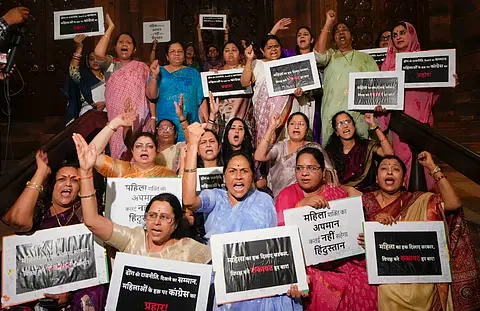
WomenReservation- Senior Congress leader Margaret Alva has voiced strong support for the opposition’s position on the stalled Women’s Reservation Amendment Bill, raising concerns over the intent and structure of the proposed legislation. She argued that the bill, presented as a step toward improving women’s representation in Parliament, may instead disproportionately benefit certain less-developed states.
Concerns Over Seat Redistribution
Alva questioned the proposal to increase the number of Lok Sabha seats by 50 percent, asking for clarity on how such calculations were made and who influenced the decision. She expressed doubts about the rationale behind the expansion, suggesting that it could alter the balance of representation among states. According to her, states that contribute more economically might end up with fewer seats compared to others receiving greater financial support.
She pointed out that this restructuring could lead to disparities, where some states might gain significantly more parliamentary representation than others, potentially affecting federal balance. Her remarks reflect a broader concern within sections of the opposition about how delimitation and seat redistribution could reshape political dynamics.
Allegations of Delay in Implementation
Alva also accused the ruling party of lacking genuine commitment to implementing women’s reservation. She claimed that despite public assurances, the process has been repeatedly delayed. According to her, the demand for reserving one-third of Lok Sabha seats for women has existed for years, yet concrete action remains pending.
Highlighting the Congress party’s past contributions, she noted that women have previously held key positions such as President, Prime Minister, and Lok Sabha Speaker. She argued that efforts to portray recent developments as the beginning of women’s empowerment overlook historical progress made over decades.
Alternative Proposal Introduced in Parliament
The debate gained momentum after DMK MP P Wilson introduced a Private Member’s Constitution Amendment Bill. His proposal suggested implementing women’s reservation from the next general election without increasing the current strength of 543 Lok Sabha seats. Importantly, it also ruled out the need for delimitation or a fresh census.
Wilson’s bill extends the reservation framework beyond Parliament to include State Legislative Assemblies, the National Capital Territory of Delhi, and Union Territories such as Puducherry and Jammu and Kashmir. He emphasized that the proposed reservation would be permanent rather than temporary, marking a significant shift from earlier approaches.
Parliamentary Voting and Outcome
The Lok Sabha took up multiple bills together, including the Constitution Amendment Bill, the Delimitation Bill, and amendments related to Union Territories laws. Following discussions, a division vote was conducted on the Constitution Amendment Bill.
The bill failed to pass, with 298 members voting in favor and 230 against. After its defeat, the government chose not to proceed with the other linked bills. This outcome effectively halted the broader legislative package aimed at restructuring parliamentary representation while introducing women’s reservation.
Differing Approaches to Women’s Reservation
The government’s proposal had aimed to expand the Lok Sabha from 543 to 816 seats while ensuring 33 percent reservation for women. This expansion was to be based on data from the 2011 census, with assurances that all states would receive a proportional increase in representation.
However, opposition parties maintained that they support women’s reservation in principle but strongly opposed linking it to delimitation. They argued that reservation could be implemented within the existing parliamentary framework without altering seat distribution or waiting for additional processes.
Ongoing Political Debate
The issue continues to remain a point of contention between the government and opposition. While both sides agree on the importance of increasing women’s participation in legislative bodies, they differ sharply on the method and timing of implementation.
As discussions evolve, the focus is likely to remain on balancing representation, ensuring fairness among states, and addressing long-standing demands for gender equality in political institutions