
Spaceflight – Artemis II Crew Returns Safely After Historic Lunar Journey
Spaceflight – The crew of NASA’s Artemis II mission completed a dramatic return to Earth on Friday, splashing down in the Pacific Ocean and bringing to a close humanity’s first crewed journey around the Moon in more than 50 years.
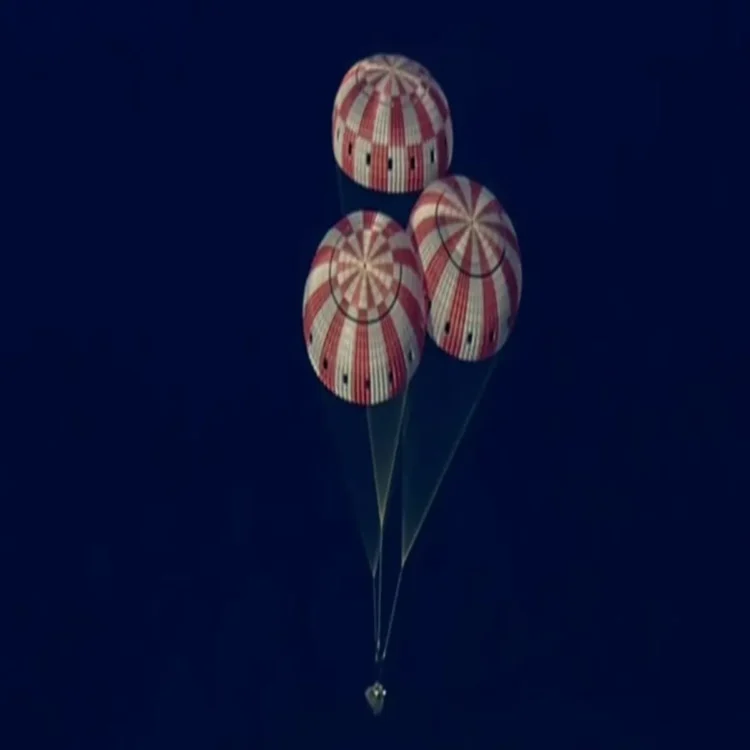
The four-member team—Commander Reid Wiseman, pilot Victor Glover, mission specialists Christina Koch and Jeremy Hansen—ended their mission with a high-speed atmospheric reentry that echoed the intensity of the Apollo era. Traveling at nearly 33 times the speed of sound, their Orion spacecraft, named Integrity, executed an automated descent before landing safely at sea.
A High-Stakes Reentry Under Close Watch
As the spacecraft reentered Earth’s atmosphere, it encountered extreme temperatures, forming a sheath of superheated plasma around the capsule. This caused a temporary communications blackout, a critical phase that heightened tension inside Mission Control. Engineers closely monitored the performance of the heat shield, a vital component designed to protect the crew from temperatures reaching thousands of degrees.
The situation was particularly significant given concerns raised during an earlier uncrewed test flight in 2022, when the heat shield showed unexpected wear. This time, however, the system performed as intended, ensuring a safe descent.
Emotional Moments at Splashdown
Relief and celebration followed as communication was restored and parachutes deployed successfully. The capsule descended gently into the Pacific, where recovery teams aboard the USS John P. Murtha were ready to receive the astronauts. Military aircraft and helicopters supported the recovery operation near the California coast.
Inside Mission Control, families of the astronauts watched anxiously. Applause broke out as the spacecraft emerged from blackout and again upon splashdown, marking a successful end to a mission watched worldwide.
Record-Breaking Journey Beyond the Moon
Launched on April 1 from Florida, Artemis II pushed human space exploration to new limits. The crew traveled farther from Earth than any humans before, reaching a distance of over 252,000 miles. Although the mission did not involve landing on the Moon, it served as a critical step in testing systems for future lunar operations.
During their flyby, the astronauts captured unprecedented images of the Moon’s far side, a region never before seen directly by humans. They also witnessed a total solar eclipse from space, an experience described by the crew as deeply moving.
A Mission That Inspired Global Attention
The mission drew international interest and praise from global leaders and public figures. The astronauts’ images of Earth rising behind the Moon evoked memories of historic Apollo missions, reinforcing the emotional and scientific impact of the journey.
In one poignant moment, the crew requested permission to name lunar craters after their spacecraft and a loved one, adding a personal touch to the historic mission.
Technical Challenges Along the Way
Despite its success, Artemis II encountered minor technical issues. The spacecraft experienced valve problems in both its water and propulsion systems, and onboard sanitation systems required repeated attention. However, the crew managed these challenges effectively, emphasizing that such difficulties are part of advancing space exploration.
Mission specialists noted that real-world testing in space often reveals issues that cannot be fully replicated on Earth, making such missions essential for progress.
Preparing for Future Lunar Missions
Artemis II serves as a foundation for upcoming missions under NASA’s Artemis program. Future flights aim to establish a sustainable human presence on the Moon. Artemis III is expected to focus on docking operations, while Artemis IV plans to attempt a crewed lunar landing near the Moon’s south pole later in the decade.
The astronauts expressed hope that their mission would inspire a renewed appreciation for Earth and the importance of exploration. Their journey marks not just a technological achievement, but a reminder of humanity’s shared curiosity and ambition.