
Investment – Bangladesh Private Investment Falls to Lowest Level in 11 Years
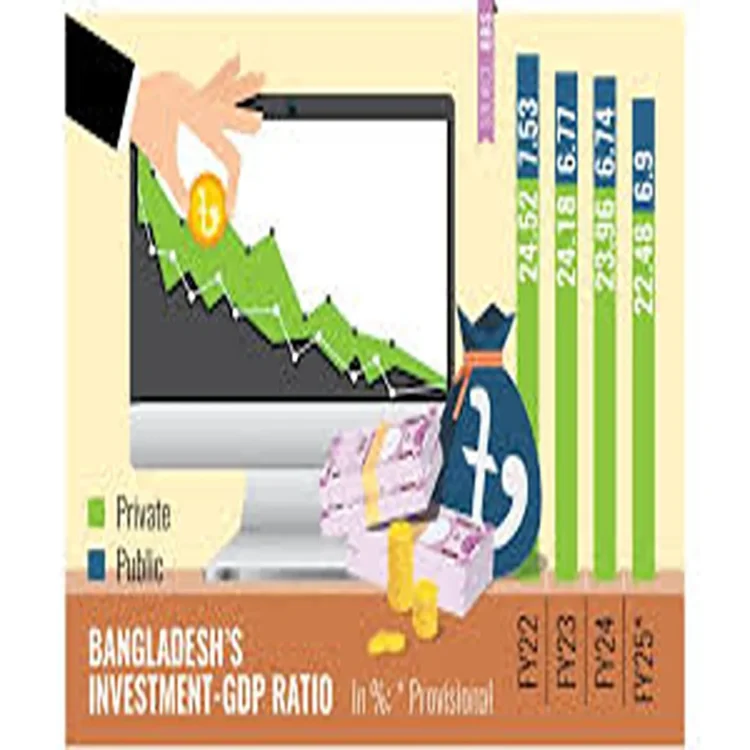
Investment – Private investment in Bangladesh declined sharply during the fiscal year 2024–25, reaching its lowest level in more than a decade. According to recently released data from the Bangladesh Bureau of Statistics, private investment dropped to 22.03 percent of the country’s Gross Domestic Product. This is the weakest level recorded in the last eleven years and highlights mounting concerns over the country’s investment environment and overall economic stability.
Public Investment Also Continues to Decline
The report also points to a continued fall in government spending on development projects. Public investment declined for the third year in a row, reflecting slower implementation of the government’s Annual Development Programme. During the fiscal year 2024–25, public investment accounted for 6.51 percent of GDP, compared with 6.74 percent in the previous fiscal year.
This figure represents the lowest level of public investment recorded since at least fiscal year 2013. Analysts say delays in project execution and tighter fiscal conditions have contributed to the slowdown in development spending.
Concerns Over Employment Opportunities
Economists warn that declining investment levels could have wider economic consequences, particularly for employment generation. Bangladesh’s labor market receives a large number of new entrants every year, and lower investment could reduce the number of jobs created across key sectors.
Experts note that sustained investment is critical for maintaining industrial expansion and supporting economic growth. Without sufficient private and public investment, the country may struggle to create enough employment opportunities for its growing workforce.
Experts Call for Policy Reforms
M Masur Reaz, chairman and founder of Policy Exchange Bangladesh, described the situation as a matter of concern for the country’s long-term economic prospects. He emphasized that Bangladesh requires stronger investment flows to expand exports and create new employment opportunities.
Reaz noted that major policy reforms were needed nearly a decade ago to improve the business environment. However, he said those reforms were introduced only in a fragmented manner rather than through a coordinated strategy, limiting their overall impact on investment growth.
Political Uncertainty Adds to Economic Pressure
The investment climate has also been influenced by political developments in recent years. Reaz pointed out that uncertainty increased following the mass protests in July 2024 that led to the removal of former Prime Minister Sheikh Hasina. According to analysts, such developments often create hesitation among investors who prefer a stable policy and political environment.
Political uncertainty can affect business confidence, delay investment decisions, and slow the pace of new projects across various sectors of the economy.
Structural Challenges Affecting Competitiveness
Ashikur Rahman, principal economist at the Policy Research Institute of Bangladesh, said a combination of structural and economic issues is contributing to the decline in private investment. He highlighted that weak business conditions, rising production costs, and persistent infrastructure challenges have reduced the country’s competitiveness in global markets.
Rahman explained that when operating costs rise and infrastructure constraints remain unresolved, companies may postpone expansion plans or limit new investments. This, in turn, affects industrial growth and export performance.
Financial Constraints Limiting Corporate Investment
Syed Akhtar Mahmood, a former global lead for regulatory reforms at the World Bank Group, said both short-term financial pressures and deeper structural factors are influencing the current investment trend.
Mahmood noted that several large companies had already borrowed heavily when interest rates were relatively low. As borrowing costs increased in recent years, many firms may now find it difficult to take on additional loans for new investment projects.
According to Mahmood, even if new business opportunities arise, companies with high existing debt levels may hesitate to expand further. This situation could continue to affect private investment levels in the near future.
Economists say addressing these challenges will require policy consistency, improvements in infrastructure, and measures that strengthen business confidence. Without such steps, Bangladesh may face difficulty restoring higher investment levels that are essential for sustained economic growth.