
WomenReservation – Government Explores Changes to Implement Women’s Quota Sooner
WomenReservation – The Central government has begun consultations with Opposition parties to explore possible changes to the women’s reservation law, aiming to accelerate the implementation of a policy that guarantees one-third representation for women in the Lok Sabha and state legislative assemblies. According to sources familiar with the discussions, the outreach is intended to gather views on whether amendments to the existing law could help bring the reservation into effect earlier than currently scheduled.
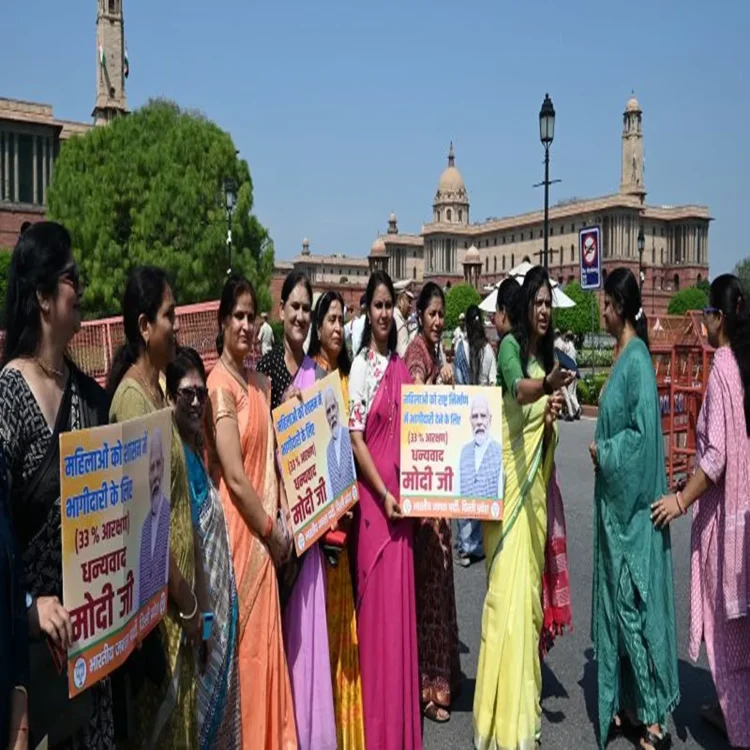
Background of the Women’s Reservation Law
The legislation, formally known as the Constitution (One Hundred and Sixth Amendment) Act, 2023 and widely referred to as the Women’s Reservation Bill, was approved during a special session of Parliament in September 2023. The law provides for a 33 percent quota for women in the Lok Sabha and in state assemblies across the country.
However, the law includes a condition that the reservation will come into force only after two key steps are completed. First, a national Census must be conducted after the law comes into effect. Second, a delimitation exercise must follow to redraw parliamentary and assembly constituencies based on updated population data.
Timeline Linked to Census and Delimitation
Under the current framework, the next delimitation process is expected after the Census planned for 2027. This means the actual allocation of reserved seats for women would only occur once constituency boundaries are revised according to the latest population figures.
Political observers have pointed out that this timeline could significantly delay the rollout of the reservation system. Many opposition leaders had earlier expressed concern that linking the quota to these processes might postpone its practical implementation for several years.
Government Reaches Out to Opposition Leaders
Sources indicate that the government has informally contacted leaders from various Opposition parties to discuss whether the law could be modified to remove or adjust the conditions tied to the Census and delimitation exercises.
The aim of these discussions is to examine whether the reservation for women could be introduced earlier through legislative changes. Although no formal proposal has been placed before Parliament yet, the consultations suggest that the government may be considering a bipartisan approach before moving forward.
Notably, the Women’s Reservation Bill received unanimous support in both Houses of Parliament when it was passed in 2023. Despite this broad backing, concerns about the timeline for implementation have remained a point of debate.
Experts Question Link Between Reservation and Delimitation
Some policy experts have argued that connecting the women’s quota to delimitation may unnecessarily complicate the process. Economist and former Chief Statistician Pronab Sen has previously suggested that the reservation provisions could be separated from the delimitation requirement through an amendment to the law.
Sen questioned why the implementation of the women’s quota should depend on constituency redrawing. According to him, the reservation risks being delayed because it has been tied to both the Census and delimitation exercises.
He also indicated that the Opposition could push for amendments to ensure that the quota is implemented without waiting for the full delimitation process to conclude.
Concerns About Political Implications
Another issue raised by experts relates to the potential political challenges of delimitation itself. If constituency boundaries are redrawn strictly according to population figures, some states could lose parliamentary representation while others gain seats.
States in southern India, as well as regions such as Maharashtra and Gujarat, have previously expressed concerns about such changes. These states have generally recorded lower population growth compared to several northern states, which could affect their representation if seats are redistributed solely based on updated population data.
Because of these concerns, linking women’s reservation to delimitation may introduce additional political complexities.
A Long Legislative Journey
The idea of reserving seats for women in Parliament and state assemblies has been debated for decades. The Women’s Reservation Bill was first introduced in 1996 but remained stalled for years due to disagreements among political parties.
In 2010, the Rajya Sabha passed a version of the bill during the tenure of the United Progressive Alliance government. However, it was not brought to a vote in the Lok Sabha at that time because consensus among parties could not be achieved.
More than two decades after its first introduction, the bill was finally approved by both Houses of Parliament in 2023, marking a significant milestone in efforts to improve women’s political representation in India.