
Opposition Alliance – INDIA Bloc Faces Growing Strains Amid Regional Differences
Opposition Alliance – Congress leader and former Maharashtra Chief Minister Prithviraj Chavan has openly acknowledged emerging divisions within the opposition INDIA bloc, highlighting concerns about the coalition’s ability to remain united ahead of future political challenges.
Absence of Tamil Nadu Representation Raises Questions
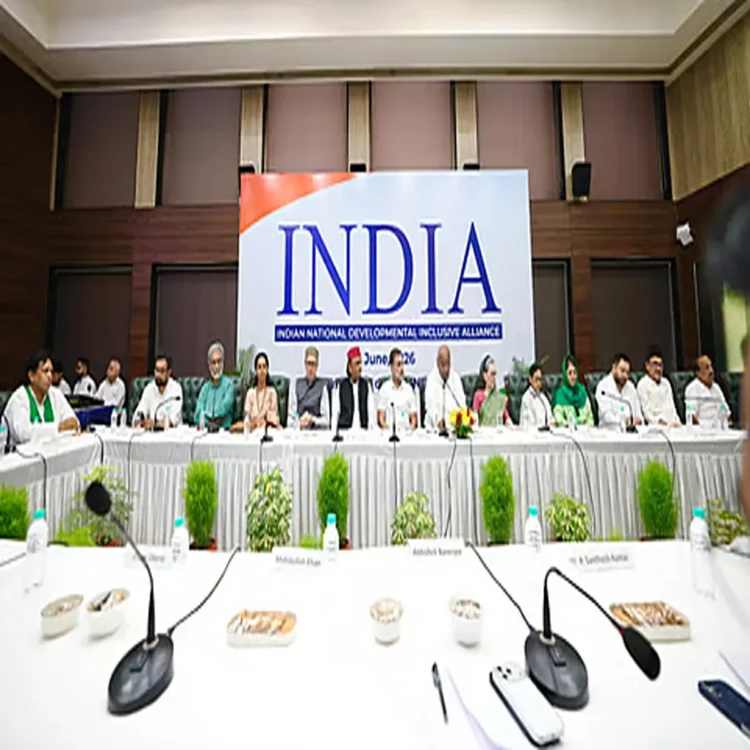
The discussion gained momentum after Tamil Nadu had no representation at a recent INDIA bloc meeting held on Monday. The absence drew attention as the Dravida Munnetra Kazhagam (DMK), a major regional ally, chose not to participate amid reported tensions with the Congress. The strain reportedly followed political developments in Tamil Nadu, where Congress was said to have distanced itself from the MK Stalin-led party and extended support to actor-turned-politician Vijay’s Tamilaga Vettri Kazhagam (TVK) during government formation discussions.
At the same time, TVK was not invited to the opposition gathering because the party currently does not have members in either House of Parliament.
Chavan Admits Challenges Within the Coalition
Speaking on the situation, Chavan said the Congress continues its efforts to question and challenge the ruling alliance. However, he admitted that internal differences have become visible within the INDIA bloc.
According to him, public dissatisfaction is growing in several areas, and opposition parties may not have fully met the expectations of citizens. He suggested that voters are looking for stronger coordination and more effective political alternatives.
Concerns Over Political Realignments
Chavan also expressed concern about shifting political loyalties in different states. Drawing comparisons with earlier political developments in Maharashtra, where both the Nationalist Congress Party (NCP) and Shiv Sena witnessed significant splits, he pointed to recent developments involving the Trinamool Congress in West Bengal.
He claimed that several Trinamool Congress parliamentarians had moved closer to the National Democratic Alliance (NDA), indicating broader political changes that could influence opposition strategies. Despite the challenges, Chavan maintained that opposition leaders would continue engaging with the public and presenting their views on national issues.
Congress Calls for Greater Opposition Unity
Meanwhile, Uttar Pradesh Congress President Ajay Rai defended the strength and relevance of the Congress party. Describing the party as a deeply rooted political force, he said Congress remains capable of supporting and uniting a broad range of regional parties.
Rai emphasized that regional political groups should work alongside Congress to build a stronger opposition platform. He argued that cooperation among opposition parties would be essential in addressing national political challenges and presenting a united front.
Differences Surface Among Other Alliance Partners
The recent INDIA bloc meeting also highlighted disagreements involving other alliance members. Although representatives from the Communist Party of India (Marxist) and the Jharkhand Mukti Morcha (JMM) attended the gathering, both parties had recently experienced friction with Congress.
The CPI(M) had earlier sought clarification from Congress regarding comments made during the Kerala election campaign, where allegations related to the Bharatiya Janata Party (BJP) became a point of contention.
In Jharkhand, differences emerged within the ruling alliance over preparations for upcoming Rajya Sabha elections. The JMM and Congress reportedly disagreed on seat-sharing arrangements, creating temporary uncertainty within the coalition. However, discussions between the parties later helped resolve the matter.
Alliance Faces Test of Cohesion
The developments underscore the challenges facing the INDIA bloc as it seeks to maintain unity among diverse regional and national parties. While alliance leaders continue to stress cooperation, recent disagreements have highlighted the complexities involved in managing a broad political coalition with varying regional priorities and interests.