
NavyLeadership – Vice Admiral Krishna Swaminathan Named India’s Next Naval Chief
NavyLeadership – The Government of India has announced the appointment of Vice Admiral Krishna Swaminathan as the next Chief of the Naval Staff, marking a major leadership transition within the Indian Navy. The decision was confirmed on Saturday through an official statement issued by the Ministry of Defence.
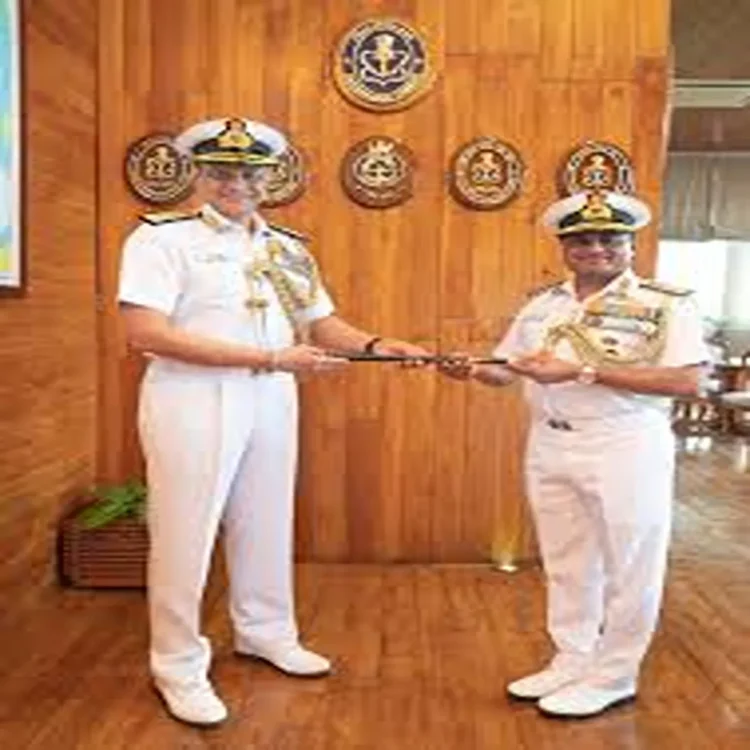
The appointment comes ahead of the retirement of the current Navy chief, Admiral Dinesh Kumar Tripathi, who is scheduled to conclude his service on May 31, 2026. Vice Admiral Swaminathan is expected to take charge at a time when India continues to strengthen its maritime capabilities and strategic presence across the Indo-Pacific region.
Extensive Operational Experience
Vice Admiral Krishna Swaminathan currently serves as the Flag Officer Commanding-in-Chief of the Western Naval Command, a position he assumed in July 2025. Over the course of his long naval career, he has built a strong reputation through several operational and leadership assignments across the Indian Navy. Commissioned into the force on July 1, 1987, he specializes in Communication and Electronic Warfare.
He has commanded a wide range of frontline naval platforms, including missile vessels INS Vidyut and INS Vinash, missile corvette INS Kulish, guided missile destroyer INS Mysore, and aircraft carrier INS Vikramaditya. These assignments have placed him at the center of some of the Navy’s most significant operational responsibilities over the years.
Key Leadership and Training Roles
During his tenure as a Rear Admiral, Swaminathan served as Chief Staff Officer (Training) at the Southern Naval Command headquarters in Kochi. In that role, he played an important part in strengthening training systems and operational preparedness within the Navy. He also contributed to the establishment of the Indian Naval Safety Team, which oversees safety procedures and operational standards across multiple branches of the naval force.
He later headed the Navy’s Work Up Organisation as Flag Officer Sea Training before taking over as Flag Officer Commanding of the Western Fleet. His experience further expanded when he was appointed as Flag Officer Offshore Defence Advisory Group and Advisor on Offshore Security and Defence to the Government of India.
Following his promotion to the rank of Vice Admiral, he held several important administrative and strategic appointments. These included serving as Chief of Staff at the Western Naval Command, Controller of Personnel Services, and Chief of Personnel at Naval Headquarters. Before assuming his current command, he was also Vice Chief of the Naval Staff.
Strong Academic and Strategic Background
Apart from his operational credentials, Vice Admiral Swaminathan is also recognized for his academic achievements and professional military education. He studied at the National Defence Academy in Khadakwasla and later attended prestigious institutions including the Joint Services Command and Staff College in the United Kingdom, the College of Naval Warfare in Karanja, and the United States Naval War College in Rhode Island.
His educational qualifications include a Bachelor of Science degree from Jawaharlal Nehru University, a Master’s degree in Telecommunications from Cochin University of Science and Technology, and a Master’s in Defence Studies from King’s College London. He also earned an MPhil in Strategic Studies and a PhD in International Studies from Mumbai University.
Decorated Career in the Indian Navy
Vice Admiral Swaminathan has received several distinguished military honors during his service career. His awards include the Param Vishisht Seva Medal, Ati Vishisht Seva Medal, and Vishisht Seva Medal, reflecting his contribution to national defence and naval operations.
With decades of operational, administrative, and strategic experience, his appointment is being viewed as a significant development for the future leadership of the Indian Navy as it continues to focus on maritime security and modernization efforts.