
Indonesia – Modi Receives Ceremonial Welcome Ahead of Talks With Prabowo
Indonesia – Prime Minister Narendra Modi was accorded a ceremonial Guard of Honour in Jakarta on Tuesday as he began a series of official engagements during his visit to Indonesia. Indonesian President Prabowo Subianto received the Prime Minister at the formal welcome ceremony, which marked the start of their high-level bilateral programme.
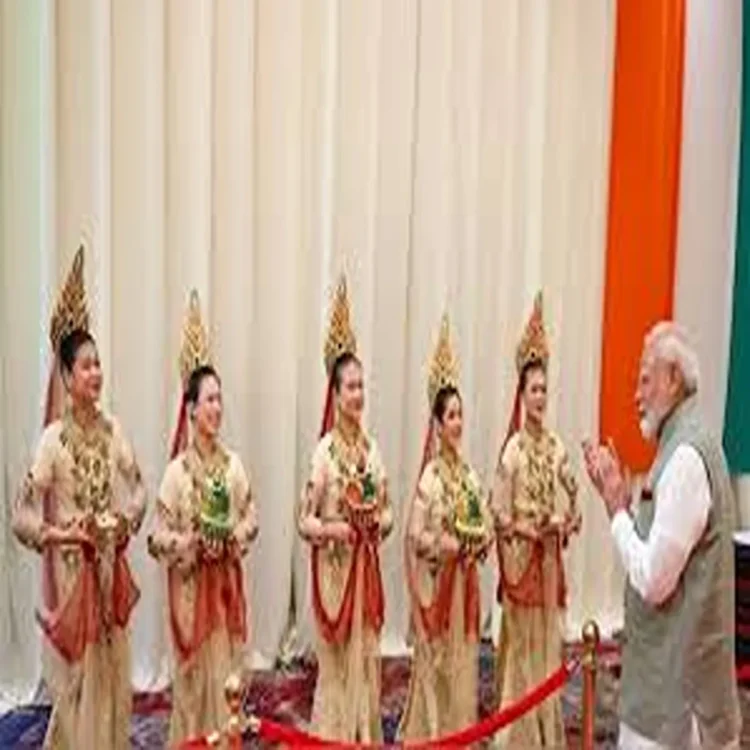
Formal Reception Opens Official Programme
The two leaders exchanged a warm greeting during the ceremony before moving towards their scheduled diplomatic discussions. Modi is expected to hold detailed talks with President Prabowo on a range of regional, strategic and economic matters, with both sides looking to build on the growing momentum in India-Indonesia relations.
Modi arrived in Indonesia on Monday as part of a three-country tour. His aircraft was escorted by military jets after entering Indonesian airspace, and he was welcomed at the airport by President Prabowo. A traditional cultural performance was also organised to mark the Indian leader’s arrival.
Fourth Visit Reflects Expanding Bilateral Engagement
The July 6-8 visit is Modi’s fourth trip to Indonesia and comes at the invitation of President Prabowo. It is also the first bilateral visit since India and Indonesia elevated their relationship to a Comprehensive Strategic Partnership in 2018.
Officials are expected to review progress across defence, maritime security, trade, investment and people-to-people ties. The discussions are likely to focus on practical steps that can strengthen cooperation between the two major Indian Ocean nations.
Defence and Maritime Cooperation on Agenda
Defence engagement has emerged as an important part of the India-Indonesia partnership in recent years. The two countries have expanded official exchanges, conducted joint military exercises and explored opportunities for defence industry collaboration.
Indonesia’s purchase of BrahMos supersonic cruise missiles has also added a new dimension to security cooperation. Maritime coordination is expected to remain a key subject during the talks, particularly as both countries share interests in maintaining stability, safety and open sea routes across the Indo-Pacific region.
India’s MAHASAGAR framework, which stands for Mutual and Holistic Advancement for Security Across the Regions, is expected to guide discussions on wider regional cooperation. The initiative outlines India’s approach towards maritime security, economic growth and inclusive development across the Indian Ocean region.
Visit Linked to Act East and Indo-Pacific Vision
Before leaving India, Modi said his visits to Indonesia, Australia and New Zealand would support India’s Act East Policy and reinforce its approach towards a free, open and inclusive Indo-Pacific.
The Prime Minister said the tour would also help deepen engagement in strategic, economic and people-focused areas. After completing his Indonesia programme, he is scheduled to travel to Australia and New Zealand for further official meetings.
Diaspora Outreach and Cultural Engagement Planned
During his stay in Jakarta, Modi is expected to meet members of the Indian community in Indonesia. Members of the diaspora have expressed hope that the visit will create fresh opportunities for cooperation in areas such as infrastructure, energy, mining and emerging technologies.
The Prime Minister is also scheduled to visit the UNESCO-listed Prambanan Temple Complex in Yogyakarta with President Prabowo. The historic site is widely seen as a reminder of the longstanding cultural and civilisational connections between India and Indonesia.
Trade and Critical Minerals Expected to Feature
Indonesia remains India’s second-largest trading partner within the ASEAN region. Bilateral trade reached USD 24.78 billion in the 2025-26 financial year, while more than 130 Indian companies have investments across different sectors of the Indonesian economy.
Critical minerals are also likely to receive attention during the talks. Indonesia holds a significant share of the world’s nickel reserves and is a major producer of bauxite, copper and tin. These resources are important for India’s supply chain plans, clean energy goals and expanding manufacturing sector.
The visit is expected to provide an opportunity for both governments to assess the full range of bilateral ties and identify new areas for long-term cooperation in trade, investment, security and regional development.