
Delimitation – Sonia Gandhi Flags Concerns Over Special Parliament Session Timing
Delimitation – Congress Parliamentary Party Chairperson Sonia Gandhi on Monday raised serious concerns over the Centre’s decision to convene a special session of Parliament on April 16, stating that the core issue is not women’s reservation but the proposed delimitation exercise, which she described as deeply troubling for the constitutional framework.
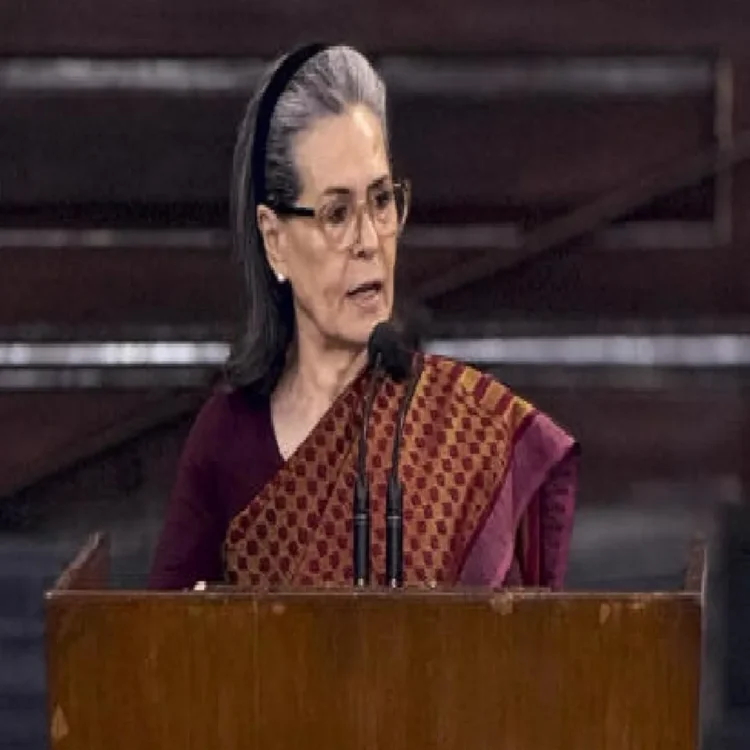
Concerns Over Delimitation Take Centre Stage
In her remarks, Gandhi argued that the process of delimitation—redrawing parliamentary constituencies—could have far-reaching implications if not handled with transparency and consensus. She cautioned that such a move, if rushed, could disturb the balance of representation among states, particularly those that have successfully implemented population control measures.
According to her, any attempt to alter the composition of the Lok Sabha must be approached with both political sensitivity and fairness, ensuring that no region is disadvantaged either relatively or absolutely.
Allegations of Political Timing
Gandhi questioned the timing of the proposed session, pointing out that it coincides with ongoing election campaigns in Tamil Nadu and West Bengal. She suggested that the urgency behind introducing key legislation during this period raises questions about the government’s intent.
She also alleged that Prime Minister Narendra Modi may be attempting to shift focus away from the caste census issue. Gandhi claimed that earlier commitments regarding a caste-based enumeration now appear uncertain, indicating a possible delay in its implementation.
Debate Over Women’s Reservation
Referring to the Nari Shakti Vandan Adhiniyam, 2023, Gandhi clarified that the opposition had supported women’s reservation but had opposed linking its implementation to the completion of the Census and subsequent delimitation.
She noted that opposition leaders had urged the government to enforce the reservation from the 2024 Lok Sabha elections. However, the law was structured in a way that delays its rollout until after the Census process, which itself has been postponed.
Gandhi further questioned why there is now talk of advancing the implementation timeline to 2029, asking why such a shift has taken considerable time and why broader discussions could not be held before calling a special session.
Demand for Wider Consultation
Highlighting the lack of dialogue, Gandhi said opposition parties had repeatedly requested an all-party meeting after the completion of assembly elections on April 29. She described the government’s refusal to engage in such consultations as dismissive of democratic norms.
Drawing from past examples, she pointed to the extensive deliberations that preceded the 73rd and 74th Constitutional Amendments in the early 1990s, which introduced reservations for women in local governance. Those reforms, she noted, were the result of years of discussion and consensus-building.
Census Delay and Its Impact
Gandhi also raised concerns about the delayed Census, originally scheduled for 2021. She emphasized that the absence of updated population data has affected welfare schemes, particularly those linked to the National Food Security Act.
She questioned the urgency of initiating a digital Census in 2027 while previous delays remain unexplained. According to her, the argument that a caste census would slow down the overall process does not hold, citing examples of states like Bihar and Telangana that completed similar exercises within months.
Representation and Equity Concerns
On the issue of delimitation, Gandhi stressed that any increase in parliamentary seats must consider both demographic changes and equitable representation. She warned that a purely numerical approach could disproportionately impact states with lower population growth.
She also reiterated the need to address representation for Other Backward Classes (OBCs), noting that while provisions exist for Scheduled Castes and Scheduled Tribes within women’s reservation, similar measures for OBC women have not yet been included.
Call for Measured Approach
Concluding her remarks, Gandhi stated that there is sufficient time to hold detailed discussions before introducing any constitutional amendments. With the monsoon session of Parliament scheduled for mid-July, she suggested that a consultative approach would strengthen both the legislative process and public trust.
She emphasized that the issue at hand is not the principle of women’s reservation, which has already been accepted, but the manner in which broader structural changes are being pursued