
CivilRights – Jesse Jackson’s Global Legacy Rooted in Gandhian Ideals
CivilRights – Reverend Jesse Jackson’s life reflected a powerful thread linking the American civil rights movement with global struggles for justice, drawing deeply from the philosophy of nonviolence shaped by Mahatma Gandhi.
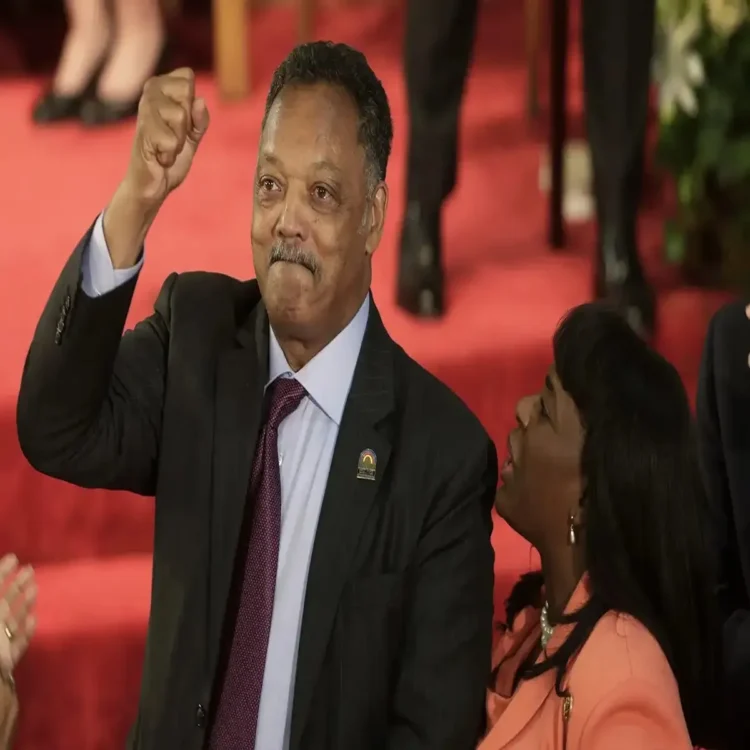
Jackson, who passed away on Tuesday, long viewed himself as part of a historic continuum of leaders committed to equality and racial justice. He frequently acknowledged the influence of his mentor, Martin Luther King Jr., and traced that lineage further back to Gandhi, whose doctrine of Satyagraha inspired movements far beyond India’s borders.
Gandhi’s Influence on a Generation of Leaders
Speaking in New Delhi in 2008 at a gathering marking the 60th anniversary of Gandhi’s assassination, Jackson described Gandhi as the “spiritual godfather” of modern movements for civil rights and human dignity. He said that Gandhi’s moral vision shaped not only King’s leadership in the United States but also global figures such as Nelson Mandela.
At the event, Jackson reflected on what he saw as the enduring strength of Gandhi’s message. Six decades after his death, he said, the ideals of democracy, peace and human rights remained vibrant. Both Gandhi and King, he observed, were visionaries who challenged the prevailing order and refused to conform to the expectations of their times.
Jackson argued that Gandhi’s commitment to ending divisions based on race, caste, class and gender continued to resonate in contemporary struggles. He credited Gandhi’s example with energising decolonisation movements across Africa, Asia, Latin America and the Caribbean, transforming political realities for millions.
Carrying Forward King’s Nonviolent Struggle
In the United States, Jackson became one of the most visible advocates of nonviolent protest after King’s assassination. He worked to extend the gains of the civil rights movement, including landmark reforms that dismantled segregation and expanded voting rights.
Business leader M.R. Rangaswami, founder of Indiaspora, noted in a condolence message that the sacrifices made by African-American activists had far-reaching consequences. The Civil Rights Act, he said, not only addressed racial injustice but also paved the way for immigration reforms that opened doors to communities of colour, including many from India.
Jackson often emphasised that nonviolence was not a passive stance but a strategic and moral force. While acknowledging global threats such as nuclear conflict and economic inequality, he maintained that nonviolent resistance remained the most effective path toward lasting peace.
Recognising India’s Freedom Struggle
Jackson’s connection to India extended beyond admiration for Gandhi. During a visit to Kolkata in 2014, he paid tribute to Netaji Subhas Chandra Bose by visiting Netaji Bhawan, Bose’s ancestral home. In the visitors’ book, Jackson wrote a brief but symbolic message underscoring the complementary roles of Gandhi and Bose in India’s independence movement.
While in Kolkata, he addressed students at the Indian Institute of Management, where he discussed the impact of globalisation. He argued that interconnected economies should be guided by fairness and shared responsibility rather than narrow national interests.
Jackson proposed replacing the notion of “foreigner” with a framework built on common global standards and economic justice. To explain his philosophy of international cooperation, he used a simple metaphor: when a house is on fire, saving only one room is futile; collective action is essential to preserve the entire structure.
Political Milestones in the United States
Jackson’s commitment to expanding representation also shaped his role in American politics. During his 1984 campaign for the Democratic Party’s presidential nomination, he pointed to global examples of female leadership, including India’s then prime minister Indira Gandhi, to argue that women were fully capable of holding the highest offices.
Although his campaign did not secure the nomination, it influenced the political conversation. That year, the Democratic ticket included Geraldine Ferraro as the vice presidential nominee, marking the first time a woman appeared on a major party’s national slate.
Throughout his career, Jackson linked domestic civil rights battles with broader international movements for freedom and equality. By invoking Gandhi’s philosophy and advocating cooperation across borders, he framed justice not as a national issue alone but as a shared human responsibility.