
Bengaluru Anti-Encroachment Drive: Political Row Over Bengaluru Anti-Encroachment Drive Raises Questions on Governance and Federal Boundaries
Bengaluru Anti-Encroachment Drive: Karnataka’s political landscape witnessed a sharp exchange of words after comments made by the Kerala Chief Minister on an ongoing anti-encroachment drive in Bengaluru. The issue quickly moved beyond administrative action and turned into a wider debate involving inter-state political boundaries, minority rights, urban governance, and the role of political narratives during election periods.
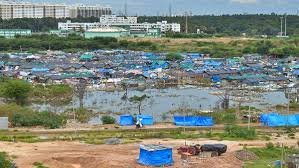
Background of the Bengaluru Anti-Encroachment Drive
The controversy began with an anti-encroachment operation carried out in parts of North Bengaluru. According to the Karnataka government, the drive targeted areas identified as unsafe and illegally occupied. Officials stated that the land in question was previously a quarry pit and a dumping ground, posing serious environmental and health risks to residents living there.
The drive involved the removal of settlements that had reportedly come up without legal authorization. State authorities argued that the action was part of a broader urban safety and land management initiative rather than a move directed at any specific community.
Kerala Chief Minister’s Strong Criticism
The issue gained national attention after Kerala Chief Minister Pinarayi Vijayan expressed strong disapproval of the demolition drive. In a public social media post, he described the action as shocking and deeply painful, particularly highlighting that Muslim families had been residing in the affected localities for several years.
He drew parallels between the Bengaluru demolitions and what he referred to as aggressive bulldozer politics seen in parts of North India. His remarks suggested that the actions reflected a broader pattern of anti-minority governance, questioning how such measures could take place under a Congress-led government in Karnataka. He also raised concerns about humanitarian aspects, pointing out that families were allegedly left without shelter during harsh weather conditions.
Karnataka Deputy Chief Minister’s Response
Karnataka Deputy Chief Minister DK Shivakumar responded firmly to the criticism. He advised the Kerala Chief Minister not to interfere in Karnataka’s internal matters without fully understanding the facts. According to him, the remarks were politically motivated and timed to influence voters ahead of elections in Kerala.
Shivakumar emphasized that senior leaders should refrain from making statements based on incomplete information. He maintained that the encroachment drive was purely administrative and focused on public safety. He clarified that the land was hazardous, unfit for habitation, and had been illegally occupied, making government intervention necessary.
Safety, Health, and Urban Planning Concerns
From the Karnataka government’s perspective, the encroached land posed severe health and safety threats. Officials cited risks associated with living on former quarry pits and waste dumping grounds, including structural instability, sanitation issues, and long-term health hazards.
The state leadership argued that allowing such settlements to continue would amount to negligence. They stressed that land grabbing and illegal occupation undermine planned urban development and create dangerous living conditions, especially for vulnerable populations.
Political Narratives and Election Timing
The exchange also highlights how governance issues often become entangled with electoral politics. Shivakumar labeled the criticism as a political gimmick, suggesting it was aimed at shaping public opinion rather than addressing ground realities. The timing of the remarks, close to election activity in Kerala, added fuel to this argument.
On the other hand, Vijayan’s comments resonated with broader debates on minority rights, displacement, and state accountability. Supporters viewed his stance as a moral intervention, while critics saw it as crossing federal boundaries.
Broader Implications for Federal Relations
This episode underscores the delicate balance between states in India’s federal structure. While leaders may voice concern over humanitarian issues beyond their borders, such interventions can also be perceived as political overreach.
The Bengaluru encroachment controversy is no longer just about land or demolitions. It reflects deeper questions about how cities manage informal settlements, how governments communicate sensitive actions, and how political leaders navigate criticism in a multi-state democracy.