
Strait of Hormuz – Tanker Fire Reported Near Oman Amid Rising Tensions
Strait of Hormuz – Maritime security concerns near Oman have intensified after a tanker was reportedly struck by an unidentified projectile, triggering a fire on board while it was sailing south.
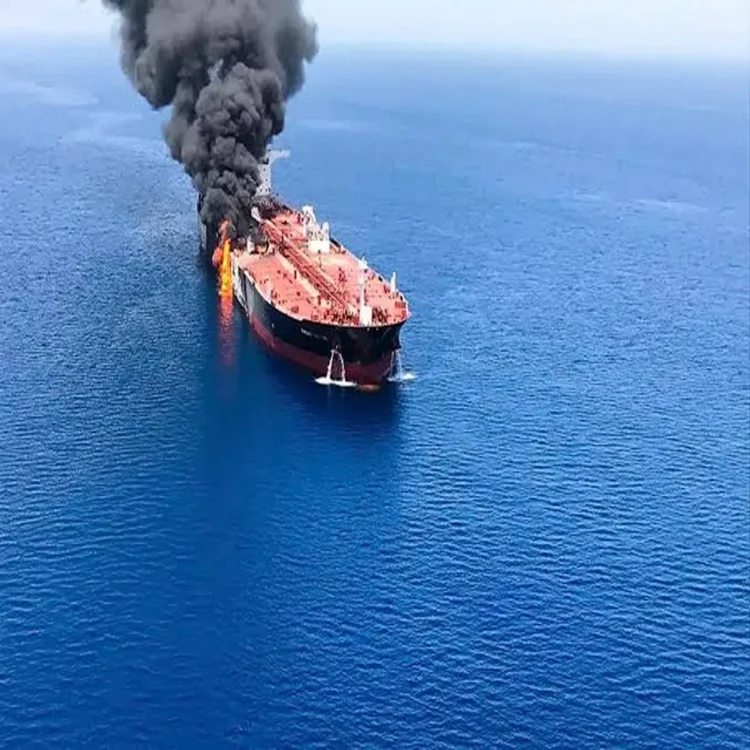
The United Kingdom Maritime Trade Operations agency said the vessel was hit on its port side about eight nautical miles east of Limah, Oman. The incident was reported on Tuesday through the agency’s official X account.
No casualties or pollution reported
According to UKMTO, there were no reported injuries among the crew and no environmental damage was immediately identified. Authorities have begun examining the circumstances surrounding the incident.
The agency advised ships operating in the region to remain alert while passing through nearby waters. It also asked vessel operators to promptly report any unusual or suspicious activity.
The tanker incident comes at a time of heightened diplomatic and military tensions around the Strait of Hormuz, a strategically important shipping route used by energy and commercial vessels travelling between the Persian Gulf and international markets.
Iran criticises Germany over Hormuz remarks
Separately, Iranian Foreign Ministry spokesperson Esmaeil Baghaei criticised Germany after comments made by German Foreign Minister Johann Wadephul regarding the Strait of Hormuz.
Baghaei accused Berlin of supporting military action against Iran and described Wadephul’s remarks as a serious misrepresentation of the situation. In a post on X, he said Germany should be held accountable for what Tehran considers its support for aggression against Iran.
The Iranian spokesperson’s comments followed Wadephul’s statement that Iran should be responsible for removing mines from international shipping routes. According to Al Jazeera, the German foreign minister alleged that Tehran had unlawfully placed mines in a key maritime passage.
Wadephul reportedly said that Germany did not need to offer concessions to Tehran, arguing instead that Iran had a responsibility to restore safe passage for international shipping.
Tehran warns against foreign military activity
Iranian Deputy Foreign Minister Kazem Gharibabadi had also issued a warning on July 4 against military activity by countries outside the region in the Strait of Hormuz.
Responding to a joint statement by UK Prime Minister Keir Starmer and French President Emmanuel Macron, Gharibabadi said the waterway should not be used for military demonstrations by external powers.
He said Iran viewed itself as a key guarantor of security in the Strait of Hormuz and would closely monitor military movements in the area. Gharibabadi added that countries responsible for creating tensions would face consequences for their actions.
His statement underlined Tehran’s position that security in the strategic waterway should be handled by countries located along its coastline rather than by outside military powers.
UK, France and Oman stress safe navigation
The joint UK-France statement said Oman had agreed to work with both countries to support safe navigation within its territorial waters.
It described the Strait of Hormuz as a crucial route for the global economy and said restoring secure passage for vessels of all nationalities was an international priority.
The statement noted that uninterrupted maritime movement through the strait remains important for global trade, particularly for oil and gas shipments moving from Gulf producers to overseas markets.
Iran rejects regional security summit
Earlier, on July 2, Iran criticised a US-led regional security summit held in Bahrain. Tehran rejected what it described as Western efforts to shape security arrangements in the Persian Gulf and the Strait of Hormuz.
Gharibabadi said a military gathering in Bahrain could not establish legal order or long-term security in the region. He also challenged the role of the US military command structure, maintaining that Iran has a central role in matters concerning Hormuz.
The reported tanker fire near Oman is now being investigated as regional governments continue to exchange sharp statements over maritime security, military deployments and freedom of navigation in one of the world’s most sensitive sea lanes.