
Spaceflight – Artemis II Crew Sets New Distance Record During Lunar Flyby
Spaceflight – The Artemis II mission marked a significant step forward in human space exploration as astronauts completed a close flyby of the Moon and began their journey back to Earth.
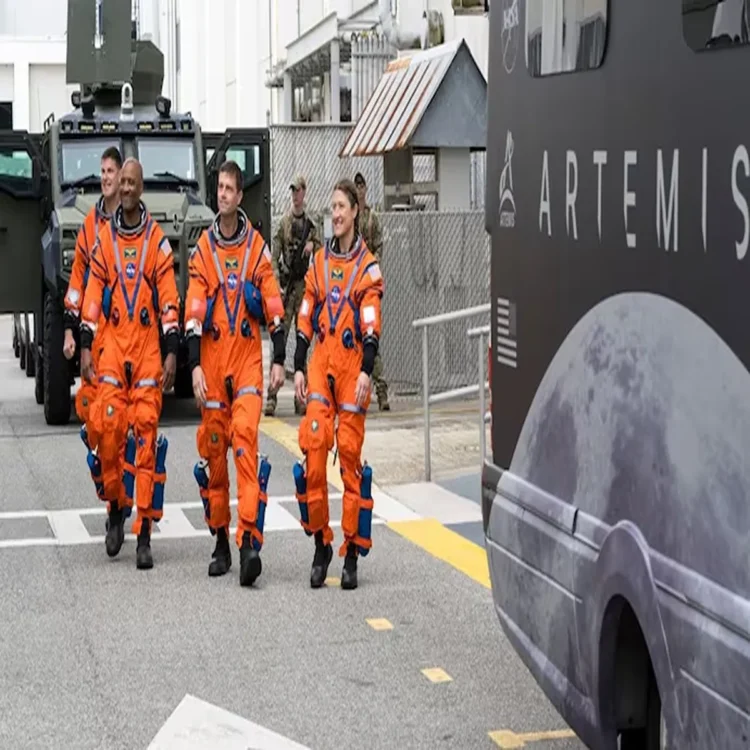
The crew of NASA’s Artemis II mission successfully concluded a critical phase of their journey as they navigated around the far side of the Moon and turned their spacecraft toward Earth. The flyby, which lasted several hours, offered the astronauts rare and detailed views of regions of the Moon that remain unseen from Earth. The mission represents a major advancement in NASA’s renewed efforts to send humans back to the lunar surface after decades.
Record-breaking distance achieved during mission
During the flyby, the Artemis II spacecraft surpassed the previous human distance record set by Apollo 13 in 1970. The crew traveled more than 252,000 miles away from Earth, setting a new benchmark for human spaceflight. This achievement came just before the astronauts began their closest approach to the Moon, marking a defining moment in the mission.
Astronaut Jeremy Hansen expressed amazement at the clarity and scale of the lunar landscape, describing the experience as unforgettable. The crew emphasized that future missions should aim to push these limits even further.
Emotional moments and symbolic gestures
Shortly after breaking the record, the astronauts proposed naming two newly observed lunar craters. One was suggested to carry the name of their spacecraft, while the other was dedicated to a personal loss experienced by mission commander Reid Wiseman. The emotional moment brought the crew together as they reflected on both scientific progress and personal memories.
The astronauts also captured extensive imagery of the Moon and Earth, using both professional cameras and handheld devices. Their observations are expected to provide valuable data for scientists studying lunar geology and future landing sites.
Following a historic trajectory path
The mission followed a free-return trajectory, a path that uses the gravitational pull of the Earth and Moon to guide the spacecraft without requiring significant fuel consumption. This same approach was used during the Apollo 13 mission, allowing astronauts to safely return to Earth after an in-flight emergency.
As the spacecraft moved behind the Moon, communication with Earth was temporarily lost for around 40 minutes. During this period, the crew reached their closest distance to the lunar surface and began their return journey. The spacecraft is expected to splash down in the Pacific Ocean after completing the multi-day trip back.
Scientific observations and exploration goals
The Artemis II astronauts dedicated much of their mission time to scientific observation. They focused on key lunar features, including a massive impact basin known for its distinct ring formations. The crew also observed previous Apollo landing sites and areas near the Moon’s south pole, which is considered a prime location for future missions.
In addition to lunar observations, the astronauts were able to view several planets and witness a solar eclipse from space. These observations add further value to the mission’s scientific contributions.
NASA scientists anticipate receiving thousands of images and detailed reports from the crew, which will support planning for upcoming missions.
Preparing for future lunar landings
Artemis II is the first crewed lunar mission by NASA since the Apollo era ended in the early 1970s. It serves as a precursor to future missions that aim to establish a sustained human presence on the Moon. Upcoming missions will test docking procedures and eventually lead to astronauts landing near the lunar south pole.
The mission also carries symbolic significance, drawing inspiration from earlier lunar missions while introducing new technology and international collaboration. With astronauts from both the United States and Canada onboard, Artemis II reflects a broader global effort in space exploration.
As the crew continues their journey home, the mission stands as a reminder of humanity’s ability to explore beyond Earth and work collectively toward ambitious scientific goals.