
NATO – Trump Questions Alliance Support During Iran Crisis Talks
NATO – US President Donald Trump said he was dissatisfied with the response of several NATO allies during the military confrontation involving Iran, describing the crisis as a measure of whether alliance members would support Washington in a major security emergency.
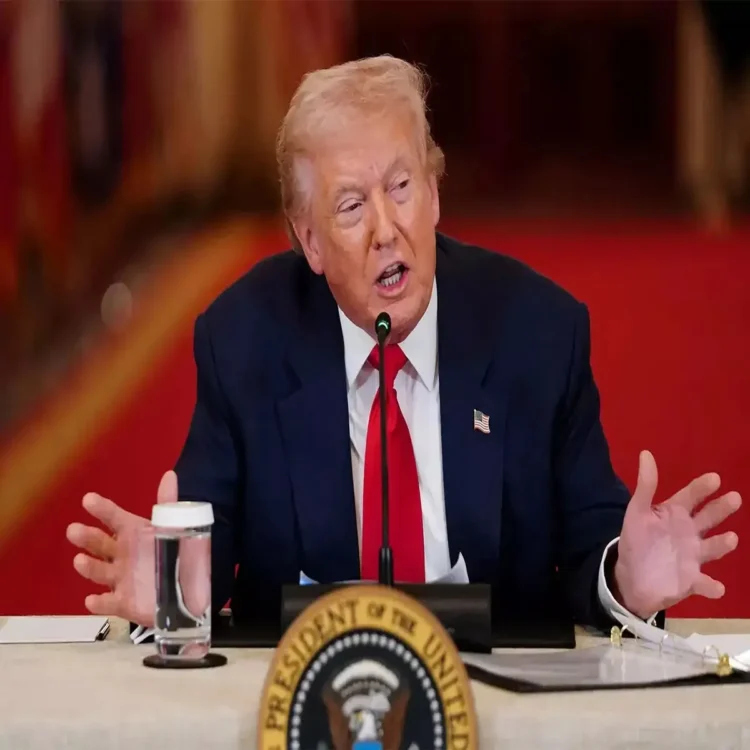
Trump made the remarks on Tuesday while speaking with reporters during a bilateral meeting with Turkish President Recep Tayyip Erdogan before the NATO leaders’ summit in Ankara. He said recent disagreements over military cooperation had reinforced doubts he has expressed for years about the reliability of America’s closest allies.
Longstanding doubts over NATO commitments
Trump has frequently questioned whether European partners contribute enough to collective security and whether they would stand with the United States when needed. His latest comments suggested that the Iran crisis had brought those concerns into sharper focus.
According to Trump, some allied governments declined to allow US forces to use their air bases for operations against Iranian targets. He also criticised countries that did not send military resources to help secure the Strait of Hormuz, a key global shipping route for oil and other energy supplies.
“We didn’t need any help at all, and in a way, I was testing people,” Trump told reporters. “I was testing to see whether or not they’d be there because I’ve long said that we helped them, but I’m not sure that they’d be there for us.”
The comments came as NATO leaders gathered in Turkey for discussions expected to include the regional fallout from the Iran conflict, defence spending and wider questions about collective responsibility within the alliance.
Italy dispute adds to tensions
Trump also referred to his differences with Italian Prime Minister Giorgia Meloni, saying Italy’s position on the Strait of Hormuz had affected their relationship. He said Meloni had declined to support Washington’s approach in the region, though he added that he continued to regard her positively on a personal level.
“She refused to get involved with the Hormuz Strait, or you could also say just Iran,” Trump said. “So it soured my relationship with her a little bit. But I like her. I think she’s a nice person. But I think she made a mistake.”
The US president argued that Italy’s dependence on energy imports from the Gulf made its decision especially significant. He contrasted that position with the United States, which he said has substantial domestic oil resources.
“We have a lot of oil,” Trump said. “The United States has more oil than anybody. And when you add Venezuela to it, it’s like we have far more oil than anybody. We don’t need the straits.”
He said Washington’s involvement was based on what it viewed as a broader strategic need rather than a direct dependence on the waterway.
Criticism of European leaders
In recent weeks, Trump has also publicly criticised several European leaders over their handling of the Iran situation. His remarks have included comments directed at Meloni and UK Prime Minister Keir Starmer, as well as frustration with efforts by NATO Secretary-General Mark Rutte to maintain close coordination with the White House.
Trump’s criticism has renewed debate over the future direction of US-NATO relations. The alliance has relied heavily on American military power since its creation after the Second World War, while successive US administrations have urged European members to increase their defence capabilities and spending.
Turkey praised for regional role
During the Ankara meeting, Trump praised Erdogan and Turkish officials for their understanding of regional tensions and for their involvement in diplomatic efforts aimed at reducing the conflict.
“They know Iran very well, and they know the problems with Iran,” Trump said of Turkey. “They’ve been very instrumental, along with a couple of other countries, in helping.”
Trump described the US action against Iran as a military operation focused on preventing Tehran from developing nuclear weapons, rather than as a conventional war. He said Turkey had the military capacity to become directly involved but had chosen not to do so.
“He could have gotten into the fight,” Trump said, calling Turkey “a very powerful military nation.”
Trump also said he believed Erdogan shared Washington’s objective of preventing Iran from obtaining a nuclear weapon. “I don’t think he wants to see them have a nuclear weapon either,” Trump said. “I’m pretty sure of that. In fact, I’m totally sure of that.”