
Indo-Pacific – India and Japan Advance Quad, Energy and Supply Chain Cooperation
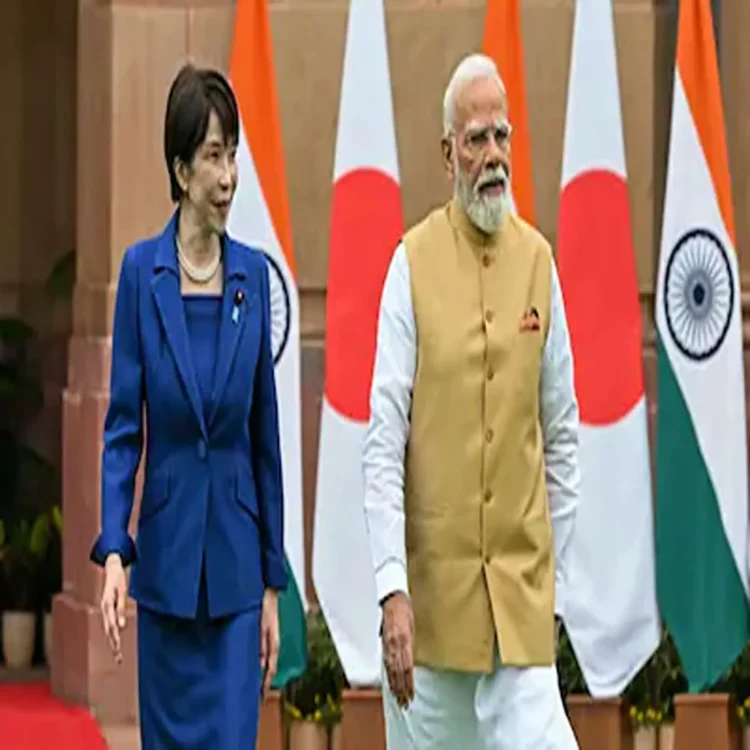
Indo-Pacific – India and Japan have renewed their support for the Quad partnership, with Prime Minister Narendra Modi and Japanese Prime Minister Sanae Takaichi outlining a shared approach to security, economic resilience and stability in the Indo-Pacific. The two leaders also agreed to speed up preparations for the next Quad Leaders’ Summit during bilateral discussions held in India.
Bilateral partnership linked to wider Quad agenda
A joint statement issued after the talks said stronger cooperation between New Delhi and Tokyo would contribute to the Quad’s wider work in the region. The Quad, which brings together India, Japan, Australia and the United States, has increasingly focused on practical initiatives involving security, technology, infrastructure and disaster response.
Modi and Takaichi said their countries would expand cooperation in four key areas: maritime and cross-border security, economic prosperity including critical minerals, critical and emerging technologies, and humanitarian assistance. The discussions reflected a broader effort by both governments to address regional challenges through partnerships with other like-minded countries.
Support reiterated for ASEAN’s regional role
The two prime ministers again expressed support for ASEAN unity and centrality in the Indo-Pacific. They also endorsed the ASEAN Outlook on the Indo-Pacific, describing it as an important framework for encouraging peace, openness and cooperation across the region.
India and Japan further agreed to begin preparations for a trilateral 1.5-track policy dialogue involving the Philippines. Such dialogues generally bring together government representatives, researchers and policy experts. The proposed format is expected to examine regional stability and strengthen exchanges on shared strategic concerns.
Focus on critical minerals and manufacturing resilience
Critical mineral supply chains featured prominently in the joint statement. India and Japan noted that modern manufacturing and clean-energy industries depend heavily on a limited range of suppliers for important minerals and components.
Both sides said they would work with partners and international financial institutions to reduce dependence on single-source supply networks. Their cooperation is expected to draw on initiatives such as the World Bank Group’s Resilient and Inclusive Supply-chain Enhancement Partnership and the Asian Development Bank’s Critical Minerals-to-Manufacturing Financing Partnership Facility.
The aim is to support more diverse supply routes, strengthen infrastructure and improve access to materials needed for advanced manufacturing across Asia.
Energy resilience receives fresh attention
Energy security was another major subject during the summit. The leaders agreed to explore possible joint investments and other forms of cooperation across the maritime energy transport chain.
They referred to several regional efforts intended to improve energy resilience, including Japan’s Partnership On Wide Energy and Resources Resilience, India’s support for energy security in South Asia, and the Quad Initiative on Indo-Pacific Energy Security. The two sides also welcomed the adoption of a Joint Statement on Energy Resilience.
India and Japan will additionally deepen cooperation on strategic petroleum reserves. Their plans include technical exchanges and sharing best practices on maintaining emergency oil stockpiles, which are used to help countries manage disruptions in global energy supplies.
Japan backs India’s IEA membership aspiration
During the discussions, Takaichi expressed Japan’s support for India becoming a full member of the International Energy Agency. India is currently an association country of the Paris-based organisation, which works with governments on energy policy, supply security and clean-energy transitions.
The commitment came during Takaichi’s three-day official visit to India from July 1 to July 3. She attended the 16th India-Japan Annual Summit, where the two leaders reviewed bilateral cooperation and exchanged views on regional and international developments.
Takaichi also joined Modi at the India-Japan Business Forum, highlighting the role of private investment and commercial partnerships in expanding economic ties between the two countries.