
Economy – Markets React Sharply After PM Modi Warns of Global Crisis Risks
Economy – Prime Minister Narendra Modi’s appeal for financial restraint amid escalating tensions linked to the Iran conflict triggered widespread reactions across India’s financial markets and corporate sector on Monday.
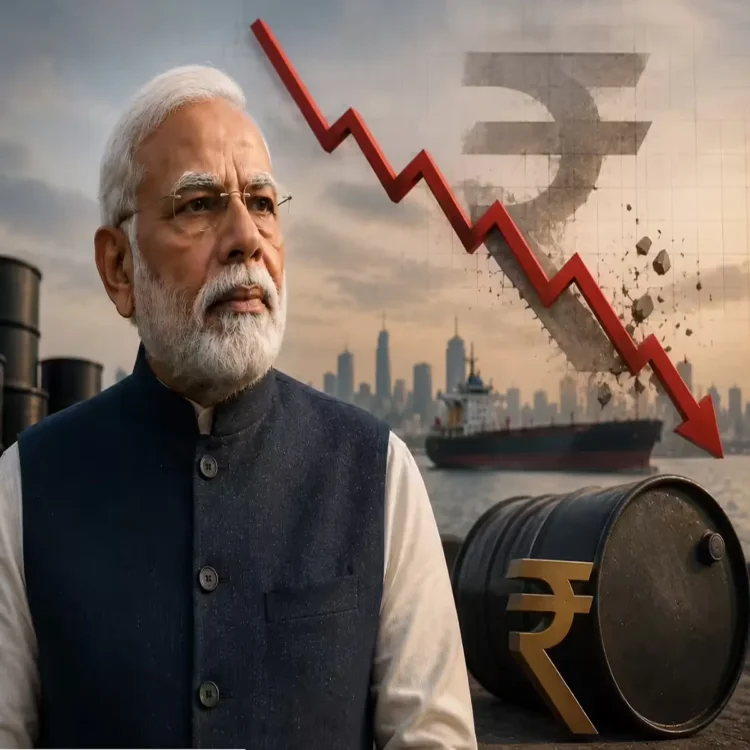
Indian benchmark indices witnessed heavy selling pressure after investors interpreted the Prime Minister’s remarks as a warning of possible economic turbulence in the coming months. The domestic currency also weakened significantly against the US dollar, reflecting growing concerns over rising import costs and external financial pressures.
Stock Markets and Rupee Register Sharp Decline
The BSE Sensex dropped 1,312.91 points, ending the session at 76,015.28, while the NSE Nifty50 closed 360.30 points lower at 23,815.85. The decline erased more than 1.5% of investor wealth during the trading session as market sentiment turned cautious following the government’s comments on global disruptions.
The Indian rupee also came under intense pressure. After losing considerable ground over the past year, the currency slipped another 82 paise on Monday to close at a record low of 95.31 against the US dollar. Currency dealers attributed the fall to concerns over rising oil prices, higher import bills and fears of prolonged instability in West Asia.
PM Calls for Financial Prudence
During a public address in Hyderabad on Sunday, Prime Minister Narendra Modi urged citizens and businesses to adopt measures aimed at reducing economic strain during uncertain global conditions. Referring to supply chain disruptions, inflationary risks and geopolitical instability, he appealed for collective participation to strengthen the country’s resilience.
Among the suggestions made by the Prime Minister were reducing unnecessary foreign travel, limiting gold purchases and lowering fuel consumption. He also encouraged companies to consider work-from-home systems wherever feasible, similar to the arrangements widely adopted during the Covid-19 period.
The comments immediately sparked discussions in financial circles, with many investors interpreting them as signals that the government may soon introduce measures to manage rising economic stress.
Fuel Pricing Concerns Intensify
Speculation over a possible increase in retail fuel prices gained momentum after the Prime Minister’s remarks on reducing petrol and diesel usage. Later in the day, the petroleum ministry stated that state-run oil marketing companies are expected to face under-recoveries amounting to nearly ₹2 lakh crore during the first quarter of FY27.
The ministry added that the government is currently reviewing fuel pricing trends in view of global crude oil volatility and increasing pressure on public sector energy firms.
India remains heavily dependent on imported crude oil, making the economy vulnerable to geopolitical tensions in major oil-producing regions. Petroleum imports touched nearly $172 billion in FY26, continuing to place significant pressure on the country’s external balance.
Rising Gold Imports Add to Economic Pressure
Apart from fuel imports, the government is also monitoring the sharp increase in gold purchases. Official figures show India’s gold imports surged 24% to around $72 billion in FY26.
Analysts have linked part of this increase to the free trade agreement with the UAE, under which gold imports reportedly climbed sharply from nearly $3 billion in 2022 to approximately $16.5 billion in 2025.
India’s foreign exchange reserves, which are used to manage external payment obligations and support currency stability, stood at $690 billion during the week ending May 1. The reserves had earlier reached a peak of $728 billion in late February.
Industry Groups Respond to PM’s Remarks
Technology industry body Nasscom said several companies had already implemented remote and hybrid work systems to optimise operational efficiency and reduce commuting-related energy usage. The organisation indicated that many firms continue to support flexible work arrangements where business operations permit.
Corporate leaders also acknowledged concerns arising from the growing Gulf crisis. Bharti Enterprises chairman Sunil Mittal stated that the evolving geopolitical situation has increased pressure on economies worldwide, including India, and businesses are closely monitoring developments.