
Diplomacy – Modi Begins Israel Visit to Expand Strategic Cooperation
Diplomacy – Indian Prime Minister Narendra Modi arrived in Israel on Wednesday for a two-day visit aimed at reinforcing bilateral ties across security, trade, and advanced technology sectors. The trip, undertaken at the invitation of Israeli Prime Minister Benjamin Netanyahu, underscores the steady expansion of cooperation between the two countries over the past decade.
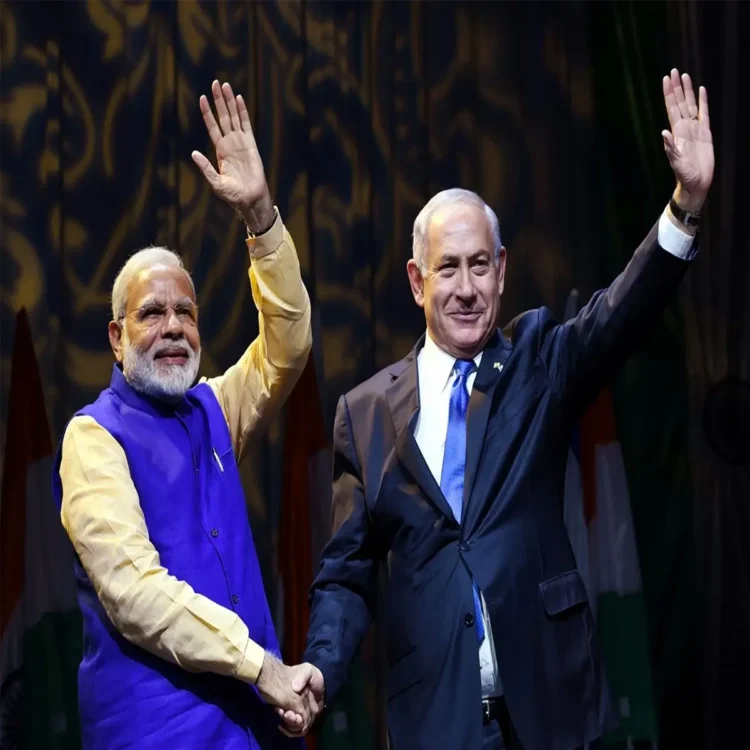
In a statement issued before departure, Modi described the India–Israel relationship as a strong and evolving strategic partnership. He said discussions with Netanyahu would focus on widening collaboration in areas such as defence, innovation, agriculture, water management, and investment. The visit also includes an address to Israel’s Parliament, the Knesset, marking the first time an Indian prime minister has been invited to speak before the legislative body.
High-Level Talks to Focus on Security and Innovation
The central agenda of the visit includes defence coordination, economic engagement, and emerging technologies. Israeli officials have indicated that subjects such as artificial intelligence, quantum computing, and joint research initiatives will feature prominently in the discussions.
Netanyahu, speaking ahead of the visit, referred to Modi as a close friend and highlighted the shared strategic outlook between the two nations. In recent public remarks, he described India and Israel as partners committed to innovation, stability, and technological advancement.
The meeting comes at a sensitive time for Israel’s international relations, following months of diplomatic strain linked to the conflict in Gaza that began in October 2023. Analysts suggest that Modi’s visit could carry symbolic importance for Israel, reinforcing ties with a major Asian partner during a period of heightened global scrutiny.
Expanding Economic Engagement
Trade remains a cornerstone of the India–Israel partnership. According to India’s Ministry of Commerce and Industry, bilateral trade reached approximately $3.62 billion in the 2025 fiscal year. India is currently Israel’s second-largest trading partner in Asia, reflecting growing economic interdependence.
Both governments are expected to explore avenues to increase investment flows and enhance cooperation in sectors such as renewable energy, cybersecurity, and agricultural technology. Israeli expertise in water conservation and drip irrigation systems has already contributed to projects in several Indian states, while Indian firms have expanded their footprint in Israel’s technology ecosystem.
Officials from both sides have emphasized that economic collaboration complements longstanding defence ties, which have historically formed the backbone of the relationship.
Diplomatic Context and Historical Ties
Modi’s visit also reflects the transformation of India’s approach toward Israel over the past three decades. Although India formally established diplomatic relations with Israel in 1992, earlier governments maintained a cautious distance due to domestic political considerations and support for the Palestinian cause.
The trajectory shifted significantly after Modi took office. In 2017, he became the first Indian prime minister to travel to Israel, a visit that signaled a more open engagement. Netanyahu returned the gesture with a state visit to India the following year, reinforcing momentum in bilateral relations.
At the same time, India has continued to articulate support for a two-state solution in the Israel–Palestine conflict. Following the October 7, 2023 attacks carried out by Hamas, Modi was among the early world leaders to express solidarity with Israel. However, India also joined over 100 countries earlier this month in voicing concern over Israeli measures related to the occupied West Bank and the Palestinian Authority, reflecting a calibrated diplomatic position.
Strengthening People-to-People Links
Beyond official meetings, the visit is expected to promote academic exchanges, tourism, and collaboration between startups and research institutions. Both governments have highlighted the importance of people-to-people engagement in sustaining long-term ties.
As the two leaders convene for talks, observers note that the visit reinforces a partnership increasingly defined by technological cooperation and strategic alignment. With shared interests in innovation, defence, and economic growth, India and Israel appear poised to broaden their collaboration in the years ahead.