
Ram Sutar: Sculptor who gave India its tallest tribute, dies at 100
Ram Sutar: a renowned sculptor whose creations helped define contemporary India’s visual identity and whose creative vision gave Gujarat’s Statue of Unity its shape, died at his home in Noida.
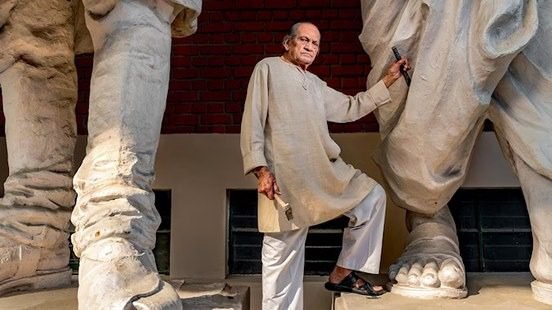
Sutar was one hundred. According to family reports, age-related illnesses caused his death. A pivotal period in Indian monumental painting came to an end with his passing.
Following the announcement of his passing, condolences flooded in from all around the nation. Prime Minister Narendra Modi and President Droupadi Murmu expressed their respects, calling him an artist whose works preserved India’s heritage and ideals.
His passing was described by leaders and cultural organizations as an irreversible loss to the country’s creative legacy. Ram Sutar leaves behind a remarkable legacy etched on India’s terrain, as well as his family.
His sculptures, which are displayed in public areas, institutional structures, and city centers, continue to engage with daily life and subtly tell a country’s narrative.
Born in Gondur hamlet in Maharashtra’s Dhule district on February 19, 1925, Ram Sutar ascended from modest beginnings to become the most prominent public sculptor in the nation.
After receiving his training at Mumbai’s Sir J.J. School of Art, where he was awarded a gold medal, Sutar spent more than 70 years creating sculptures that came to represent India’s political, cultural, and historical awareness.
The monument of Unity, a massive monument of Sardar Vallabhbhai Patel at Kevadia, Gujarat, is Sutar’s most well-known work.
At 182 meters, it is the world’s tallest statue and a landmark that has completely changed India’s place in the world’s monumental architecture.
The task of transforming Patel’s status as the architect of India’s union into a shape that blended authority, realism, and restraint fell to Ram Sutar, the statue’s principal sculptor and conceptual designer.
Sutar stressed on realism in contrast to abstract monumental traditions, making sure that Patel’s stance, expression, and clothing communicated determination without being aggressive. Patel is seen in the monument pushing ahead, signifying determination and leadership.
Sutar personally managed the creative details despite the project’s extraordinary size, collaborating closely with engineers and designers to maintain human expression and proportional accuracy. He remained involved far into his 1990s, demonstrating his enduring dedication to fine workmanship.
Since its inauguration in 2018, the Statue of Unity—which also serves as the creative pinnacle of Sutar’s career—has grown to become a key tourist destination for Gujarat and a symbol of national pride. The statue’s success, according to art historians, is due to both its engineering and its sculptural coherence, which is uncommon at this size.
at addition to the Statue of Unity, Ram Sutar’s artwork may be seen at well-known public areas both domestically and overseas. The equestrian monument of Chhatrapati Shivaji Maharaj outside Parliament House, the famous statue of Mahatma Gandhi outside the Indian Parliament, and statues of national luminaries like V.D. Savarkar and B.R. Ambedkar are examples of his works.
His sculptures, which eschew excess while maintaining a powerful presence, are renowned for their dignity, balance, and emotional restraint.
Sutar was awarded several distinguished honors for his contributions to Indian art, including the Padma Bhushan in 2016 and the Padma Shri in 1999. In recognition of his lifelong contributions to public art, he was also given the Maharashtra Bhushan, the state’s highest civilian honor.
The Statue of Unity and his many other creations serve as timeless recollections of an artist who turned stone and metal into symbols of shared remembrance as India laments his departure.