
RahulGandhi – BJP Stages Black Flag Protest During Mumbai Visit
RahulGandhi – Bharatiya Janata Party supporters demonstrated with black flags against Congress leader Rahul Gandhi during his visit to Mumbai on Saturday, intensifying the ongoing political confrontation between the ruling party and the Opposition.
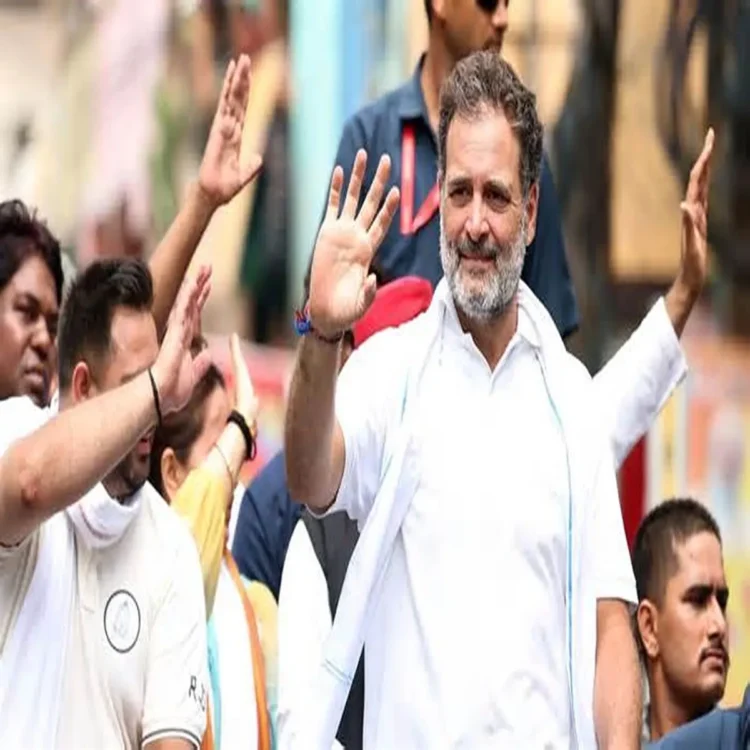
Gandhi arrived in the city early in the day at Chhatrapati Shivaji Maharaj International Airport before heading by road to Bhiwandi in neighboring Thane district. His visit was linked to his scheduled appearance before a local court in connection with a defamation case dating back to 2014.
Protest Erupts at Mulund Toll Naka
As Gandhi’s convoy moved through the city, a group of BJP workers assembled at the Mulund toll naka, waving black flags and chanting slogans directed at the Congress leader. The demonstration was positioned by the protesters as a response to what they described as recent actions by the Youth Congress during the AI Summit.
Several BJP supporters speaking at the site claimed that Gandhi routinely criticizes initiatives undertaken by Prime Minister Narendra Modi, including those concerning national matters. They alleged that slogans raised by Youth Congress members at the AI Summit had cast the country in a negative light internationally, prompting Saturday’s protest.
Police maintained a visible presence at the location and along Gandhi’s route to prevent any direct confrontation between party workers. Security arrangements were heightened in anticipation of potential tensions between supporters of the ruling BJP and the Opposition Congress.
Congress Calls Protest a Political Distraction
Reacting to the incident, Congress leader Sachin Sawant dismissed the protest as a calculated attempt to shift attention away from what he described as pressing national concerns. He argued that the ruling party was engaging in public theatrics instead of addressing substantive issues facing the country.
Sawant questioned the BJP’s stance on international matters, including its approach to relations with former US President Donald Trump. He also raised concerns related to financier Jeffrey Epstein, asserting that the government owed greater transparency to citizens.
According to Sawant, such protests were designed to dominate headlines rather than provide answers on economic and governance-related challenges.
Allegations Over Trade and Farmers’ Interests
In addition to his criticism of the protest, Sawant accused the BJP of compromising the interests of farmers in Maharashtra and across India. He referred to a trade agreement with the United States, alleging that agricultural stakeholders had been placed at a disadvantage. The ruling party has not issued an immediate response to those specific claims.
The exchange underscores the broader political contest unfolding in Maharashtra, where both parties are seeking to consolidate public support amid ongoing national debates on economic policy and governance.
NCP (SP) Terms Protest Disrespectful
The Nationalist Congress Party (Sharad Pawar faction) also condemned the black-flag demonstration. Manoj Pradhan, the party’s Thane city chief, described the act as inconsistent with democratic principles.
He emphasized that Rahul Gandhi serves as the Leader of the Opposition in the Lok Sabha and holds a constitutional position. According to Pradhan, displaying black flags against an elected representative in this manner diminishes the decorum expected in a parliamentary democracy.
Pradhan further stated that Gandhi frequently raises issues affecting ordinary citizens and should be engaged through debate rather than symbolic protest.
Heightened Political Atmosphere
Saturday’s developments reflect the charged political environment ahead of key electoral battles. Public demonstrations, counter-allegations, and strong rhetoric have become common features of interactions between the BJP and Congress.
While the protest concluded without any reported clashes, the sharp exchange of statements from both sides suggests that political tensions are likely to continue in the coming weeks. As parties sharpen their strategies, public events such as Gandhi’s court appearance are increasingly becoming flashpoints in the broader contest for political narrative.