
Defense – India commissions third nuclear submarine to boost deterrence strength
Defense – India has taken a significant step in strengthening its maritime defense posture by inducting its third nuclear-powered ballistic missile submarine, INS Aridhaman. The development marks a notable advancement in the country’s efforts to ensure a continuous and credible nuclear deterrent at sea, reinforcing a critical component of its strategic defense framework.
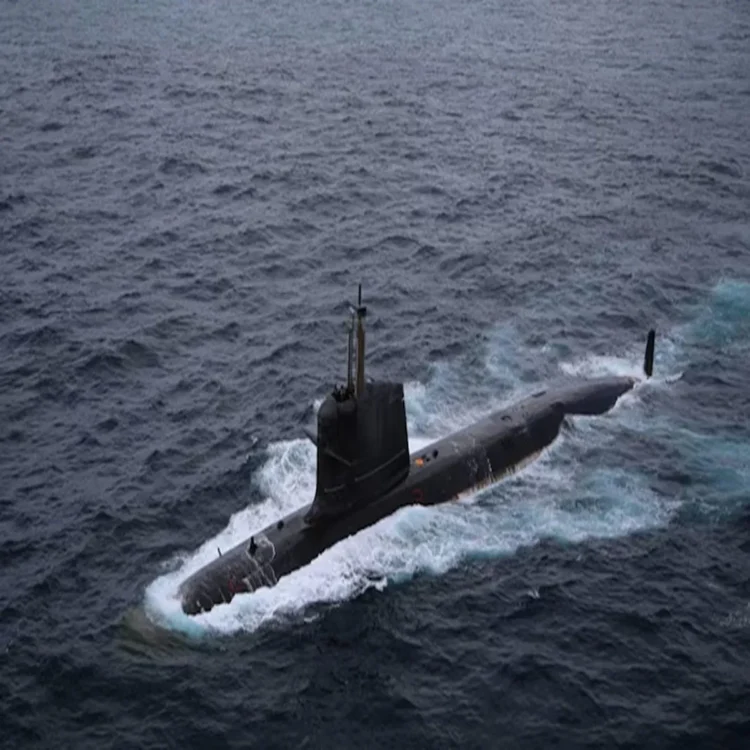
Induction signals progress in nuclear deterrence strategy
The commissioning of INS Aridhaman follows the earlier induction of INS Arihant in 2016 and INS Arighaat in 2024. With three such submarines now operational, India has reached an important milestone in maintaining a sustained presence underwater. This capability allows at least one submarine to remain on active patrol while others undergo routine maintenance or crew training, ensuring uninterrupted deterrence readiness.
Earlier in the day, Defence Minister Rajnath Singh hinted at the development through a brief social media message, suggesting the importance of the induction without disclosing operational details.
Capabilities of INS Aridhaman
INS Aridhaman is estimated to have a displacement ranging between 6,500 and 7,000 tonnes. It is designed to carry a mix of submarine-launched ballistic missiles, including up to eight K-4 missiles or a larger number of shorter-range K-15 missiles, depending on mission requirements.
Submarines of this class are considered a key element of a nation’s second-strike capability due to their ability to remain hidden underwater for extended periods. Their stealth and survivability make them central to India’s policy of credible minimum deterrence and its declared no-first-use doctrine.
Current composition of India’s submarine fleet
India’s overall submarine fleet currently includes around 17 vessels. Among them are three nuclear-powered ballistic missile submarines, while the remaining are conventional diesel-electric submarines. These include platforms from the Kalvari, Kilo, and Shishumar classes, each serving different operational roles within the navy.
The addition of Aridhaman enhances the strategic arm of the fleet, complementing conventional submarines that are primarily tasked with surveillance, coastal defense, and tactical missions.
Future submarine programs under development
India is also working on next-generation nuclear submarines to further strengthen its underwater capabilities. Plans include the development of an improved S4 variant and the larger S5-class submarines. These future platforms are expected to be equipped with longer-range missiles, enabling them to cover targets across a wider geographic area.
At the same time, efforts are underway to develop nuclear-powered attack submarines under Project 77. Unlike ballistic missile submarines, which are designed for strategic deterrence, attack submarines are built for offensive operations, including tracking enemy vessels and securing sea lanes.
Need for nuclear-powered attack submarines
Currently, India does not operate a nuclear-powered attack submarine of its own. In the past, the navy leased an Akula-class submarine from Russia, and discussions are ongoing for another lease under the Chakra III arrangement. These submarines serve as an interim solution while indigenous development continues.
Attack submarines play a crucial role in modern naval warfare. Equipped with torpedoes and cruise missiles, they are designed for anti-submarine warfare and maritime dominance, complementing the strategic role of ballistic missile submarines.
Regional comparison highlights strategic competition
In comparison, China maintains a significantly larger and more advanced underwater fleet. It operates several Jin-class ballistic missile submarines along with multiple nuclear-powered attack submarines and a sizable conventional fleet exceeding 50 vessels.
Pakistan, on the other hand, does not possess nuclear-powered submarines. However, it is working towards a limited sea-based deterrent by adapting nuclear-capable cruise missiles for deployment on its existing submarines and inducting new diesel-electric platforms with foreign collaboration.
The induction of INS Aridhaman reflects India’s continued focus on strengthening its naval capabilities in a region where undersea competition is steadily intensifying.