
US: analysts inform legislators that India exhibits “stiffest resistance” to China’s pressure
US: specialists on South Asia told Congress that India has shown the “stiffest resistance” to China’s increasing assertiveness in the Indo-Pacific.
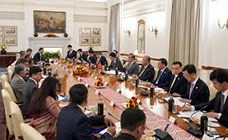
These experts highlighted growing bipartisan concern in Washington over Beijing’s attempts to dominate the region militarily, economically, and digitally during a closely watched hearing of the House Foreign Affairs Subcommittee on South and Central Asia on the US–India strategic partnership on Wednesday (local time).
India “has engaged in… stopping Chinese coercion at their border,” Jeff Smith of the Heritage Foundation told the panel, describing New Delhi’s responses as some of the most forceful actions done by any of China’s neighbors. He said that, in contrast to us, TikTok was able to prohibit the app almost overnight. He went on to say that India “imposed severe restrictions on Chinese investments… that could pose security risks” and “banned dozens of Chinese apps.”
China’s “string of pearls ideology is… an overt attempt to encircle and control the Indian Ocean,” said Committee Chairman Bill Huizenga. He said that India’s strategic position and increasing naval might made it essential to preserving a free and open Indo-Pacific, saying that this expansion “is no longer just a theory.”
Lawmakers were reminded of the 2020 border conflicts by Dhruva Jaishankar of ORF America, who pointed out that China’s mobilization “resulted in clashes in which 20 Indian military personnel lost their lives.” He said that Beijing’s growing military presence, which includes new unmanned and cyber capabilities as well as nuclear modernization, together with its foreign port network, might “be used to secure critical choke points.”
Smith said that Washington needs to bolster India’s maritime posture from the Andaman and Nicobar Islands to the Western Pacific, strengthen New Delhi’s capabilities, and expand information cooperation. He informed MPs that “India has shown the stiffest resistance.” “The location of India between China and the United States is very important.”
Despite recent trade tensions, witnesses cautioned that Beijing’s actions are bringing India and the US closer together. Smith said, “This continues to be a low-cost, high-benefit partnership for the United States.”
The evidence revealed a rare consensus: the US-India alliance is growing as one of Washington’s most important instruments to resist China’s ongoing military pressure.
According to Huizenga, China has recently disclosed new unmanned and cyber technologies, increased and modernized its nuclear weapons, and carried out one of the biggest naval buildups in its history.
A significant PLA mobilization in 2020 led to conflicts that claimed the lives of 20 Indian military men. Additionally, China has established a network of potentially dual-use ports across the Indo-Pacific region and beyond, which may be used to protect vital choke points.
According to him, the Indian Navy has responded by stepping up, speeding up patrols, and helping to share the maritime load in the Indian Ocean and Pacific.
According to Sameer Lalwani of the German Marshall Fund, the United States can maintain its long-term technology superiority and defeat China in the strategic struggle by collaborating with India. Joint US-Indian military drills, intelligence collaboration, logistical agreements, and defense co-development are all examples of defense cooperation, which is essential to counterbalancing China’s military might.