
SpaceRace – NASA’s Artemis II Launch Signals New Era in Lunar Exploration
SpaceRace – The United States has taken a significant step in its lunar ambitions with the successful launch of its first crewed Moon mission in over five decades. The Artemis II mission lifted off from Kennedy Space Center, carrying four astronauts on a planned journey around the Moon and back. The development has been widely described by political leaders and space officials as a defining moment in modern space exploration.
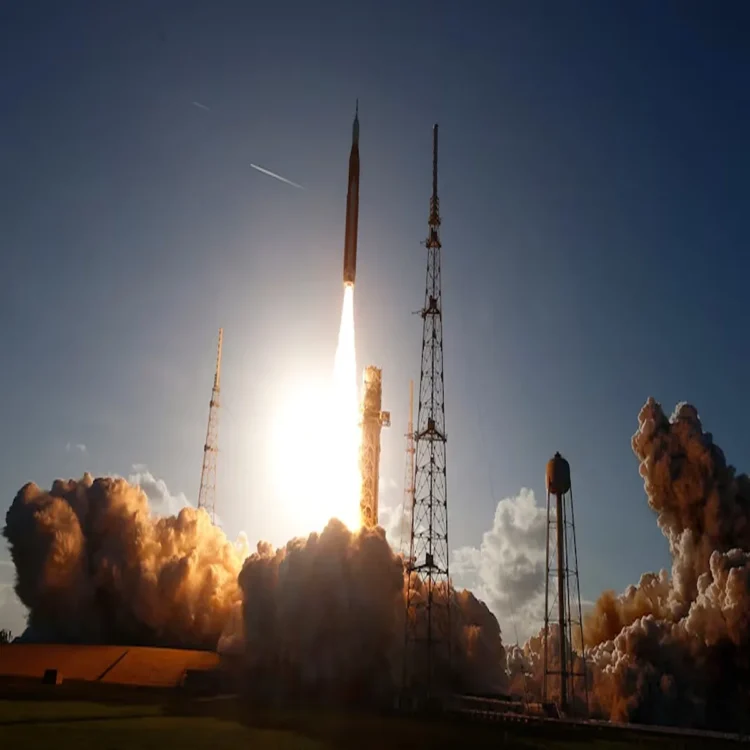
Mission Launch Marks Historic Return
The Space Launch System rocket departed at 6:35 p.m. Eastern Time, sending astronauts Reid Wiseman, Victor Glover, Christina Koch, and Canadian astronaut Jeremy Hansen into orbit aboard the Orion spacecraft. The mission is scheduled to last around ten days, during which the crew will travel around the Moon before returning safely to Earth.
Shortly after liftoff, Orion successfully deployed its solar panels and transitioned into operational flight mode. Engineers began closely monitoring onboard systems as the spacecraft settled into an elliptical orbit around Earth, marking the early success of key mission phases.
Leaders Highlight Strategic Importance
US President Donald Trump praised the mission during a national address, calling it an “amazing achievement” and commending both NASA’s team and the astronauts involved. Lawmakers also emphasized the broader implications of the mission, viewing it as part of a larger global competition in space exploration.
Senate Commerce Committee Chairman Ted Cruz noted that Artemis II reflects the United States’ commitment to maintaining leadership in space. He pointed to increasing international competition, particularly from China, and stressed the importance of staying ahead in what he described as a rapidly evolving space race.
Similarly, Representative Zoe Lofgren acknowledged the mission’s broader impact, stating that it has the potential to inspire people worldwide and renew public interest in space science and exploration.
A Critical Test for Future Missions
NASA officials have made it clear that Artemis II is primarily a test mission. It is the first time the Orion spacecraft is carrying astronauts, making it crucial for validating life-support systems and overall performance under real mission conditions.
NASA Administrator Jared Isaacman described the launch as a pivotal moment, suggesting that it represents the beginning of a broader effort that extends beyond a single mission. According to him, Artemis II lays the foundation for future human missions to the Moon and eventually deeper space exploration.
During the mission, Orion completed key orbital maneuvers, including perigee and apogee burns to refine its trajectory. Although there was a brief communication interruption following one of the burns, it was quickly resolved, and the crew maintained contact with mission control.
Technical Checks and In-Flight Observations
Astronauts reported a minor issue involving a blinking fault indicator during routine system checks. Ground teams are currently examining the situation, though it has not affected mission progress so far.
In the coming days, the crew will perform a proximity operations test. This involves manually guiding Orion near the rocket’s upper stage to verify navigation and control systems. The test is considered essential for ensuring the safety and accuracy of future lunar landings.
NASA Associate Administrator Amit Kshatriya emphasized that the mission is still in its early stages, noting that the real evaluation lies in how the spacecraft and crew perform throughout the journey.
Preparing for Lunar Flyby and Return
If all systems continue to function as planned, Orion will carry out a translunar injection maneuver, sending the spacecraft toward the Moon. The mission includes a flyby of the Moon’s far side, a region not visible from Earth, before using lunar gravity to assist in its return.
The spacecraft is expected to conclude its journey with a controlled splashdown in the Pacific Ocean. The success of Artemis II will play a crucial role in shaping upcoming missions aimed at establishing a long-term human presence on the Moon.