
Spaceflight – Artemis II Crew Returns Safely After Historic Lunar Mission
Spaceflight – NASA’s Artemis II astronauts have safely returned to Earth after completing a landmark journey around the Moon, signaling a renewed era of human space exploration beyond low Earth orbit.
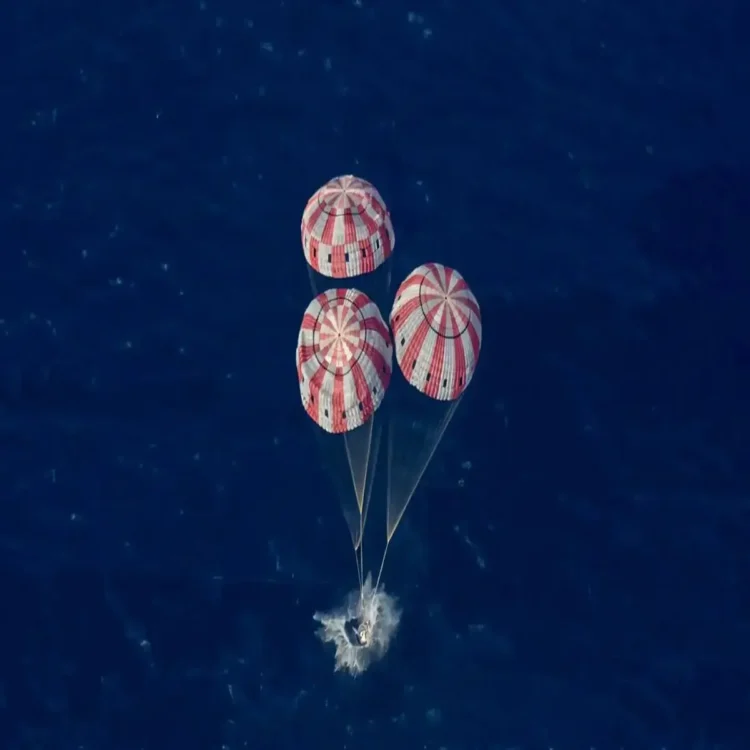
NASA confirmed that the Orion spacecraft carrying four astronauts concluded its mission with a controlled splashdown in the Pacific Ocean near the California coast on Friday evening. The landing occurred at 8:07 p.m. Eastern time, marking the end of a nearly ten-day mission that took humans farther into space than they have traveled in more than five decades. Recovery teams quickly moved in to secure the capsule and assist the crew.
Historic Return to Deep Space
The Artemis II mission represents a major step forward in human spaceflight. It is the first time since the Apollo era that astronauts have traveled beyond low Earth orbit and ventured into deep space. The crew orbited the Moon before safely returning, demonstrating critical capabilities for future missions.
The astronauts onboard included Reid Wiseman, Victor Glover, Christina Koch, and Canadian astronaut Jeremy Hansen. Their successful return highlights international cooperation and technical readiness for upcoming lunar missions. Shortly after landing, Wiseman confirmed that all four crew members were safe and stable.
Record-Breaking Journey Around the Moon
During the mission, the spacecraft reached a distance of over 252,000 miles from Earth, surpassing previous human spaceflight records. This milestone adds to the significance of the mission, reinforcing its role in shaping the future of lunar exploration.
The astronauts had the opportunity to observe the Moon’s far side—an area not visible from Earth—and study various surface features, including craters and ancient basins. These observations are expected to contribute valuable data for upcoming missions.
The mission also carried symbolic importance. Victor Glover became the first Black astronaut to travel to the Moon’s vicinity, Christina Koch the first woman, and Jeremy Hansen the first Canadian to take part in such a mission.
Technical Challenges Managed Successfully
Despite its success, the journey was not entirely free of challenges. Minor technical issues were reported during the mission, including irregularities with the onboard sanitation system and unusual smells inside the spacecraft. However, these problems were managed effectively and did not impact the mission’s overall objectives or crew safety.
NASA officials emphasized that addressing such issues during test missions is an essential part of preparing for long-duration space travel.
Intense Re-entry and Safe Recovery
One of the most demanding phases of the mission was the spacecraft’s re-entry into Earth’s atmosphere. Traveling at speeds of nearly 25,000 miles per hour, the Orion capsule encountered extreme heat levels reaching approximately 5,000 degrees Fahrenheit.
As it descended, a sequence of parachutes deployed to slow the spacecraft before it touched down in the ocean. Recovery teams approached the capsule by boat and later transported the astronauts via helicopter to a nearby naval vessel for routine medical evaluations.
Widespread Praise and Future Plans
The mission has drawn widespread appreciation from officials and experts across the United States. NASA leadership commended the years of preparation, engineering effort, and teamwork that made the mission possible. Government leaders also described the mission as a significant achievement that demonstrates the potential of modern space exploration.
Artemis II serves as a critical step in NASA’s long-term lunar program. The next phase, Artemis III, is expected to test docking systems and ultimately attempt a human landing on the Moon later in the decade.
With this successful mission, NASA has laid the groundwork for sustained human presence beyond Earth, moving closer to its goal of returning astronauts to the lunar surface and preparing for future missions to Mars.