
Headline: Bangladesh Lynching Incident Sparks Debate Over Law, Order, and Minority Safety
Headline: The recent death of a Hindu man in Bangladesh has triggered renewed debate around law, order, and the safety of minority communities in the country. The interim government led by Muhammad Yunus has officially responded to the incident, stating that misleading narratives are being circulated on social media and by certain media outlets. According to the authorities, the incident has been misrepresented as communal violence, while preliminary investigations point to criminal activity as the primary cause.
Background of the Rajbari Incident
The incident occurred in Pangsha upazila of Rajbari district, where a man identified as Amrit Mondal lost his life following a violent confrontation with local residents. Initial reports suggested that the killing was linked to religious identity, which quickly gained traction online. However, law enforcement agencies clarified that the situation stemmed from allegations of extortion rather than communal tension.
Police sources explained that Mondal, accompanied by several associates, allegedly attempted to extort money from a local household. This action reportedly provoked anger among residents, leading to a physical clash. During this confrontation, Mondal sustained critical injuries.
Police Action and Medical Response
After receiving information about the altercation, police teams rushed to the scene and rescued Mondal in a severely injured condition. He was immediately transported to a nearby hospital for emergency treatment. Despite medical efforts, doctors declared him dead at around 2:00 am.
Following standard procedure, Mondal’s body was transferred to the Rajbari Sadar Hospital morgue for an autopsy to determine the exact cause of death. Authorities stated that the post-mortem examination would play a key role in establishing the sequence of events and responsibility.
Government Clarification on Communal Angle
In an official statement, the interim government emphasized that there was no evidence linking the incident to communal violence. According to police records and preliminary findings, Mondal was allegedly a listed criminal with multiple cases filed against him, including serious charges such as murder.
The statement further noted that Mondal had entered the area with the intention of collecting extortion money and lost his life during a clash with agitated locals. The government urged the public and media organizations to avoid spreading unverified or misleading information that could inflame tensions.
Arrests and Ongoing Investigation
After the incident, most of Mondal’s associates reportedly fled the scene. Police later arrested one individual connected to the group and recovered firearms from his possession. Investigators confirmed that Mondal had at least two criminal cases registered against him, strengthening the claim that the incident was linked to organized crime rather than religious targeting.
Authorities assured that the investigation is ongoing and that all those responsible for unlawful actions will be brought to justice, regardless of their background.
Comparison With a Recent Lynching Case
The Rajbari incident occurred just days after another shocking case in which a Hindu man, Dipu Das, was lynched in Mymensingh over alleged blasphemy. In that case, the victim’s body was reportedly set on fire, sparking nationwide outrage. Law enforcement agencies have so far arrested twelve people in connection with that killing.
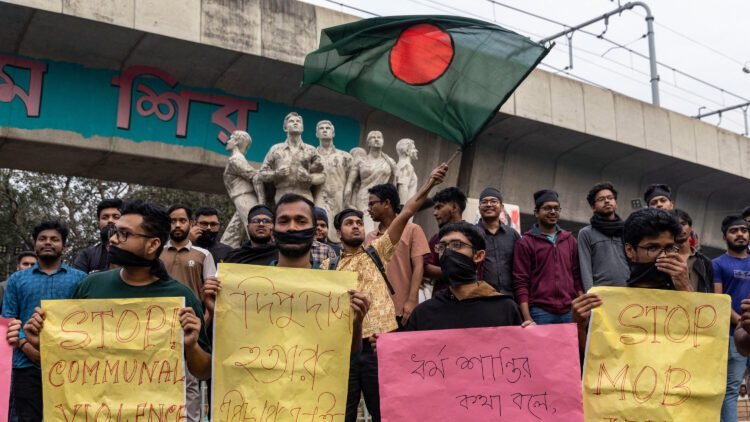
The earlier incident led to widespread protests by factory workers, students, and human rights organizations across Dhaka and other parts of the country. It also drew international attention, with neighboring India formally expressing concern over the safety of minority communities in Bangladesh.
Minority Safety and Political Context
The Hindu population in Bangladesh has reported growing insecurity following political changes after the removal of former prime minister Sheikh Hasina in August last year. Several incidents involving minority groups have raised questions about governance, accountability, and law enforcement effectiveness.
In response to the Mymensingh case, the interim government announced support measures for the victim’s family, including care for his minor child, wife, and parents. Officials reiterated their commitment to protecting all citizens and maintaining social harmony.
Conclusion
The government’s response to the Rajbari death highlights the importance of verified information and responsible reporting, especially in sensitive cases involving minority communities. While concerns about safety and justice remain, authorities maintain that the incident was criminal in nature and not driven by communal motives. As investigations continue, the situation underscores the broader challenge of balancing law enforcement, social stability, and minority rights in a changing political landscape.