
India–EU : Free Trade Pact Signals New Phase in Global Economic Cooperation
India–EU : Prime Minister Narendra Modi on Tuesday welcomed the conclusion of a free trade agreement between India and the European Union, describing it as a landmark step that reflects the growing alignment between two of the world’s largest economic blocs. Speaking at the virtual opening of India Energy Week 2026, Modi said the agreement brings together economies that collectively account for roughly a quarter of global output and a substantial share of international trade.
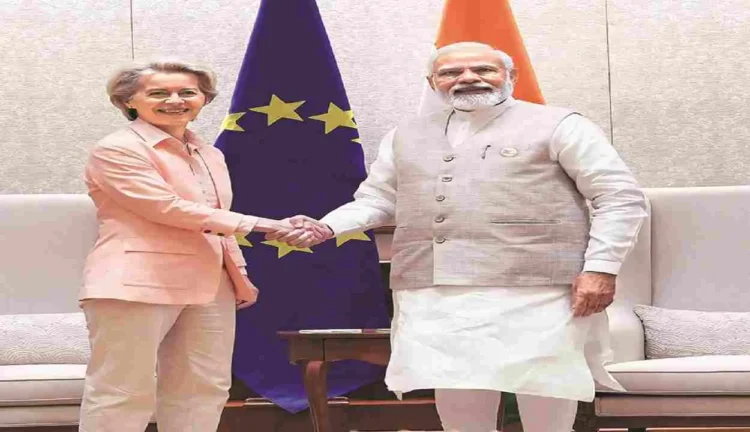
A Deal With Wide Economic Reach
Addressing an international audience, the prime minister underlined the scale of the agreement, noting that it is expected to open new opportunities for India’s population of more than 1.4 billion people while also benefiting millions across the European Union. Beyond trade figures, he said the pact underscores shared values such as democratic governance and adherence to the rule of law, positioning the agreement as more than a commercial arrangement.
Alignment With Existing Trade Partnerships
Modi said the India–EU free trade agreement complements India’s existing trade frameworks with the United Kingdom and the European Free Trade Association. Together, these arrangements are intended to strengthen India’s access to key global markets while providing European partners with deeper engagement in one of the world’s fastest-growing major economies.
Implications for Industry and Services
Highlighting the domestic impact, the prime minister said the agreement is expected to support both manufacturing and services. He pointed to expanded opportunities for industrial stakeholders and service providers, suggesting that the pact could help Indian businesses integrate further into global value chains. According to Modi, the agreement is likely to encourage long-term investment decisions by improving predictability and market access.
Boost to Investor Confidence
Modi also linked the agreement to broader global perceptions of India as an investment destination. He said the deal would reinforce confidence among international businesses and investors at a time when countries are seeking stable and diversified economic partnerships. India, he added, continues to pursue cooperation across sectors as part of its wider global engagement strategy.
Long Negotiations Reach Conclusion
Negotiations on the free trade agreement began in 2007 and have unfolded against a backdrop of shifting global trade patterns. Talks were revived in 2022 and concluded earlier this week, with the agreement set to be formally announced during the India–EU summit. The deal is expected to serve as a foundation for a deeper economic and strategic partnership in the years ahead.
Expanding Strategic and Security Cooperation
Alongside the trade pact, India and the European Union have also moved forward on security and defence cooperation. A new partnership framework, described by EU officials as a milestone, aims to expand collaboration in multilateral forums and strengthen bilateral defence ties. The formal signing is scheduled to take place during the 16th India–EU Summit being held in New Delhi.
India Joins Select Group of EU Partners
With the agreement, India becomes the third Asian country, after Japan and South Korea, to secure such a comprehensive trade deal with the European Union. Together, India and the EU represent nearly one-fifth of global trade and around a quarter of the world’s population, highlighting the growing economic and strategic weight of the partnership.
Trade and Investment at the Core
Trade and investment remain central to India–EU relations. The EU is currently India’s second-largest trading partner in goods, accounting for just over 11 percent of India’s total merchandise trade. In 2024, bilateral trade in goods exceeded 120 billion euros, with strong growth recorded over the past decade.
Services and Investment Ties Deepen
Services trade has also expanded rapidly, more than doubling over the last ten years. Key areas include information technology, telecommunications, professional services, and transport. Foreign direct investment further reflects the depth of engagement, with EU investments in India surpassing 130 billion euros in 2024, making the bloc the country’s largest source of overseas investment.