
TamilNaduElections – AIADMK and BJP Near Agreement on Assembly Seat Sharing
TamilNaduElections – The All India Anna Dravida Munnetra Kazhagam (AIADMK) and the Bharatiya Janata Party (BJP) appear to be moving closer to finalising a seat-sharing arrangement ahead of the upcoming Tamil Nadu Assembly elections. According to political sources familiar with the discussions, the BJP may contest close to 29 constituencies as part of the AIADMK-led National Democratic Alliance (NDA).
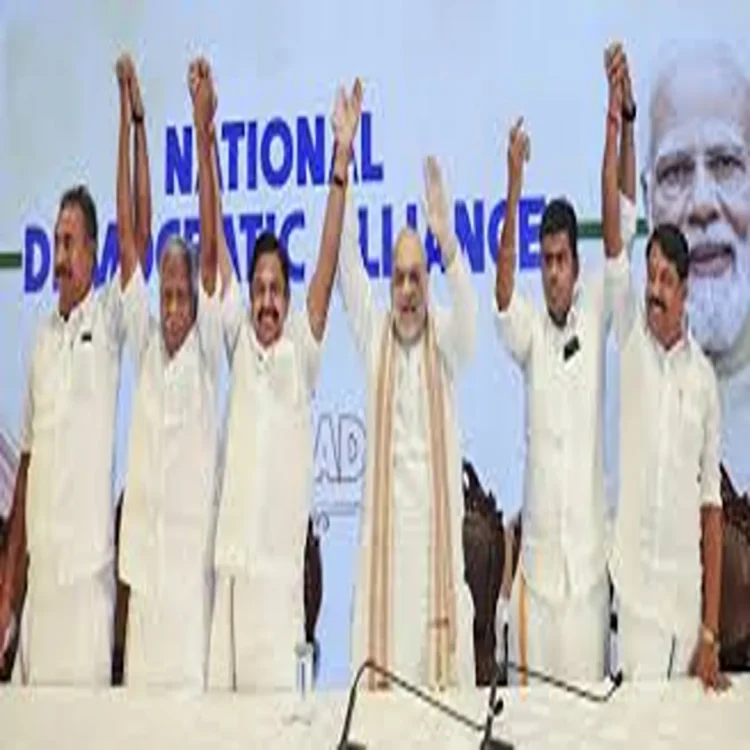
Although official negotiations between alliance partners have not yet begun, informal consultations over the past few weeks have helped shape a preliminary framework for the distribution of seats among the parties involved.
Informal Talks Shape Early Framework
Leaders from both the AIADMK and BJP have indicated that broad understandings have already emerged through backchannel discussions. The tentative formula suggests that the BJP will likely receive around 29 constituencies to contest, while other allies will also be accommodated within the alliance structure.
The Pattali Makkal Katchi (PMK), another important regional partner, is expected to be allotted roughly 18 seats under the proposed arrangement. Meanwhile, the Amma Makkal Munnetra Kazhagam (AMMK), led by T.T.V. Dhinakaran, may receive about nine constituencies.
A senior AIADMK leader acknowledged that both major partners have largely aligned their expectations regarding the seat-sharing formula. However, the leader emphasised that the agreement will only be formally confirmed once structured discussions take place between alliance members.
Formal Negotiations Expected After Prime Minister’s Rally
Political leaders indicate that the formal round of talks is likely to begin shortly after Prime Minister Narendra Modi’s scheduled rally in Tiruchirappalli on March 11. The event is expected to serve as an important moment for the NDA’s political outreach in the state.
According to party insiders, the seat-sharing negotiations could begin around March 14. During these discussions, representatives from each alliance partner are expected to finalise the distribution of constituencies and address remaining strategic concerns.
BJP Scales Down Earlier Seat Demand
During the early stages of the alliance discussions, the BJP had reportedly presented a list of nearly 60 constituencies that it was interested in contesting. Union Minister Piyush Goyal, who has been actively involved in facilitating the talks, is said to have conveyed the party’s initial expectations.
However, as negotiations progressed, the BJP significantly reduced its demand, eventually settling around a figure close to 30 seats. Sources suggest that AIADMK leaders persuaded their ally to accept a slightly smaller allocation by offering constituencies believed to have favourable electoral prospects for the BJP.
This approach was reportedly aimed at balancing the interests of the alliance partners while maintaining the overall competitiveness of the coalition in the state’s electoral landscape.
Uncertainty Linked to Possible New Alliance Partner
Another factor contributing to the delay in finalising the agreement is the BJP’s reported attempt to bring actor-politician Vijay’s Tamilaga Vettri Kazhagam (TVK) into the NDA alliance.
If discussions with Vijay’s party progress successfully, the current seat-sharing formula may require adjustments to accommodate the new entrant. As a result, both the AIADMK and BJP appear to be proceeding cautiously while leaving room for possible changes.
At present, AIADMK leaders are believed to be aiming to contest approximately 170 seats in the 234-member Tamil Nadu Assembly, leaving the remaining constituencies for alliance partners.
Allocation for Regional and Smaller Parties
Within the tentative arrangement, the AMMK had initially requested around 13 constituencies. However, AIADMK leaders are understood to have proposed a reduced allocation of nine seats. These constituencies may include Sholinghur, Andipatti, Ottapidaram, Nanguneri, Pudukkottai, Harur, Melur, Papanasam, and Musiri.
In addition to the major alliance partners, smaller regional parties are also expected to receive limited representation. Current discussions suggest that two seats each could be allotted to the Tamil Maanila Congress led by G.K. Vasan, B. John Pandian’s Tamizha Makkal Munnetra Kazhagam, and T.R. Paarivendhar’s Indiya Jananayaga Katchi.
Debate Over Election Symbols for Allies
Alliance leaders are also discussing the possibility of smaller partners contesting elections using the AIADMK’s well-known “two leaves” symbol, a strategy some believe could improve the coalition’s chances in certain constituencies.
However, sources indicate that the BJP may prefer candidates aligned with its party to contest under the “lotus” symbol instead. The final decision on this issue is expected to emerge during the upcoming formal negotiations.
As the Tamil Nadu Assembly elections approach, the outcome of these discussions will play a significant role in shaping the NDA’s electoral strategy in the state.