
SIR: Amit Shah will speak at 5 p.m. today when the Lok Sabha continues its consideration of
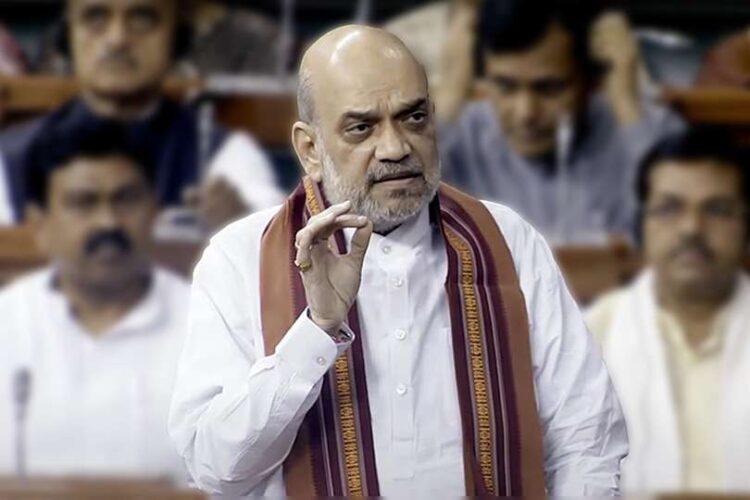
SIR: Union Home Minister Amit Shah will speak to the House on electoral changes at 5 p.m. on Wednesday, as the Lok Sabha continues its debate of the Special Intensive Review (SIR).
The Election Commission of India (ECI) is conducting the SIR procedure in 12 states including Uttar Pradesh. The Opposition has strongly criticized this process, which the Lower House of Parliament began discussing on Tuesday.
The Home Minister will address the SIR process in the Lok Sabha at 5 p.m., according to a statement made by Union Parliamentary Affairs Minister Kiren Rijiju on X.
Manish Tewari, a Congress MP, began the Lok Sabha discussion earlier on Tuesday by voicing worries over the usage of public finances in the lead-up to elections. He questioned the custom of giving voters financial handouts.
“You cannot win elections at the expense of the state or national coffers. He warned that such actions compromise the integrity of the political process and said, “This will bankrupt our democracy, our country.” He also said that the Election Commission of India (ECI) had “no legal basis to conduct SIR” and demanded more openness, questioning why the Commission does not provide political parties access to machine-readable voter lists.
He demanded that the selection legislation for Election Commission officials be changed in three ways. The selection panel must include the Chief Justice of India and the Leader of the Opposition in the Rajya Sabha. “SIR, be stopped immediately, a blanket ban must be imposed on direct cash transfer before the election, it is against democracy,” Tewari said.
In response to these comments, BJP MP Sanjay Jaiswal said that the opposition was just bringing up the SIR and “vote-chori” issues to deflect criticism from their significant defeats in the just finished Bihar elections.
According to Jaiswal, the first instance of “vote-chori” took place in 1947 when Jawaharlal Nehru was named prime minister even though the majority of Congress Working Committee members favored Sardar Vallabhbhai Patel.
Jaiswal expanded his thesis by pointing to other incidents, like as the declaration of emergency in 1975 and the contentious elections in Jammu and Kashmir in 1987, which he characterized as instances of Congress-led “vote chori.”
Additionally, Lok Sabha LoP Rahul Gandhi asked sharp questions during the electoral reforms discussion, which the Congress often referred to as the SIR (Special Intensive Revision) debate: “Why was the Chief Justice of India removed from the selection panel of the Election Commissioner? What may be the reason for eliminating the CJI? Do we not think the CJI is real? We do, of course. So why isn’t he there in the room?
“I’m seated in that space. Prime Minister Narendra Modi and Home Minister Amit Shah are on one side of the so-called democratic decision, while the Leader of the Opposition is on the other. In that room, I have no voice. What they determine is what takes place. He went on to explain, “Why are Amit Shah and the Prime Minister so eager to choose the precise candidate for the position of Election Commissioner?
“This has never happened before. In India’s history, no prime minister has ever taken this action. This administration amended the legislation in December 2025 to guarantee that no Election Commissioner will face consequences for any actions during their tenure. Why would the Home Minister and Prime Minister provide such immunity? He continued by accusing, “Why grant a privilege that no Prime Minister has ever granted before?”
During his address, Gandhi made a scathing statement against the BJP: “There is no bigger anti-national act than stealing votes.”
While taking part in the SIR discussion, BJP MP Nishikant Dubey said that the Congress had undermined important constitutional institutions by implementing modifications in the 1970s. Rahul Gandhi’s assertion that national institutions had been “captured by the Rashtriya Swayamsevak Sangh (RSS)” was vehemently denied by him.
Dubey cited the 1976 Swaran Singh Committee and the ensuing 42nd Constitutional Amendment in his House address, claiming that the action severely undermined institutional autonomy under the Emergency.
He said that via modifications spearheaded by Congress, even the presidency was reduced to a ceremonial position.