
Rahul Gandhi : Targets New Rural Job Law, Warns Against Repeal of MGNREGA Rights
Rahul Gandhi : The political debate around rural employment intensified on Thursday as senior Congress leader Rahul Gandhi sharply criticised the Union government over its decision to replace the long-standing rural employment guarantee scheme with a new law. Speaking at a national convention of rural workers in the capital, he alleged that the intention behind scrapping the earlier framework mirrors the approach adopted during the introduction of controversial agricultural reforms, which were eventually rolled back after widespread protests.
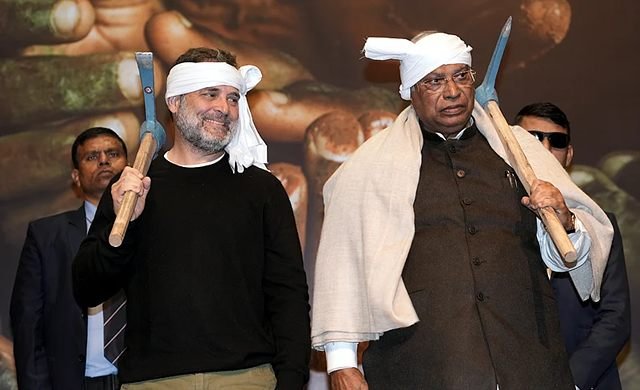
According to Gandhi, the rural employment programme was never just a welfare initiative but a rights-based mechanism designed to protect the dignity and livelihood of the poorest sections of society. He argued that dismantling such a system threatens not only economic security in rural India but also the constitutional principles on which inclusive development is based.
Rural Employment and the Idea of Dignified Work
In his address, the Congress leader emphasised that the original rural job guarantee law was conceived to ensure that anyone in need of employment could legally demand work. He said the scheme empowered citizens rather than positioning them as passive beneficiaries. By operating through local self-governance institutions, it strengthened grassroots democracy and ensured public participation in decision-making.
Gandhi claimed that the replacement law weakens this structure and removes the people’s voice from rural development. He asserted that decentralisation was a core strength of the earlier framework, allowing village-level bodies to plan and implement projects suited to local needs. According to him, this model is now being undermined.
Allegations of Wealth Concentration
The Congress leader also accused the ruling party of following policies that concentrate wealth and resources in the hands of a limited group. He argued that such an approach erodes democratic values and widens social and economic inequality. In his view, the rollback of employment guarantees fits into a larger pattern of governance that prioritises corporate interests over public welfare.
He warned that weakening rural job security could push vulnerable workers into exploitative conditions, reversing decades of progress in labour rights. Gandhi urged workers to recognise the broader implications of the policy shift and stand together to demand accountability.
Lessons From Farmers’ Protests
Drawing parallels with the farmers’ movement, Gandhi recalled how agricultural workers and cultivators united to oppose reforms they believed were unjust. He noted that sustained unity eventually forced the government to withdraw the measures. According to him, the same collective resolve is now required from rural labourers to protect their employment rights.
He stressed that unity remains the biggest challenge, stating that fragmented opposition only strengthens policies that harm marginalised communities. Gandhi suggested that if workers remain united, policy reversals are possible, just as they were in the past.
Concerns Raised by Congress Leadership
Other senior Congress leaders present at the convention echoed similar concerns. Party president Mallikarjun Kharge alleged that the repeal of the employment guarantee framework could revive exploitative labour practices. He argued that secure employment opportunities are essential to prevent rural workers from falling into cycles of dependency and debt.
Kharge also criticised the government’s emphasis on high-profile infrastructure projects, claiming that basic employment and social security issues are being neglected. He compared current development claims with past achievements, suggesting that earlier administrations had delivered more tangible results for ordinary citizens.
Call for Collective Action
The convention concluded with a strong appeal for collective action to safeguard rural employment rights. Speakers highlighted that employment security is directly linked to social stability, migration patterns, and rural economic growth. They warned that ignoring these aspects could have long-term consequences for the country’s socio-economic fabric.
As the debate continues, the issue of rural employment remains a critical political and economic concern. With millions dependent on public work programmes for survival, the future of employment guarantees is likely to remain at the centre of national discourse in the months ahead.