
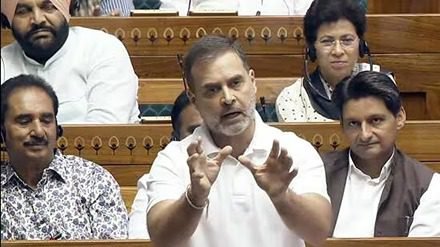
Rahul Gandhi: lashes out at the government after the VB-G RAM G Bill is approved by parliament, calling it “anti-state, anti-village.”
Rahul Gandhi: The Viksit Bharat Guarantee for Rozgar and Ajeevika Mission (Gramin) (VB-G RAM G) Bill was passed in Parliament; however, the opposition is still vocally protesting this.
The Trinamool Congress members resumed their protest on the stairs leading to the House entrance, while a unified opposition protested outside Parliament on Friday against the legislation’ approval.
Lok Sabha LoP Currently in Germany, Rahul Gandhi joined the chorus of voices opposing the measure, saying it was “anti-state” and “anti-village” on purpose.
“The Modi administration destroyed twenty years of MGNREGA in a single day last night. There is no “revamp” of MGNREGA in VB-G RAM G. It destroys the demand-driven, rights-based guarantee and replaces it with a Delhi-controlled rationed system. By design, it is anti-village and anti-state. Rural workers gained negotiating power because to MGNREGA. With genuine alternatives, incomes rose, working conditions improved, exploitation and distress migration decreased, and rural infrastructure was built and revitalized. This administration is specifically trying to break that leverage. VB-G RAM G reduces the one tool available to the rural poor by limiting labor and creating additional reasons to reject it. The head of Congress posted on X.
“During COVID, we saw what MGNREGA meant. It prevented crores of people from going hungry and incurring debt when the economy crashed and livelihoods fell apart. Additionally, women benefited the most from it; year after year, they have contributed more than half of the person-days. Women, Dalits, Adivasis, landless laborers, and the poorest OBC groups are the first to be displaced when a jobs program is rationed. And to top it all off, Parliament passed this measure without enough review. The measure was not sent to a Standing Committee, as the opposition demanded. Never should a bill that alters the rural social compact and impacts millions of workers be passed without thorough committee review, expert input, and public hearings. PM Modi’s goals are clear: centralize power, erode the influence of rural India, particularly Dalits, OBCs, and Adivasis, and then shill for “reform” using catchphrases,” he said.
“MGNREGA is one of the world’s most effective programs for empowering people and reducing poverty. We will not allow this administration to undermine the final line of defense for the impoverished in rural areas. He said, “We will unite with workers, panchayats, and states to oppose this action and create a national front to guarantee that this legislation is repealed.
Priyanka Gandhi, a Congress MP, also criticized the administration, claiming that it would be detrimental if the plan died.
“The original MGNREGA scheme, which was structured so that the Center paid 90% of the funds for it, was the foundation of the rural economy and the greatest support for those who were extremely poor and had trouble finding employment, so this bill will be extremely detrimental to the poorest of the poor. This is one of the wonderful programs that has been in place for 20 years and has benefited the poor, particularly those who have nothing. The States won’t be able to finance this revised version of the Bill as it drastically reduces the amount allotted from federal monies. It implies that the plan will fail, which would be very detrimental,” she said.
The Viksit Bharat Guarantee for Rozgar and Ajeevika Mission (Gramin) (VB-G RAM G) Bill was approved by the Rajya Sabha after receiving approval from the Lok Sabha. The Parliament enacted the bill on December 18, the final day of its Winter Session 2025.
The Bill increases the number of days that adult members of rural households who are willing to do physical labor with little expertise are guaranteed 125 days of pay employment, up from the current 100 days.
The Central Government and the State Governments shall share 60:40 in funds, according to Section 22 of the Bill. This arrangement also applies to the Himalayan States, the North Eastern States, and the Union Territories (Jammu & Kashmir, Uttarakhand, and Himachal Pradesh).