
Manipur News: Unauthorized Ring Road Construction in Manipur Triggers Environmental and Security Concerns
Manipur News: The National Green Tribunal has issued a firm directive ordering an immediate stop to the construction of an allegedly unauthorized ring road passing through forested and hilly regions of Manipur. The decision, delivered on December 23, came after serious concerns were raised regarding environmental degradation and the absence of mandatory statutory approvals. The tribunal’s intervention has brought renewed focus on environmental governance, infrastructure regulation, and regional security issues in the state.
Tribunal’s Immediate Directions to State Authorities
In its order, the green court instructed the Chief Secretary of Manipur to ensure strict enforcement of the construction halt. District magistrates and superintendents of police across six affected districts were directed to prevent any further work on the disputed road until a comprehensive examination of the matter is completed. This step reflects the tribunal’s emphasis on accountability and compliance with environmental laws.
Road Outside Approved Development Plans
State officials clarified that the road under scrutiny is not part of the officially sanctioned ring road project around Imphal, which is being developed with financial assistance from international development agencies. Instead, the controversial stretch reportedly cuts through ecologically sensitive forest areas in districts such as Churachandpur, Kangpokpi, Noney, and Ukhrul. Authorities stressed that no government department had included this route in approved infrastructure plans.
Petition by Civil Society Organization
The issue was brought before the tribunal following a petition filed by the Coordination Committee on Manipur Integrity, a collective representing several civil society groups. The petition highlighted concerns about unchecked construction activities and alleged violations of environmental and administrative norms. According to the petitioners, such actions pose long-term risks to biodiversity, forest conservation, and local livelihoods.
Alleged Lack of Mandatory Clearances
The petition claimed that the road was being constructed without obtaining essential approvals, including environmental clearance and forest clearance. It also alleged the absence of any formal approval or no-objection certificate from state authorities. Information reportedly obtained from multiple government departments indicated that no permissions had been granted for the project. Satellite imagery was cited as additional evidence to support claims of unauthorized construction in protected zones.
Community Allegations and Social Sensitivities
The petition further alleged involvement of specific community groups in the construction, based on a memorandum submitted by an external organization. These claims have added a sensitive social dimension to the issue, underscoring the need for careful handling to avoid further tension in an already fragile regional context.
Application of the Precautionary Principle
The tribunal noted that despite earlier instructions, the state government had not submitted a preliminary report on the matter. While the administration requested additional time to verify details from forest divisions, the tribunal chose to invoke the precautionary principle under environmental law. This principle prioritizes preventive action in situations where environmental harm is possible, even if full scientific certainty is lacking.
Local Names and Emerging Security Concerns
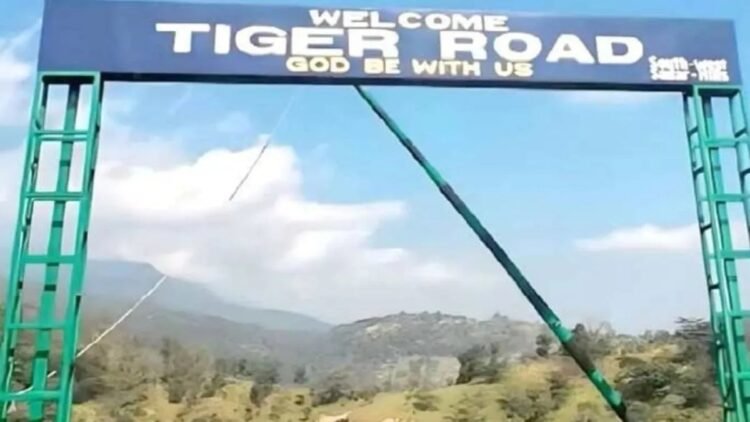
Following the tribunal’s order, representatives of the petitioning organization stated that the road is locally referred to by names such as German Road or Tiger Road. These names are reportedly associated with alleged insurgent figures. The road reportedly gained wider attention during periods of unrest, when images and videos circulated online showing signage and an alleged inauguration event.
Allegations of Illegal Activities During Unrest
Concerns were also raised that the road may have been used during times of instability for activities such as illegal drug trafficking, movement of arms and ammunition, and unauthorized transit of individuals. While these claims are yet to be independently verified, they have intensified calls for a thorough investigation by both civil and security agencies.
Government’s Position and Future Action
Earlier, after protests by other community groups, the Manipur government stated that it had neither approved nor sanctioned any such road. Officials maintained that legal action would follow if on-ground verification confirmed illegal construction. The government also indicated that issues linked to designated camps under existing operational agreements would be examined in consultation with central authorities.
The next hearing on the matter has been scheduled for February 2, 2026. Until then, the construction ban remains in force, signaling a strong message on environmental compliance and rule of law.