
IndigenousRights – Bangladesh Tribal Groups Oppose Controversial Forest Development Plan
IndigenousRights – Several indigenous leaders and Catholic community representatives in central Bangladesh have issued a strong warning to the government, stating that protests could intensify if a controversial forest development project is not withdrawn. The disagreement centers around a proposed initiative in the Madhupur forest area of Tangail district, which local communities say threatens both their livelihoods and cultural heritage.
Concerns Over Land and Livelihood
Members of the Garo and Koch indigenous communities argue that the planned construction of an artificial lake and eco-park is not a development effort, but a move that could force them off land they have occupied for generations. These communities depend heavily on the forest for agriculture and daily sustenance, and leaders fear the project will disrupt this long-standing relationship with the land.
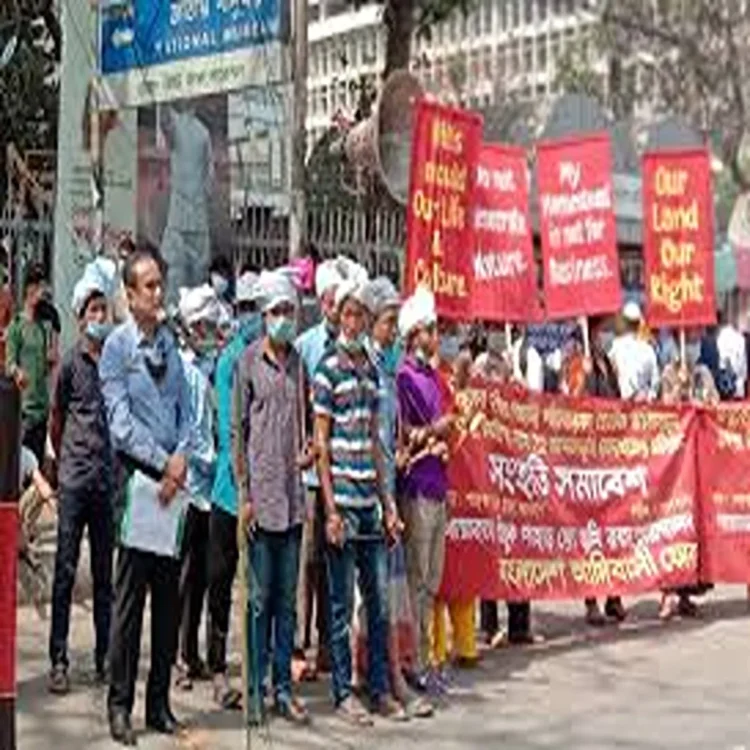
Toni Chiran, president of the Bangladesh Indigenous Youth Forum, addressed a large gathering of protesters earlier this month in Madhupur. The demonstration brought together hundreds of students and community members who voiced their opposition to the project. Chiran stated that the development would strip indigenous families of their farmland, damage the natural forest ecosystem, and undermine their ability to maintain traditional ways of life.
Allegations of Forced Displacement
Community leaders have described the project as part of a broader pattern that risks displacing indigenous populations. According to them, the initiative has been presented as environmentally friendly development, but its actual impact could be deeply harmful to both people and nature.
Speakers at the protest emphasized that the forest is not just a physical space but a vital part of their identity. They argue that any development plan that ignores this connection fails to account for the social and cultural consequences faced by indigenous residents.
Historical Background of the Project
The proposal to develop an eco-park and artificial lake in Madhupur is not new. The government first introduced the idea in 2000, but it faced strong resistance from local communities. In 2004, tensions escalated during protests, resulting in violence that left at least one person dead and several others injured. Following these events, the project was temporarily halted.
In 2026, authorities revived the plan and have reportedly begun initial work, including excavation in the designated area. This move has reignited concerns among indigenous groups, who see it as a continuation of earlier efforts that were widely opposed.
Impact on Environment and Culture
Janoki Chisim, secretary of the Garo Indigenous Student Union, expressed concern that the project could harm both the forest ecosystem and the people who depend on it. He stressed the importance of preserving the forest in its natural state, noting that it has supported indigenous communities for generations.
Leaders argue that the forest provides not only economic support but also cultural and spiritual significance. They believe that altering its structure through large-scale construction could lead to irreversible changes.
Warning of Escalating Protests
Indigenous representatives have made it clear that their opposition will not remain limited to peaceful demonstrations if their concerns continue to be ignored. They have called on authorities to recognize customary land rights and engage in meaningful dialogue with affected communities.
If these demands are not addressed, leaders have indicated that a broader and more organized protest movement could emerge in the coming weeks. The situation remains sensitive, with both environmental and human rights issues at stake.
As the debate continues, the future of the Madhupur forest and its indigenous inhabitants remains uncertain, highlighting the challenges of balancing development with the protection of vulnerable communities.