
India and New Zealand : wrap up negotiations for a free trade agreement
India and New Zealand: The signing of a Free Trade Agreement (FTA) between India and New Zealand on Monday represents a major advancement in the two countries’ strategic and economic cooperation.
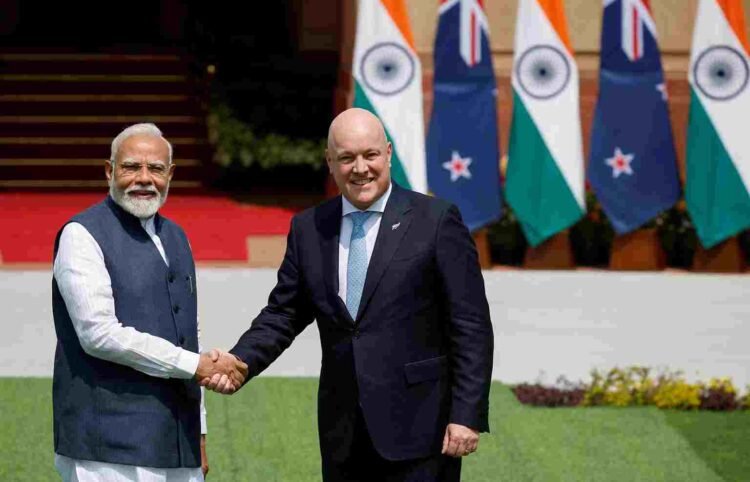
In a phone call with Prime Minister Christopher Luxon of New Zealand, Prime Minister Narendra Modi jointly announced the completion of what they called a historic, ambitious, and mutually beneficial agreement.
The leaders said that the conclusion of the agreement in a record nine months demonstrated strong political will and a common desire to increase interaction between the two countries. The India-New Zealand Free Trade Agreement negotiations were started during Prime Minister Luxon’s visit to India in March 2025.
They claim that by expanding market access, increasing investment flows, and fortifying strategic cooperation, the FTA will improve bilateral economic cooperation while opening up new opportunities for farmers, innovators, entrepreneurs, micro, small, and medium-sized businesses, students, and young people in both nations across a variety of industries.
Building on the agreement’s momentum, the two sides anticipated investments of around $20 billion from New Zealand into India over the following 15 years and expressed confidence in increasing bilateral trade over the next five years.
In addition, Prime Ministers Modi and Luxon praised advancements in collaboration in fields like sports, education, and interpersonal relationships. They also reiterated their dedication to enhancing the India-New Zealand partnership, pledging to stay in close communication as the partnership enters a new stage after the FTA’s conclusion.
New Zealand will remove tariffs on 100% of its tariff lines as part of the comprehensive, balanced, and forward-looking agreement, giving all Indian exports duty-free market access. This move is anticipated to greatly increase India’s export competitiveness and strengthen its integration into global value chains. India has provided tariff liberalization in 70 per cent of tariff lines, covering 95 per cent of bilateral commerce. The deal is in line with the Viksit Bharat 2047 vision and is one of India’s fastest-concluded free trade agreements.
On March 16, 2025, Commerce and Industry Minister Piyush Goyal and New Zealand’s Minister for Trade and Investment Todd McClay met to formally begin negotiations. These talks ended after five formal rounds and numerous in-person and virtual intersessional discussions. “Building trade around people and launching opportunities—for our farmers, entrepreneurs, students, women, and innovators” is the goal of the pact, according to Goyal. He went on to say that the agreement will increase farmer incomes and agricultural output, provide chances for Indian enterprises in the area, and give Indian youngsters access to international education and work options.
Labor-intensive industries like textiles, clothing, leather, footwear, marine products, gems and jewelry, handicrafts, engineering goods, and automobiles are anticipated to see a significant increase in exports with 100% duty-free access. This will directly benefit workers, artisans, women, youth, and MSMEs through greater integration into global value chains. To safeguard farmers and domestic industry, market access excludes dairy, coffee, milk, cream, cheese, yoghurts, whey, caseins, onions, sugar, spices, edible oils and rubber.
With India gaining market access in high-value industries including IT and IT-enabled services, professional services, education, financial services, tourism, construction, and other business services, the FTA offers New Zealand’s most ambitious service commitments in any trade agreement to date. A future-ready mobility framework with better entrance and stay options for Indian professionals, students, and young people is also included. Up to 5,000 Indian professionals will be able to work in New Zealand for up to three years under a new Temporary Employment Entry Visa pathway. These professionals will be able to work in high-demand industries like IT, engineering, healthcare, education, and construction, as well as occupations like yoga instructors, Indian chefs, and music instructors.
The agreement is “a new-generation trade agreement built on tariffs, agricultural productivity, investment, and talent,” according to Commerce Secretary Rajesh Agrawal, who also noted that New Zealand would have predictable access to India’s sizable and growing market while India’s strengths in exports and services would support labor-intensive growth. On agriculture, specialized agri-technology action plans for kiwifruit, apples and honey will concentrate on productivity increase, research cooperation, quality improvement and value-chain development, building local capabilities and promoting income growth for Indian farmers.
While the overall value of products and services traded in 2024 was around $2.4 billion, the bilateral merchandise trade between India and New Zealand was $1.3 billion in 2024–2025.