
Headline: Voter List Revision Sparks Political Controversy in West Bengal
Headline: The Special Intensive Revision of electoral rolls in West Bengal has once again become a matter of intense political debate. The process, initiated under the supervision of the Election Commission of India, has raised questions about transparency, administrative efficiency, and alleged political targeting. Recent developments involving family members of senior political leaders have further intensified public scrutiny and political reactions across the state.
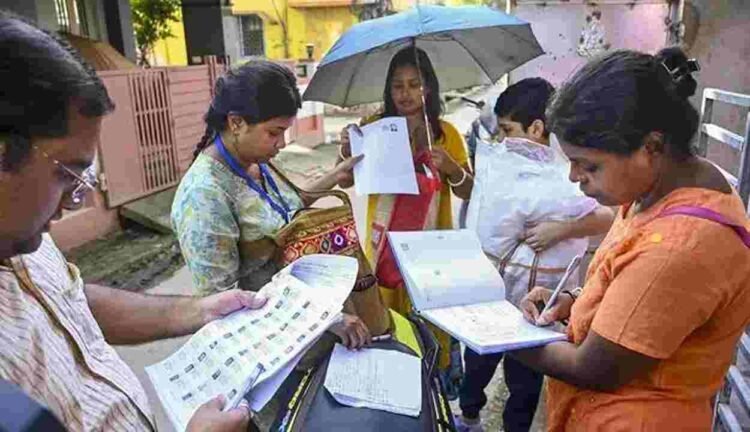
Background of the Voter List Revision Process
The Election Commission of India began the draft voter list revision exercise with the objective of updating electoral records and ensuring accuracy before upcoming elections. This revision process includes claims and objections, allowing citizens to verify, correct, or contest entries in the draft voters’ list. While such exercises are routine in democratic systems, the compressed timeline of this revision has drawn criticism from several political stakeholders in West Bengal.
Summons Issued to Family Members of a Senior MP
A major controversy emerged after two sons of Kakoli Ghosh Dastidar, a four-time Member of Parliament and the Chief Whip of Trinamool Congress in the Lok Sabha, were summoned for a hearing. The notices were issued after their names were found missing from the draft voters’ list published on December 16. The hearing relates to claims and objections submitted during the revision exercise.
According to the MP, the summons also extended to her mother and younger sister, whose names were similarly absent from the draft list. The situation has raised concerns regarding the verification mechanisms used during the preparation of the voters’ list and the criteria applied to long-standing voters.
Allegations of Administrative Harassment
Reacting strongly to the summons, Kakoli Ghosh Dastidar alleged that the entire process had turned into a farce. She questioned how immediate family members of a sitting MP, including government servants and relatives of a former state cabinet minister, could be excluded from the draft electoral roll. Her late husband, Sudarshan Ghosh Dastidar, had served as a member of the West Bengal cabinet, further intensifying her concerns about procedural lapses.
She argued that the situation reflects deeper flaws in the Special Intensive Revision exercise. According to her, attempting to complete a detailed electoral revision within a short span of two months, instead of the usual longer duration, was bound to create confusion and errors.
Wider Political Implications in the State
This incident is not isolated. Similar cases involving relatives of elected representatives from the Trinamool Congress have surfaced in recent days. Such developments have contributed to a growing narrative that the voter list revision process may be disproportionately affecting individuals connected to the ruling party in West Bengal.
Political observers note that voter list accuracy is a sensitive issue, as even minor discrepancies can influence electoral outcomes. The opposition, however, has maintained that the revision process must be allowed to proceed without political pressure and that claims and objections are part of a legally mandated procedure.
Case Involving a Legislator from East Burdwan
Another controversy emerged involving a legislator from the Khandaghosh Assembly constituency in East Burdwan. Nabin Chandra Bag alleged that his mother, brother, and sister-in-law were summoned for hearings despite their names appearing in the voters’ list as early as 2002. The notices reportedly required them to appear before election अधिकारियों to clarify their voter status.
Bag has represented the Khandaghosh constituency since 2011. His political journey includes a term as a CPI(M) legislator before joining the Trinamool Congress ahead of the 2016 West Bengal Assembly elections. He was subsequently elected twice as a Trinamool Congress candidate, in 2016 and 2021.
Concerns Over Transparency and Trust
These repeated instances have triggered a broader debate about electoral transparency and voter confidence in West Bengal. Political leaders argue that while voter list revision is essential, the process must be carried out with adequate preparation, sufficient time, and robust verification systems to avoid unnecessary distress to citizens.
Civil society groups and election analysts have emphasized that any perception of bias or administrative overreach can erode public trust in democratic institutions. They stress the importance of clear communication from election authorities and timely resolution of claims and objections.
Conclusion and Way Forward
The unfolding situation highlights the challenges associated with large-scale electoral revisions in politically sensitive environments. As hearings continue, the response of the Election Commission of India will be closely watched by political parties and voters alike. Ensuring fairness, accuracy, and transparency in the voter list revision process remains crucial for maintaining the integrity of elections in West Bengal.