
Delhi ‘No PUC, No Fuel’ Drive: Server Failure Causes Pandemonium at Pumps; Day 2 Fines Over 11,000
Delhi ‘No PUC, No Fuel’ Drive: For the second day in a row, the Delhi government strictly enforced the “No PUC, No Fuel” program, which aims to reduce air pollution. Long lines and technological issues plagued the day, even though the government was successful in implementing the law that prohibits fueling cars without a valid Pollution Under Control (PUC) permit.
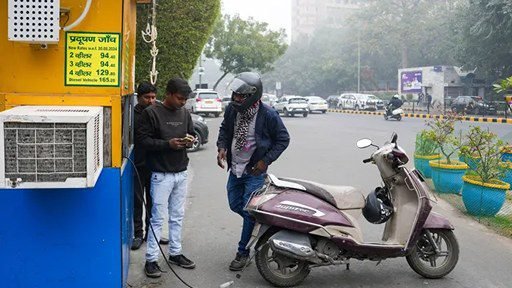
Chaos Occurs Due to Server Outage
A major technological breakdown resulted from an abrupt increase in demand for PUC certifications.
System Failure: From 11:00 am to 3:00 pm, the certificate-issuing server failed and was unavailable in many locations.
Impact: There was a great deal of inconvenience. At gas stations, drivers waited in enormous lines to get their pollution levels assessed before refueling.
Public Reaction: Because of the outage, Rama Shankar, a driver waiting in Preet Vihar (East Delhi), said he was unable to get either gasoline or a PUC certificate. “The government should strengthen its servers as the problem of them going down is a frequent occurrence,” he said.
Statistics on Enforcement
Data on the administration’s campaign against polluting cars has been made public:
Final 24 Hours (Day 2):
11,776 cars received fines for breaking emission regulations.
542 trucks were sent back after being stopped from entering the city.
Day 1 Background:
Compared to the daily average of 30,000, 61,000 persons had their PUC examined.
Five thousand cars were examined in person.
3,746 cars with invalid PUCs were penalized.
568 cars were returned.
On the Eastern and Western Peripheral Motorways, 217 non-destination cars were rerouted.
Checks and Restrictions at the Border
Commercial and private automobiles registered outside of Delhi that do not meet BS-VI emission norms are still prohibited (except from those transporting necessities). Over a hundred squads from the Delhi Police and Traffic Police have been stationed at the borders.
Enforcement Strategies: Officers are using roadblocks or halting cars on suspicion. Many places are adopting a “pay the fine or go back” policy.
Kalindi Kunj (Noida Route): On the second day, around 100 cars were sent back, compared to 200 on the first, suggesting that drivers were more attentive.
Barricades are erected close to the Badarpur toll plaza on the Badarpur and Faridabad route. Notably, the Haryana Police are also on duty 300 meters before to the border, doing U-turns to reroute noncompliant cars.
East Delhi (Ghazipur, Apsara, Chilla Borders): Traffic is slowing down because police are rigorously prohibiting non-BS-VI cars from entering from Uttar Pradesh.
Note: Since halting cars on the major Delhi-Meerut Expressway is considered risky, checks are not being done there.
Leaks: Despite the security at the major entrance points, there are rumors that some cars are still getting into Delhi via other ways.
The circumstances Authorities at gas stations use cutting-edge equipment, such as sound boxes and scanners, to quickly confirm the authenticity of certificates.
Dwarka (West Delhi): Pumps in Sectors 9, 6, and 20 were reported to have large crowds. There was a lot of traffic since this region is near Gurugram. Before refueling, drivers with expired certifications had to stand in line for up to 30 minutes at on-site testing facilities.
Similar rigor was seen in South Delhi, where noncompliant cars were refused fuel. Officials from the Transport Department and the local police continued to monitor the operation from these pumps.