
Delhi Air Pollution: A few areas are still in the “Very Poor” category despite a little improvement in air quality to 285 | View Area-Wise AQI
Delhi Air Pollution: At 8 am on Thursday, the Central Pollution Control Board (CPCB) reported that the National Capital’s Air Quality Index (AQI) was in the bad category at 285. Up to 16 locations with AQI scores over 300 were still in the pollution red zone. The highest AQI of 343 was reported in Rohini, while numerous other areas continued to have poor air quality and were placed under yellow alert.
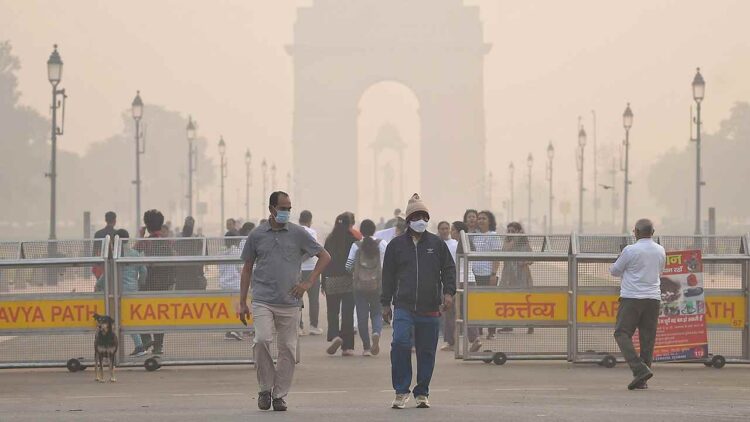
The 24-hour average AQI on Wednesday was 259, which was somewhat better than Tuesday’s reading of 282. Beginning Tuesday, there was some improvement in the capital’s air quality after nine days in a row in the extremely bad zone.
According to CPCB criteria, an AQI of 0–50 is regarded as excellent, 51–100 as satisfactory, 101–200 as moderate, 201–300 as bad, 301–400 as very poor, and 401–500 as severe.
AQI for Delhi-NCR
Gurugram scored a moderate AQI of 188, while Faridabad’s AQI of 286 put it in the poor category. Indirapuram had an AQI of 288 in Ghaziabad, which is also in the poor category. Greater Noida recorded 236 in the bad category, whereas Gorakhpur had a tolerable AQI of 83. The AQI of 309 for Noida and 330 for Muzaffarnagar, both of which are categorized as having very poor air quality, respectively, remained very low.
AQI by Area In Delhi
On Thursday, the majority of Delhi’s air quality remained in the extremely bad category, with numerous areas reporting dangerously high pollution levels. AQI was 302 (very poor) for Delhi Cantonment, 334 (very poor) for Bawana, 331 (very poor), 341 (jahangirpuri), 326 (very poor), 339 (nehru nagar), 288 (poor) for Siri Fort, 321 (very poor) for Vivek Vihar, 327 (very poor), 266 (poor) for Shadipur, and 302 (very poor) for Akshardham.
Other neighbourhoods also showed heavily polluted conditions: Alipur reported 309 (very poor), Anand Vihar 302 (very poor), Ashok Vihar 331 (very poor), Burari Crossing 293 (poor), Chandni Chowk 308 (very poor), Dwarka 285 (poor), IIT Delhi 215 (poor), ITO 309 (very poor), Jawaharlal Nehru Stadium 276 (poor), Lodhi Road 232 (poor), Major Dhyan Chand National Stadium 217 (poor), Mandir Marg 129 (moderate), Najafgarh 219 (poor), Narela 303 (very poor), DU North Campus 257 (poor), Okhla Phase-2 272 (poor), Patparganj 279 (poor), Punjabi Bagh 302 (very poor), RK Puram 311 (very poor), Rohini 343 (very poor), Sonia Vihar 303 (very poor), and Ghazipur 302 (very poor), AIIMS 226 (poor).
Some areas had somewhat improved air quality, although it was still unhealthy: India Gate and Kartavya Path had an AQI of 309 (very bad), whereas IGI Airport T-3 recorded an AQI of 211 (poor). Overall, the data shows that the city’s air quality has been steadily declining.
The weather in Delhi
Compared to Wednesday, Delhi’s lowest temperature is predicted to dip by as much as 2 degrees Celsius. The city is expected to record a low temperature of 8 degrees Celsius and a high temperature of 24 degrees Celsius today, according to the India Meteorological Department (IMD). Delhi recorded a lowest temperature of 10 degrees Celsius on Wednesday, which was around 0.4 degrees below average, and a high temperature of 25.2 degrees Celsius, which was likewise 0.4 degrees below average.
According to the IMD, minimum temperatures in northwest India, which includes Delhi, Noida, Faridabad, Gurugram, and surrounding areas, won’t change significantly for the next two days. After that, they will rise by two to four degrees Celsius over the next three days before stabilizing. The weather service has predicted partly cloudy conditions for Thursday, with a low temperature of around 8 degrees Celsius and a high temperature of about 24 degrees.