
War – Gaza Family Marks Third Ramadan Amid Ruins
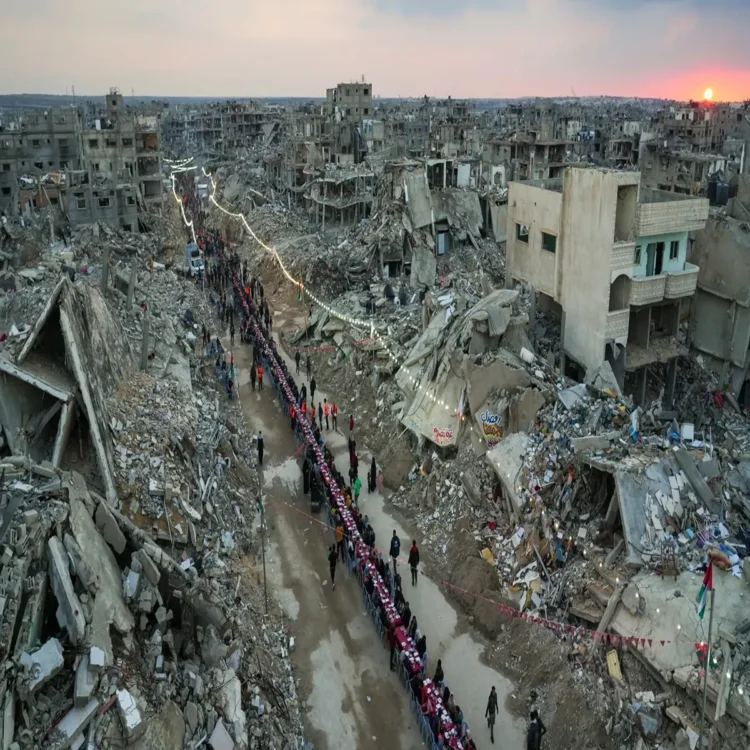
War – As dusk settles over Gaza City, Saddam al-Yazji sits with his wife Heba and their daughter Maryam at a small folding table placed beside a mound of shattered concrete and twisted steel. The debris towering behind them was once their family home. Beneath it, many of their loved ones remain buried. As they quietly share a simple bowl of soup to break their Ramadan fast, the absence around them feels heavier than the ruins themselves.
A Family Lost in a Single Strike
In December 2023, an airstrike reduced the four-story building in the Rimal district to rubble. Forty members of the extended al-Yazji family were killed in the blast, including Saddam’s parents, his siblings, and many of their children. Heba also lost her parents and brothers. The couple and their daughter were in another section of the building at the time and survived.
Saddam, now 35, says it is difficult to comprehend how quickly their lives changed. Photographs from past Ramadan gatherings bring him to tears. “This is the third Ramadan without them,” he says quietly, reflecting on the celebrations that once filled their home with laughter.
Ramadan Without the Gatherings
Before the war, the holy month meant large evening meals hosted by Saddam’s father, Kamel al-Yazji. The retired judge and former head of the Palestinian Athletics Federation would gather children and grandchildren around a long table filled with rice, meat, and traditional dishes. Ramadan is traditionally marked by prayer, reflection, and communal meals at sunset. For many in Gaza, those traditions have been interrupted by years of conflict.
Saddam earned a living by running a supermarket on the ground floor of the family building. The strike destroyed not only their home but also their source of income. Among the 40 killed were 22 children.
Some bodies were recovered soon after the explosion. Others remain under the collapsed structure. One of Saddam’s brothers lies in a makeshift grave nearby, marked with wooden sticks. According to Gaza’s health authorities, thousands across the territory are still missing beneath the rubble of damaged buildings.
Life in Displacement
After the bombing, the surviving family members moved into a tent elsewhere in Gaza City. During the previous two Ramadans, they returned to the site of their destroyed home to share the iftar meal there. Following a ceasefire that began in October, they relocated their tent closer to the ruins.
Heba describes the emotional toll as overwhelming. She says the war stripped away their sense of stability and belonging. Like many residents of Gaza, they are among the 2.1 million people displaced by the conflict. Vast tent encampments now stretch across large sections of the territory, and more than 80 percent of buildings have been damaged or destroyed.
The Wider Conflict and Casualties
The war began after an attack led by Hamas militants in October 2023 that killed around 1,200 people in Israel and resulted in the capture of more than 250 hostages. Israel launched a military campaign in response, stating its objective was to dismantle Hamas.
Since then, Gaza’s Health Ministry reports that more than 72,000 people have been killed. The ministry says women and children account for nearly half of the casualties. United Nations agencies and independent experts have generally regarded the ministry’s data as credible, though it does not distinguish between civilians and combatants. Approximately 8,000 additional bodies are believed to remain trapped under debris, according to local officials.
Israeli authorities say their forces target Hamas fighters and infrastructure, but residential buildings and shelters have also been hit during the fighting. Recovery operations have increased since the ceasefire took effect, yet limited access to heavy machinery continues to slow efforts to retrieve remains.
Remembering What Once Was
The Rimal neighborhood, once a busy urban district, now stands largely flattened. Around the modest Ramadan table where the al-Yazji family breaks their fast, the landscape stretches in gray silence.
Saddam recalls the long dining table that once brought generations together. He says he struggles with the feeling of surviving when so many others did not. For him, Ramadan has become a month not only of faith and reflection, but of remembrance.