
US and Greenland: Comprehending Trump’s fixation with the Arctic island
US and Greenland: The focus on strategic superiority and territorial expansion has been a recurring theme of US President Donald Trump’s administration. With Trump once again stepping up attempts to place the Arctic region under American rule, focus has turned to Greenland after a US military operation in Venezuela that resulted in the detention of its leader, Nicolas Maduro, and his wife.
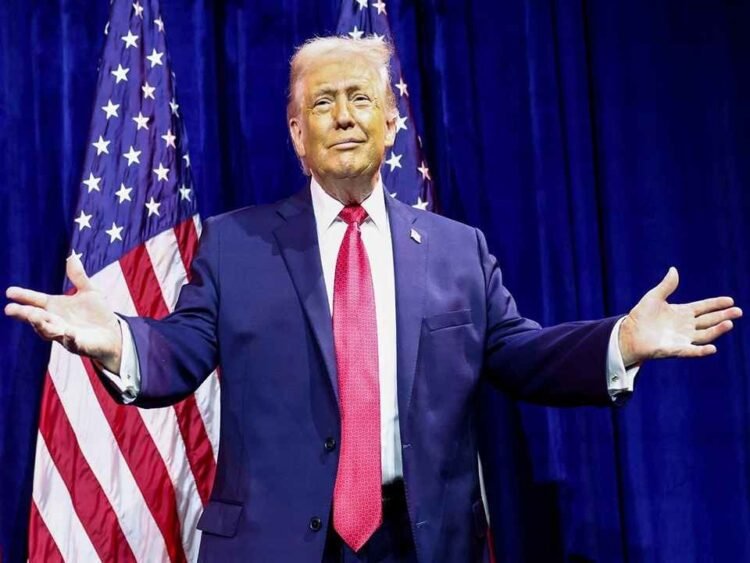
A number of US allies have harshly criticized the revived drive, which has rekindled fear across Europe. Washington has always considered Greenland to be strategically significant, and by reigniting debates about changing the status of the Danish colony, the Trump administration has once again made the island the focal point of its Arctic agenda.
During his first term in office, in 2019, Trump initially made public his interest in purchasing Greenland, comparing a possible agreement to a “large real estate purchase.” However, the plan was turned down by leaders in Copenhagen and Nuuk, who emphasized that Greenland was not for sale or transfer.
Trump resurrected his first-term pledge to buy Greenland after winning the 2024 US presidential election, but it was once again rejected.
During a briefing on Tuesday (local time), Press Secretary Karoline Leavitt said that the use of military action was not out of the question as the White House stated it was evaluating “a range of options” to annex Greenland.
According to Leavitt, President Trump has said unequivocally that “acquiring Greenland is a national security priority of the United States” and that it is essential to dissuading Arctic rivals.President Trump has made it clear that obtaining Greenland is essential to deterring our enemies in the Arctic and that it is a top national security objective for the United States. Using the U.S. Military is always an option at the Commander in Chief’s disposal, and the President and his staff are considering a variety of approaches to advance this significant foreign policy objective,” Karoline Leavitt said in a statement.
These events have raised fresh concerns about how deeply ingrained American aspirations are in the island’s contemporary history and why successive US administrations have revisited the concept of purchasing Greenland.
After purchasing Alaska from the Russians in 1867, US expansionists like then-Secretary of State William H. Seward proposed bringing Greenland and Iceland under American control in the late 19th century. The first official approach was made in 1946 by the government of President Harry Truman, who offered to pay Denmark $100 million in gold and even mentioned trades including Alaskan land. But Denmark declined to sell the island.
Why does Trump’s Arctic plan center on Greenland?
The significance of Greenland is derived from its abundance of natural resources as well as its advantageous position between the US, Europe, and Russia. The Geological Survey of Denmark and Greenland (GEUS) estimates that 36.1 billion tonnes of rare earth elements are present on the island. The US Geological Survey (USGS) estimates that economically recoverable deposits are around 1.5 million tonnes.
Graphite, lithium, and copper mineral resources that the International Energy Agency (IEA) has designated as essential for the global energy transition have also been found by GEUS. Although mining has been prohibited since 2021, Greenland’s uranium deposits are regarded as strategically crucial, despite the fact that its copper reserves are small. There are now two operational mines on the island, including the Canadian company Amaroq Minerals’ Nalunaq gold mine.
According to the National Geological Survey, Greenland’s graphite resources are estimated to be six million tons, or around 0.75 percent of the world’s total as determined by the USGS.
Greenland’s lithium deposits are projected to be 235,000 tonnes, or around 0.20 percent of the world’s total. Lithium is also a component in batteries, and the IEA predicts that demand for it might climb eightfold by 2040.
On a worldwide basis, Greenland’s copper resources are negligible, but its stocks of uranium, a sought-after nuclear fuel, may be more strategically valuable.
As the Arctic heats at a rate that is almost four times faster than the world average, Greenland’s increasing significance in global supply chains is highlighted by the 2023 Memorandum of Understanding that the European Union signed with the island to encourage the development of its natural resources. In addition, Greenland could have hydrocarbon deposits worth more than 28 billion barrels of oil, albeit no industrial drilling is being done at the moment.
The European Union signed a Memorandum of Understanding (MoU) with Greenland in 2023 to support the development of the island’s mineral resources, highlighting the island’s expanding role in global supply chains as the Arctic warms at a rate that is almost four times the global average. The EU identified 25 of the 34 minerals on its official list of critical raw materials in Greenland.
According to industry statistics, GEUS, Greenland’s Mineral Resources Authority, and Greenland’s National Oil Company (Nunaoil) estimate the island may also contain hydrocarbons that are about equal to 28.43 billion barrels of oil.
Despite its seeming abundance, Greenland has not seen any industrial oil or gas drilling, despite the fact that three oil exploration licenses are now in use in the region’s east. Consequently, the question “Why is the US keen on acquiring Greenland?” is answered.
In the meanwhile, the leaders confirmed Greenland’s membership in the transatlantic alliance on January 6 in a letter published by the Danish Prime Minister’s Office on X, declaring, “The Kingdom of Denmark – including Greenland – is part of NATO.”
Additionally, the foreign ministers of Denmark, Finland, Iceland, Norway, and Sweden have all reiterated their shared commitment to maintaining security, stability, and collaboration in the Arctic, highlighting their support for a more robust and watchful NATO presence in the area.
As Nordic nations, Arctic states, and NATO partners, the Nordic foreign ministers stated in a statement that they share a common approach to regional security, especially in light of the changing strategic challenges in the Arctic.
Shortly after European leaders reacted negatively to his statements about reaffirming NATO unity and occupying Greenland, US President Trump responded to the NATO Joint Statement on January 7 by sharply criticizing the intergovernmental military alliance, the North Atlantic Treaty Organization (NATO), and asserting that the alliance was solely dependent on Washington for its survival.
Trump claimed that most NATO nations were not fulfilling their defense budget obligations before to his involvement and were depending on Washington to cover the costs in a post on Truth Social.
The US president said that because of his personal influence, allies now pay “immediately” for defense expenditure, which he urged NATO members to increase to 5% of GDP.Recall that before I arrived, the majority of those ardent supporters of NATO were at 2% GDP and were not making ends meet. They were being paid for stupidly by the USA! I politely raised their GDP to 5%, and they promptly paid. Everyone thought it couldn’t be done, but Trump asserted that it could because, above all else, they are all his buddies.
A long-standing US ambition has been turned into a hot spot for NATO and the larger transatlantic alliance due to Trump’s renewed push for Greenland, the island’s abundant resource potential, and its strategic significance to Arctic security. Germany has now expressed concern about any unilateral American move on the island.