
UNSC: “Urgent global imperative” India demands “fit-for-purpose” revisions to address current issues
UNSC: India reaffirmed its demand for extensive UNSC changes on Monday (local time), characterizing them as a “urgent global imperative” to successfully handle current global issues.
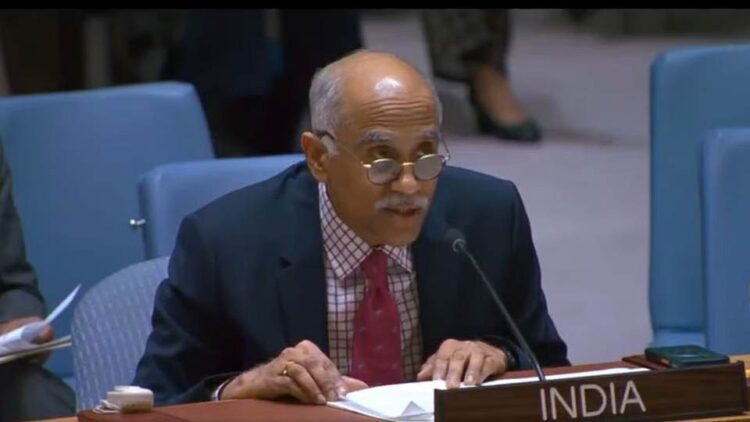
During the UNSC Open Debate on “Leadership for Peace,” India’s Permanent Representative to the UN, Ambassador Harish Parvathaneni, criticized the Council’s antiquated structure, pointing out that the body’s capacity to uphold global peace and security is increasingly hampered by eight decades-old customs.
He said that the Security Council’s existing structure is essentially out of date and does not accurately represent the geopolitical landscape of today.
The Council’s eight-decade-old design has structural and systemic components that impede attempts to maintain global peace and security. “The Security Council’s current structure is pretty much set in stone,” he said.
“We can’t create a future fit for our grandchildren with systems built for our grandparents,” the Indian ambassador added, quoting UN Secretary-General Antonio Guterres. This highlights how urgent it is to restructure the Council so that it is capable of addressing contemporary issues.
“Reforming the Security Council to make it fit-for-purpose to tackle contemporary challenges is an urgent global imperative,” the diplomat said.
Parvathaneni urged for the Intergovernmental Negotiations (IGN) framework on UNSC reform to advance in a significant way and emphasized that revamping the Security Council is an urgent global imperative.
He emphasized the need to improve representation from underrepresented and unrepresented regions in accordance with current global realities, stating that the framework, which was introduced to advance Council reform, has so far remained largely ineffective and must move to time-bound, text-based negotiations as soon as possible.
“The Inter-Governmental Negotiations framework launched for Council reform, which has largely remained barren and bereft of productive outcomes, must move towards time-bound text-based negotiations at the earliest to enhance representation from under-represented and unrepresented geographies in tune with today’s realities in both the permanent and elected categories of membership,” the representative of India stated.
India has continuously pushed for changes to the UNSC to increase its effectiveness, transparency, inclusivity, and representation.
In his speech to the UNSC last month, Ambassador Parvathaneni emphasized the need of accountability, openness, and inclusion while arguing for changes to improve the Council’s effectiveness and representation. He also highlighted India’s own contributions to UN peacekeeping.